Main Body
6 Lesson 17: 오면서 보니까 동네가 참 좋더라고요.
오면서 보니까 동네가 참 좋더라고요.
학습 목표 Goals
By the end of this lesson, you will be able to:
- Exchange information about past experiences and observations.
- Recall personal experiences about past events.
- Plan or participate in housewarming events.
들어가기 Setting Up
Lesson Focus
- INGREDIENTS – 단어 Vocabulary
-
Housewarming party
-
- RECIPE – 문법과 표현 Grammar
- A/V–던
- V–(으)면 V–(으)ㄹ수록
- A/V–더라(고)
- LET’S COOK – 해 봐요! Classroom Tasks
- Interpretive Task 1. A conversation at a housewarming party
- Interpretive & Interpersonal Task 2. A newspaper article on housing preferences
- Interpersonal & Presentational Task 3. Welcome to our town!
- KOREAN FLAVORS – 한국어와 한국 문화 Korean Language and Culture
- Korean clausal modifiers
- Housewarming party
- NOW YOU TRY! – 스스로 해봐요! Async. Practices and Tasks
- Integrated Performance Task Link
- WB Link
짝하고 얘기해 봐요! Share your thoughts!
What do you bring when you are invited to a housewarming party? Let’s read the following dialogues. What are they talking about?
 |
 |
 |
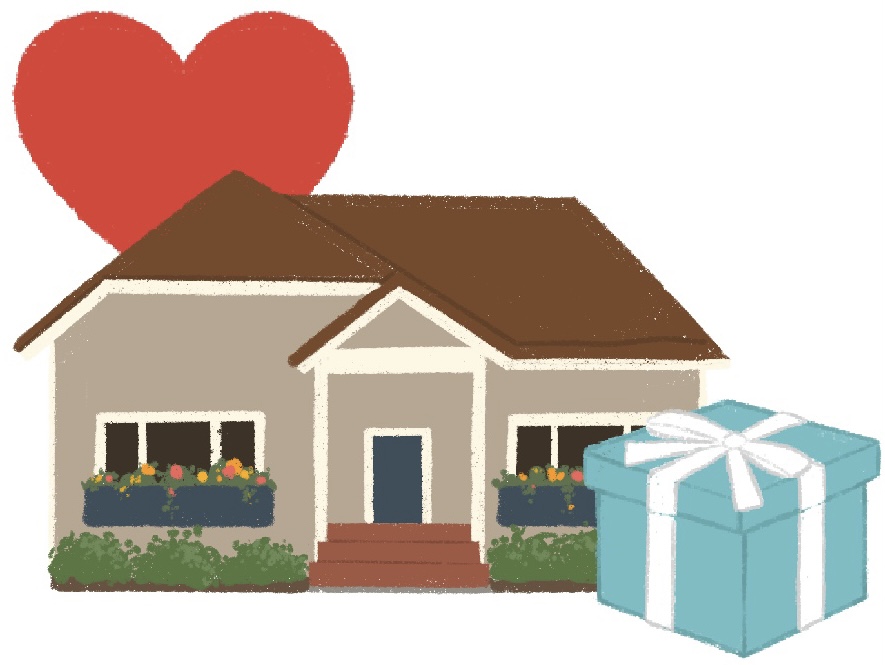
선물 Housewarming Gift
 |
 |
 |
 |
 |
| 집들이 | 거품 | 기프트 카드 | 비누 | 상품권 |
| housewarming party | bubbles | gift card | soap | gift certificate |
 |
 |
 |
 |
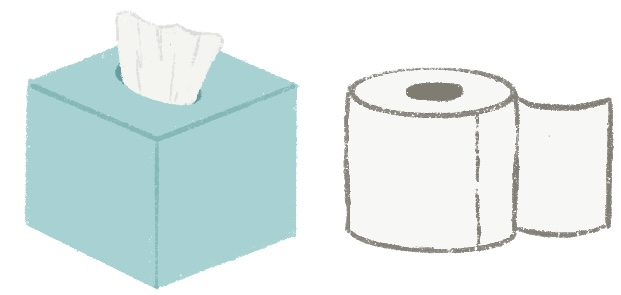 |
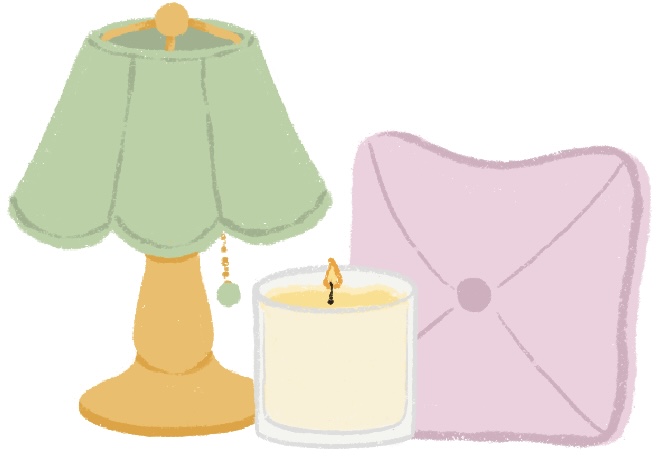
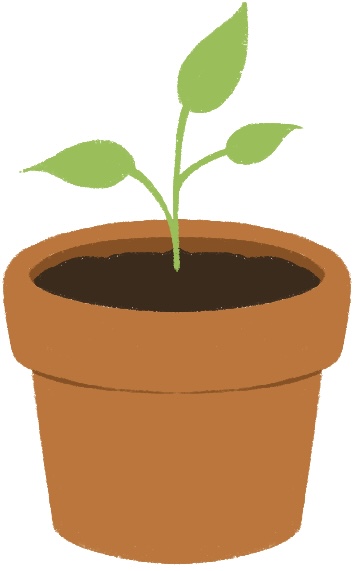
| 세제 | 수건 | 인테리어 용품 | 화분 | 휴지/화장지 |
| detergent | towel | household goods | (flower) pot | tissues |
새 단어와 표현 New Vocabulary and Expressions
| 도시 | city | 미루다 | to put off |
| 띵동띵동 | ding-dong (doorbell) | 선호하다 | to prefer |
| 문화 생활 | cultural activities | 유행하다 | to be popular, to be widespread |
| 시골 | countryside, village | 익다 | to ripen |
| 옛날 | past, old days | 다양하다 | to be diverse, to be various |
| 이탈리아 | Italy | 실용적이다 | to be of practical use |
| 인기 | popularity | 익숙하다 | to be accustomed to |
| 전원 생활 | country living | 대부분 | mostly, largely |
| 취향 | preference | 자꾸 | frequently, repeatedly |
| 나타나다 | to appear | 훨씬 | much, by far |
| 시간이 지나다 | for time to pass | 나이가 들다 | to get older |
| 인기가 있다 | to be popular | 뭘요. | Don’t mention it! Sure thing! |
| 뭘 이런 걸 다.. | Oh, you shouldn’t have (brought this…). | 별로 차린 건 없지만 많이 드세요. | It’s nothing much, I hope you enjoy it (food). |
단어 메모지 Vocabulary Notes
1. Useful Sino-Korean: –권, –용, –지
Here are some more very handy Sino-Korean roots, typically used as suffixes. 권 (book, document), 용(use), and 지(paper). 권 is always pronounced as 꿘.
|
2. 생활
생활 means daily life and often comes after another noun to specify different aspects of life.
|
3. 의성어 Onomatopoeia
Sound-mimetic or onomatopoeic words like 띵동띵동 are used much more frequently in Korean than English. They add so much color and flavor to your descriptions.
| 따르릉 | ring | 쨍그랑! | crash! |
| 드르렁드르렁 | snoring sounds | 콜록콜록 | coughing sounds |
| 멍멍 | bow-wow | 야옹 | meow |
단어 연습
연습 1.
연습 2.
| 거품 | 선호 | 실용적 | 용품 | 집들이 | 휴지 |
연습 3.
| 어서 오세요 | 뭘 이런 걸 다 | 초대해 주셔서 감사합니다 | 뭘요 | 차린 건 없지만 많이 드세요 |
연습 4.
You have found the following items on a Korean housewarming gift website. Work with a partner to ask and answer the questions. Write the number of the corresponding description in the picture(s).
|
|
|
 |
 |
|
 |
 |
|
 |
 |
|
1. 미국 사람들은 집들이 파티에 어떤 선물을 많이 합니까?
2. 한국 사람들은 옛날에 집들이 파티에 어떤 선물을 많이 했습니까?
3. 한국 사람들이 요즘에는 집들이에 어떤 선물을 많이 합니까?
4. 여러분이 친구들의 집들이 파티에 가지고 갔던 선물은 어떤 것이었습니까?
5. 받고 싶은 집들이 선물은 어떤 것입니까? 세 개를 골라 보세요.
1. A–던/었던 Noun That Was…/Was Doing For a While; Used to…

1. A/V–던 noun that … was/was doing; used to
The suffix –더 encodes rather layered meaning elements, where the doer is RECALLING a personal experience that was GOING ON FOR A PERIOD OF TIME. The experience can be something the speaker personally carried out or something they witnessed at the scene (e.g. I was reading or You saw him sleeping there). What was experienced or observed should be something that went on for a while either by habitual repetition or by the act being sustained for some time (e.g. The restaurant that they used to go to has closed down or I recall that the water dripped from the faucet for some time). This has been an in-depth exploration of the suffix –더 for advanced Korean learners such as yourselves.
For noun–modifying clauses, you know –는 marks an on-going present action and –(으)ㄴ marks an action that’s happened and completed: Finito. What if you want to express an action or event that repeated or went on for a while in the past? It is over and in the past, but it continued for a while. This is when you would use the suffix –던.
| 내가 어렸을 때 살던 동네가 이제는 큰 도시가 되었다. | The town where I used to live as a child has now become a big city. |
| 금방 여기 있던 내 수건이 어디로 갔지? | Where is my towel that was just here? |
| 내가 작업하던 문서 어디로 갔지? | Where is the document I was working on? |
Since it expresses an inherent duration, –던 is also used to make the past tense of adjectives in relative clauses: “the NOUN who was ADJECTIVE (for some amount of time).”
| 전에는 집들이 선물로 인기 있던 비누나 세제가 요즘은 별로 인기가 없대요. | Soaps and detergent that used to be popular as a housewarming gift are not popular these days. |
| 작던 강아지가 아주 커졌다. | The puppy that used to be small is now large. |
2. A/V–았/었던 N that was once and no more
Adding the past tense –었 to –던 to describe a noun emphasizes what once was is no more. V–았/었던 N = “the NOUN that someone/something (once) had VERBed at a particular point in the past.” Compare the following sentences:
| 우리가 자주 만나던 약속 장소는 가로수길이었어요. | The meeting place where we met frequently was Garosu Gil. |
| 우리가 자주 만났던 약속 장소는 가로수길이었어요. | The meeting place where we used to meet was Garosu Gil (but not anymore). |
Some speakers use –었던 with pretty much any past descriptions to emphasize “no more the case”:
| 금방 여기 있었던 내 수건이 어디로 갔지? | Where is my towel that was just here? (Now it’s gone!) |
3. Conjugation
Conjugate these verbs and adjectives on your own:
| Dictionary Form | –던 | –었/았던 | Dictionary Form | –던 | –었/았던 |
| 듣다 | 듣던 | 들었던 | 실용적이다 | ||
| 자르다 | 더럽다 | ||||
| 만들다 | 깨끗하다 |
<Answer key> 자르던, 잘랐던, 만들던, 만들었던, 실용적이던, 실용적이었던, 더럽던, 더러웠던, 깨끗하던, 깨끗했던
연습 1. –던
연습 2. –던
연습 3. –던
The following is a story about your friend 준호. It is written rather choppy with short, simple sentences. Rewrite it to show your Korean grammar prowess, underscoring some facts that are no more. Use the suffix –던.
준호는 내 고등학교 친구입니다. 준호의 집은 우리 집 옆집이라서 우리는 매일 아침 같이 학교에 갔습니다. 준호는 내 단짝 이었는데 운동도 잘하고 피아노도 잘 쳤습니다. 우리는 주말에는 동네 공원에서 같이 농구도 했습니다. 그리고 좋아하는 노래도 같이 들었습니다. 게임도 같이 하고 영화도 자주 봤습니다. 그런데 작년에 준호 가족이 지방으로 이사를 갔습니다. 준호와 나는 이제 다른 대학교에 다녀서 자주 만나지 못합니다.
(맛보기) 준호는 나하고 같이 고등학교에 같이 다니던 친구이다.
1. 준호는 ______________________________친구이다.
2. 준호는 ______________________________친구이다.
3. 준호는 ______________________________친구이다.
4. 준호는 ______________________________친구이다.
5. 준호는 ______________________________친구이다.
단짝: best friend
연습 4. –던
How have things changed from the past? Reminisce about them using the suffix –던. Make 3 to 5 sentences for each item.
(맛보기) [만화영화]
어렸을 때 아주 재미있던 만화영화가 이제는 별로 재미없어졌어요. 내가 매일 보던 만화영화는 스펀지 밥이에요. 매일 기다리던 스펀지 밥 만화영화 시간이 되면 텔레비전을 켜고 동생하고 같이 봤어요.
1. [인기 온라인 게임]
2. [유명인사 이름 celebrity]
3. [기후 변화 ]
4. [한국의 집들이]
5. Make up your own!
기후 변화: climate change
2. V/A–(으)면 V/A–(으)ㄹ수록 The More… The More…

1. V/A–(으)면 V/A–(으)ㄹ수록 the more… the more…
The V/A–(으)ㄹ수록 connector expresses that an increased magnitude of an action or state in the leading clause results in an increased effect in the following clause:
| 잘수록 더 졸음이 오네. | The more I sleep, the sleepier I am getting, I find. |
| 운동을 할수록 건강해질 거예요. | The more you exercise, the healthier you’ll get. |
| 이 세제는 쓸수록 더 좋아요. | The more I use it, the more I like this detergent. |
Some speakers use –(으)면 –(으)ㄹ수록 for added effect:
| 읽으면 읽을수록 더 읽고 싶어졌다. | The more I read, the more I wanted to read. |
| 거품이 많이 생기면 생길수록 신선한 커피래요. | They say the more bubbles it creates, the fresher the coffee is. |
2. Conjugation
Try on your own:
| Dictionary Form | –(으)면 –(으)ㄹ수록 | Dictionary Form | –(으)면 –(으)ㄹ수록 |
| 마시다 | 마시면 마실수록 | 흔하다 | 흔하면 흔할수록 |
| 듣다 | 짧다 | ||
| 만들다 | 길다 | ||
| 돕다 | 더럽다 | ||
| 부르다 | 친구(이)다 |
<Answer key> 들으면 들을수록, 만들면 만들수록, 도우면 도울수록, 부르면 부를수록, 짧으면 짧을수록, 길면 길수록, 더러우면 더러울수록, 친구(이)면 친구(일)수록
연습 1. –(으)면 –(으)ㄹ수록
연습 2. –(으)면 –(으)ㄹ수록
One person presents an opinion about each topic using –(으)ㄹ 수록. Their partner is to add their comment on the given opinion.
(맛보기) 운동–하다
(맛보기) 가: 운동은 할수록 건강해져요.
(맛보기) 나: 그럼 매일 운동해야겠네요.
1. 돈–안 쓰다
2. 과제–미루다
3. 김치–익다
4. 컴퓨터–비싸다
5. 수업–빠지다
6. 음식–맵다
7. 나이–들다
8. 기숙사에 살다
연습 3. –(으)면 –(으)ㄹ수록
깎다: to shave
때리다: to hit
늙다: to get old
연습 4. –(으)면 –(으)ㄹ수록
Answer following questions in detail, using –(으)면 –(으)ㄹ수록.
(맛보기) 쉬울 것 같았는데 하면 할수록 어려웠던 것이 있습니까?
⇒ 처음에 한국어를 한 학기 배우면 K–pop가사를 이해하고 따라 부를 수 있다고 생각했어요. 그런데 한국어를 공부하면 할수록 배울게 많아서 시간이 많이 걸려요. 그리고 K–pop을 들으면 들을수록 알고 싶은 단어가 많이 생겨서 단어 공부도 많이 해야 돼요. 그렇지만 단어 공부를 많이 하면 할수록 K–pop이 더 좋아져요.
1. 어려울 것 같았는데 하면 할수록 생각보다 쉬운 일이 있었습니까?
2. 대학에서 공부를 하면서 배우면 배울수록 더 배우고 싶은 과목이 있습니까?
3. 나이가 들면 들수록 하기 어려운 일이 있습니까?
4. 나이가 들면 들수록 하기 쉬운 일이 있습니까?
5. Your own
3. A/V–더라(고/고요) As I Recall…, I Can Tell You That

1. A/V–더라(고/고요) as I recall…, I can tell you that
The suffix –라 emphasizes your feelings (e.g., 추워라! It’s so coooold!) or a strong affect (e.g. 이제 좀 일어나라! Get up already!). –더 adds a reflective mode, so with –더라 you can speak emphatically of your experience:
| 웨이: | 케시 이사한 집 가 봤어? Have you been to Kesi’s new place? |
| 핑: | 응, 지난 주에 집들이 파티에 갔는데 집이 진짜 좋더라. Yes, I went to their housewarming party – Golly, that house is nice! |
If you want to stress a point, you can use –라고 or –라구:
| 시은: | 케시 집들이 파티에 뭐 사 가지? What should we get for Kesi’s housewarming party? |
| 은비: | 전에 다른 집들이 파티에 갔더니 화분이나 인테리어 용품도 많이 사 오더라구. 기프트 카드도 많이 하던데. I went to another housewarming party and saw lots of people bring potted plants and interior tchotchkes. I also noticed a lot of gift cards. |
–던데 can also be used as a sentence ending, Just like the connector –은/는데.
연습 1. –더라(고/고요)
연습 2. –더라(고/고요)
Tell your partner what you found and tell ‘em with feeling! As you do, use a connector that makes sense (e.g., –아/어서, –(으)니까, (으)ㄴ/는데, or –(으)면 –(으)ㄹ수록, etc.)
(맛보기) 가: 수영 씨 봤어요? 새로 이사간 집 좋아요?
(맛보기) 나: 살면 살수록 편리하더라고요. [살다/편리하다]
1. 가: 지난 주에 등산하셨지요? 등산은 재미있었어요?
1. 나: __________________________________________ [산이 높다 / 힘들다]
2. 가: 휴대폰으로 장 보는 사람들이 많아요?
2. 나: __________________________________________ [편리하다 / 많다]
3. 가: 서울에서 출퇴근 시간에 지하철 이용하는 게 편리한가요?
3. 나: __________________________________________ [사람이 많다 / 복잡하다]
4. 가: 플로리다 여행 잘 다녀오셨어요?
4. 나: __________________________________________ [9월이다 / 덥다]
5. 가: 지난 주말에 집들이 했지요? 집들이 선물 많이 받았어요?
5. 나: __________________________________________ [많이 받다 / 비누하고 휴지를 많이 가져왔다]
6. 가: 이번에 새로 나온 Top Tank 영화 봤어요? 어땠어요?
6. 나:__________________________________________ [배우가 멋있다 / 연기 를 잘 하다]
7. 가: BTS 콘서트에 갈 거예요?
7. 나: __________________________________________ [티켓을 예매하고 싶다 / 매진됐다]
8. 가: 어제 새로 사온 샴푸 써 봤어?
8. 나: __________________________________________ [거품이 많이 나다 /적게 써도 되다]
연기: acting
연습 3. –더라(고/고요)
Tell your partner passionately what you experienced or witnessed. What you have learned online counts as your personal experience! Use –더라고요.
(맛보기) 어제 부모님하고 대형 할인매장에 갔는데 물건도 많고 가격도 정말 싸더라고요.
1. 해외 여행 갈 때 _____________________.
2. 맛집에 가고 싶으면 _____________________.
3. 길을 잘 찾으려면 _____________________.
4. 어제 지하철을 탔는데 _____________________.
5. 한국에서는 집들이 파티에/에서 _____________________.
6. 한국에서 쓰레기 버리는 게 _____________________.
7. 교통도 편리하고 전망도 좋은 아파트를 구하려면 _____________________.
8. Add your own!
연습 4. –더라(고/고요)
알려줄까요? Discuss with your classmates your recent observations or experiences related to the following topic.
(맛보기) 한국 전통술
(맛보기) 막걸리를 마셔 봤는데 맛이 달콤하고 좋더라고요. 근데 너무 많이 마셨더니
(맛보기) 다음날 머리가 아프더라고요.
1. 집들이 선물
2. 감기
3. 공부가 잘 되는 장소
4. 스트레스 풀기
5. 취미 생활
6. 좋은 집 구하기
7. 좋은 룸메이트 찾기
4. 종합 연습 Role Play
Create a role play with your partner using the key grammar expressions and new vocabulary from this lesson. Include 5 to 6 meaningful rounds of dialogue. Take turns and feel free to add details to make the conversation lively.
- Context: A person who has recently moved to a new place invited their friend to the housewarming party. Give a housewarming gift and ask and answer questions about the new place.
- Participants: An older friend who just moved to a new place and their younger friend
- Key Expressions: Passive verbs, –던, – (으)ㄹ수록, –더라
- Sample dialogue:
 |
 |
 |
 |
Interpretive Task 1. 듣기
A Conversation at a Housewarming Party
Austin is having a housewarming party with his close friends at his new home. Listen to the dialogue and answer the questions in Korean.
1. Who came to the housewarming party?
2. What did the guests comment about Austin’s new place? Try to list as much as you recall.
- ___________________________________________________________
- ___________________________________________________________
- ___________________________________________________________
- ___________________________________________________________
- ___________________________________________________________
3. What did the guests bring?
4. Write down the gift–giving practices of a Korean housewarming party based on the conversation.
5. Talk with your classmates about a housewarming party: What are the similarities and differences in your own and Korean cultures?
Now, talk with your classmates about what you learned from the dialogue. Then, listen to the dialogue again.
Helpful Vocabulary
| 깊다 | to be deep/profound |
Interpretive Task 2. 읽기
A Newspaper Article on Housing Preferences
You and your friends are talking about your housing preferences and experiences and comparing perspectives.
1. Read the newspaper article and answer the questions in English.
20대 청년층 도시 생활 선호하는 것으로 나타남
도시 생활과 전원 생활 중 어느 쪽을 선호하는지에 대해 20대 남녀 100명을 대상으로 조사해 보았다. 조사 결과, 도시 생활 (72%)을 전원 생활 (28%)보다 선호하는 것으로 나타났다. 20대 청년층이 전원 생활을 더 좋아하는 이유는 다양했다. 예를 들면 건강한 음식을 먹을 수 있다/ 소음이 적고 공기가 맑다/ 사람들이 많지 않아서 복잡하지 않다/ 자연을 즐길 수 있어서 스트레스를 덜 받는다 등으로 대답했다. 하지만 설문 대상의 대부분이 도시 생활을 선호했는데, 그 이유는 다음과 같다: 직장에서 거리가 가깝다/ 편의 시설이 많다/ 대중 교통이 편리하다/ 문화 생활의 기회가 많다/ 다양한 식당이 많다/친구들이 대부분 도시에 산다. 기자가 인터뷰한 김00씨는 도시 생활을 선호하는 이유에 대해 다음과 같이 답했다. “제가 어렸을 때 살던 곳은 시골이에요. 우리 부모님하고 같이 살던 시골집이 가끔 그리워요. 하지만 동생들과 저는 대학을 도시에서 다녔고, 직장도 도시에서 찾았어요. 도시에서 살수록 편의 시설도 많고 문화 생활도 다양하게 할 수 있어서 좋더라고요. 지금은 도시 생활에 더 익숙해지고 편해졌어요. 제 동생들도 친구들이 대부분 도시에 살아서 도시 생활이 더 좋대요. 이젠 시골에서 사는 것은 좀 힘들 것 같아요.” 이렇게 청년층은 직장 문제와 편의 시설, 대중 교통 등의 이유로 도시 생활을 선호하고 있었다. 예일일보 이슬기 기자 (sglee@yaledaily.co.kr) |
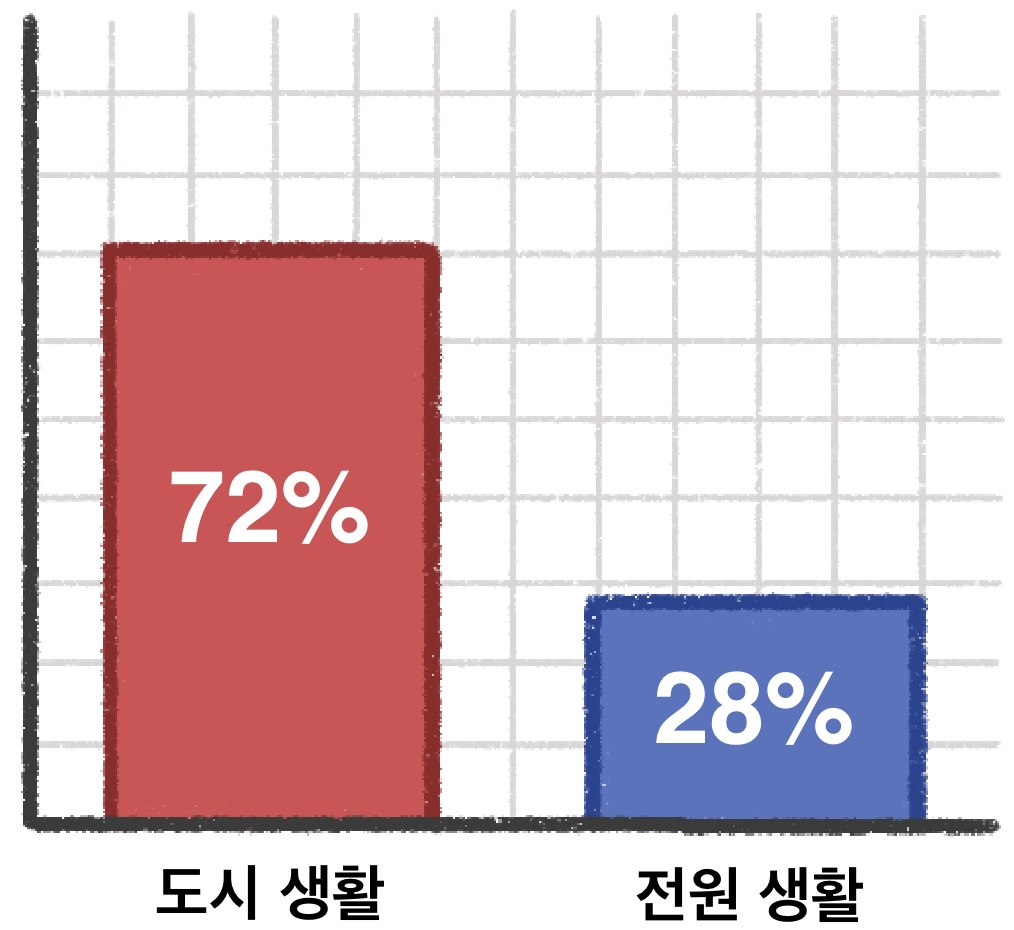
Helpful Vocabulary
| 청년층 | people from 19 to 34 years old | 대상 | object | 조사 | research |
| 자연 | nature | 이유 | reason | 편의시설 | amenities, convenient facilities |
1. What does the headline of the article mean in English?
2. Describe what the graph conveys.
3. According to the article, what are some reasons why young people like city life and country life?
| City life | Country life |
|
|
|
4. Summarize the interviewee’s response and share with the class.
Presentational Task 3. 토론하고 발표하기
Welcome to Our Town!
You are producing a short video to introduce your community to visitors and new and prospective residents. Share your testimonial with the class as a rehearsal before filming it. Include the following information about the community:
- Location
- Transportation
- Facilities
- Places to visit, etc.
Language Point: Clausal Modifier (Relative Clause)
Now is a good time to review particles in clausal modifiers (also known as sentential modifiers or relative clauses, but don’t worry too much about the grammar terms). The subject of the modifying sentence (the ‘leading sentence’) is pretty much always marked with 이/가 (and not 은/는), and the object is marked with 을/를 (not 은/는). The noun being modified in the main (or the ‘following sentence’) is usually marked with 은/는.
| [내가 먹은 음식]은 피자였다. | [The food that I had] was pizza. |
| [그 피자를 먹은 사람]은 나다. | [The one who had the pizza] is me. |
| [우리가 산 책]은 다 읽었니? | Have you finished reading [the book we bought]? |
| [방금 내가 친] 곡은 베토벤의 월광곡이다. | The piece I just played is Beethoven’s ‘Moonlight Sonata’. |
| [삼면이 바다로 둘러 싸여 있는 땅]은 반도라고 한다. | [Land surrounded by the ocean on three sides] is called a peninsula. |
| [제가 버스 정류장에서 만난 사람]은 우리 선생님이었어요. | [The person I met at the bus stop] was my teacher. |
But again, the subject can be marked with 이/가 in an answer as a focus:
| 가: 뭐가 김치 피자예요? | Which one is the kimchi pizza? |
| 나: [내가 먹은 게 (것+이)] 김치 피자예요. | [The pizza that I ate/What I ate] is the kimchi pizza. |
If the subject of the main clause (that is, the noun being described) is identified by the main clause predicate, the noun being described is marked with 은/는. If the predicate provides new information about an action or an event that the subject is involved in, the marker should be 이/가:
| [제가 버스 정류장에서 본 사람]은 우리 선생님이었어요. | [The person I saw at the bus stop] was my teacher. |
| [제가 버스 정류장에서 본 사람]이 나를 따라왔어요! | [The person I saw at the bus stop] followed me! |
In conclusion, the marking of the noun being described by the relative clause follows the normal rules for topic and focus:
| [금방 여기 있던 가위]가 어디로 없어졌다. | Those scissors that were just here have disappeared. |
| [금방 여기 있던 가위]는 내 게 아니었어. | Those scissors that were just here were not mine. |
| [제가 버스 정류장에서 만난 사람]을 선생님도 아세요? | Teacher, you also know that person I met at the bus stop? |
| [우리가 버스 정류장에서 본 사람]은 모르세요? | You don’t know that person we saw at the bus stop? |
But note that the subject and the object within the relative clause are pretty regularly marked with 이/가 and 을/를, respectively.
한국 문화 길잡이
Housewarming Party
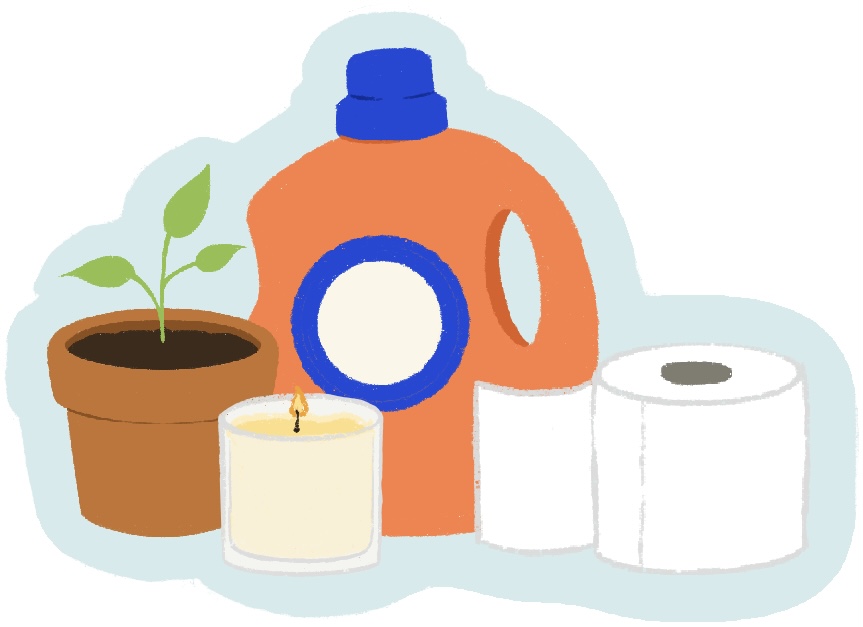
Historically, a housewarming party was a celebration of the completion of construction of a new house, and then later, of the move-in day, which were both communal efforts. In tight-knit rural communities, everyone helped a family (often newlyweds) move into their house and then celebrated together with a meal provided by the couple moving in. The neighbors and family who helped in the moving would bring gifts symbolic of wishes for prosperity and health and longevity in the new household; and there were oftentimes offerings to the house gods or ritual cleansing or blessing of the home.
Some traditional housewarming gifts are candles, matches, soap or detergent, potted plants and toilet paper – all of which may be interpreted simply as practical items for the new home. While there is nothing wrong with practical gifts – they may be much more appreciated than knick–knacks, in fact – there is also tradition to these particular items:
- Soap or detergent can symbolize pure home, but also, its round, shiny bubbles represent money and prosperity, especially the way they “rise up.”
- The flame from candles or matches also represents purity, but these are rarer gifts now that they are less useful.
- Toilet paper is a very practical gift. You can store a lot of it at one time, it doesn’t go bad, everyone uses it, and it might go overlooked during a hectic move. Toilet paper can also symbolize the wish for a clean and pure home. And, since it unrolls cleanly and smoothly for a long time, it symbolizes wishes for the lives of the homeowners to do the same.
- Potted plants (or smaller sized trees) add a touch of color and life to a home and freshen the air, but also represent prosperity, health and a thriving life (or business).
Housewarming does not involve only the new residents receiving gifts. In fact, new residents will often take 팥떡 to their new neighbors as a way of establishing good relations and laying the foundation for a harmonious community. (http://www.koreabrand.net)
Nowadays, Korea is more urbanized and more secular, so moving is done by moving companies, not by family and friends, and it is more often and especially colleagues who are invited to the new home in order to solidify work-based social networks. There also may be multiple house-warming parties in order to invite different social groups.
할 수 있어요! I Got This!
Check to see if you can do the following:
- Exchange information about past experiences and observations
- Recall personal experiences about past events
- Plan or participate in housewarming events
| Listening Script
|
|
| 띵동띵동~ | |
| 오스틴: | 아, 어서 오세요. 잘 찾아오셨네요! |
| 시엔: | 네, 초대해 주셔서 감사해요! |
| 로베르토: | 지하철 역 옆이라서 찾기 쉽더라고요. |
| 시엔: | 와, 집 좋네요! 전에 살던 기숙사보다 훨씬 더 커 보여요. |
| 로베르토: | 정말 깨끗하네요!예쁘게 정리도 잘 돼 있네요. |
| 오스틴: | 뭘요. 아직도 정리할 게 많아요. |
| 시엔: | 동네는 어때요? 마음에 들어요? |
| 오스틴: | 네, 살면 살수록 편하고 좋더라고요. 맛있는 식당도 많고 마트도 가까워서 편리해요. |
| 로베르토: | 와, 잘됐네요. 참, 여기 집들이 선물이에요. 시엔 씨하고 같이 샀어요. |
| 오스틴: | 아니, 뭐 이런 걸 다… 그냥 와도 되는데, 와~ 세제랑 휴지, 둘 다 진짜 필요했는데 정말 고마워요! |
| 시엔: | 오스틴 씨, 우리가 왜 휴지랑 세제 선물하는지 알죠? |
| 오스틴: | 어…. 사실 잘 모르겠는데요 |
| 로베르토: | 아, (ㅎㅎ) 한국에서는 보통 집들이에 갈 때 이런 걸 선물로 주더라고요. |
| 오스틴: | 아, 그래요? 몰랐어요! 재미있네요. 근데 왜 세제하고 휴지를 준대요? |
| 시엔: | 세제는 사용할수록 거품이 많이 생기잖아요. 거품이 커지는 것처럼 돈이 많이 생긴대요. 그리고 휴지는 길잖아요. 그래서 새집에서 오래오래 건강하게 살게 된대요. |
| 오스틴: | 오, 그렇게 깊은 뜻이…. 정말 고마워요!! 오늘 파스타를 요리했어요. |
| 시엔: | 정말요? 와, 맛있겠다. |
| 오스틴: | 별로 차린 건 없지만 많이 드세요! |
| 로베르토: | 잘 먹겠습니다. 와, 진짜 맛있어요! 이탈리아에서 먹던 그 맛이에요! 파스타 좀 더 있나요? |
| 오스틴: | 물론이죠! 많이 드세요! |