Main Body
1 Lesson 12: 새 직장에서 일하게 됐어요.
새 직장에서 일하게 됐어요.
학습 목표 Goals
By the end of this lesson, you will be able to:
- Share new year’s plans and wishes.
- Talk about changes of events and new developments.
- Recognize how Korean people celebrate Korean New Year.
들어가기 Setting Up
Lesson Focus
- INGREDIENTS – 단어 Vocabulary
- New Year
- RECIPE – 문법과 표현 Grammar
- V–게 되다
- V–는 동안
- V–기 바라다
- LET’S COOK – 해 봐요! Classroom Tasks
- Interpretive Task 1: New Year’s greetings
- Interpretive & Interpersonal Task 2: New Year’s card message
- Interpersonal & Presentational Task 3: Intercultural table/ Coffee and talk
- KOREAN FLAVORS – 한국어와 한국 문화 Korean Language and Culture
-
Use of markers after nouns: Topic particle –은/는 1
-
Korean traditional holidays
-
- NOW YOU TRY! – 스스로 해봐요! Async. Practices and Tasks
- Integrated Performance Task Link
- WB Link
짝하고 얘기해 봐요! Share your thoughts!
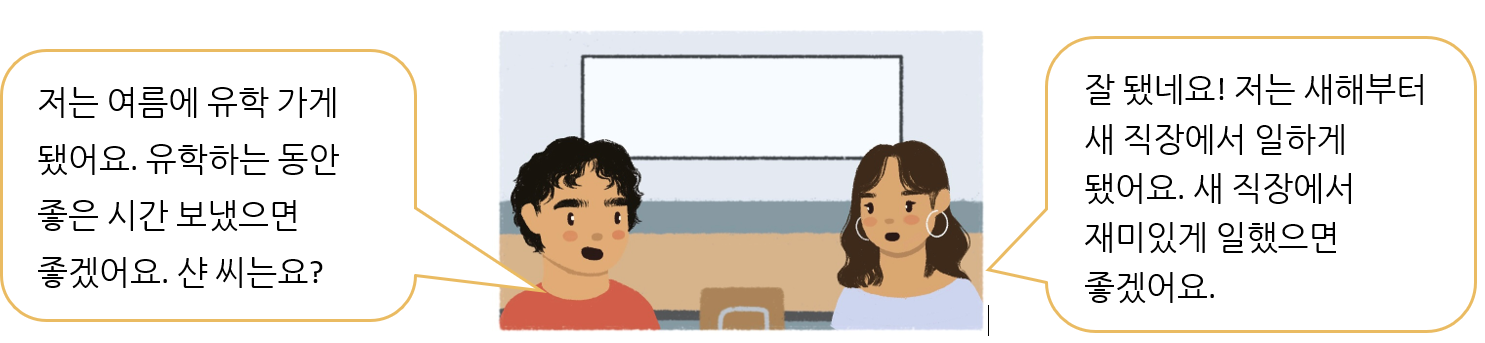
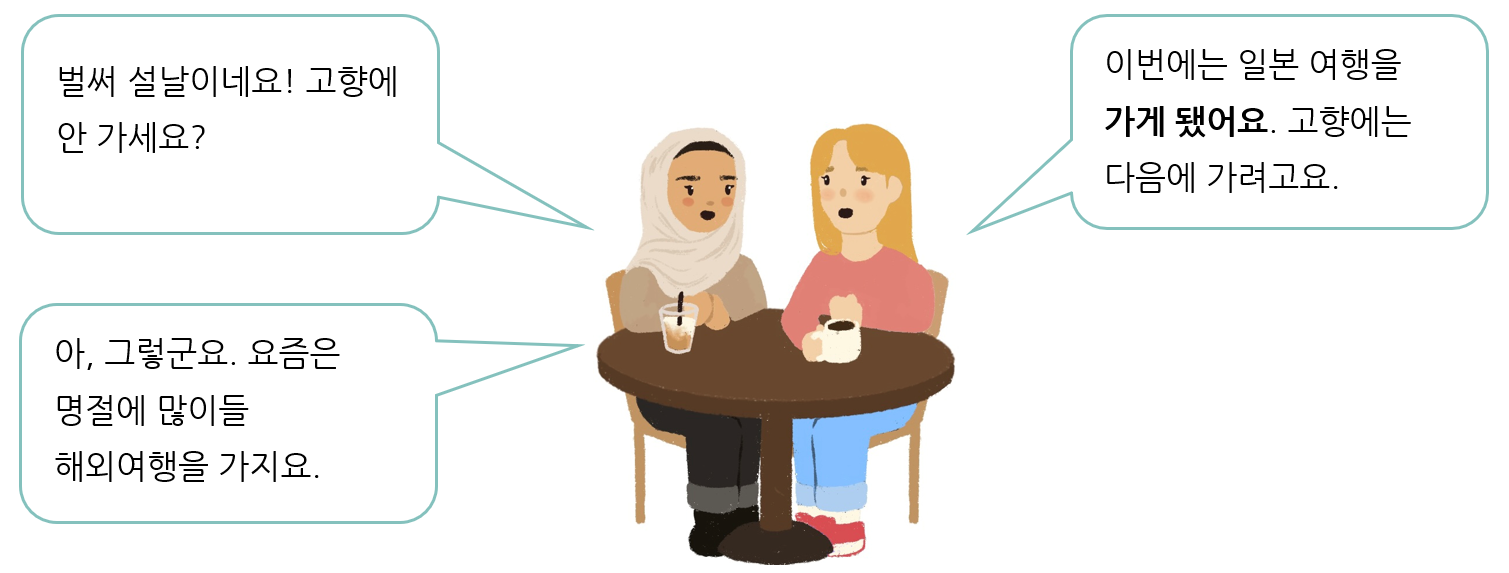
How do you celebrate the new year? What are these two people saying?
 |
 |
 |
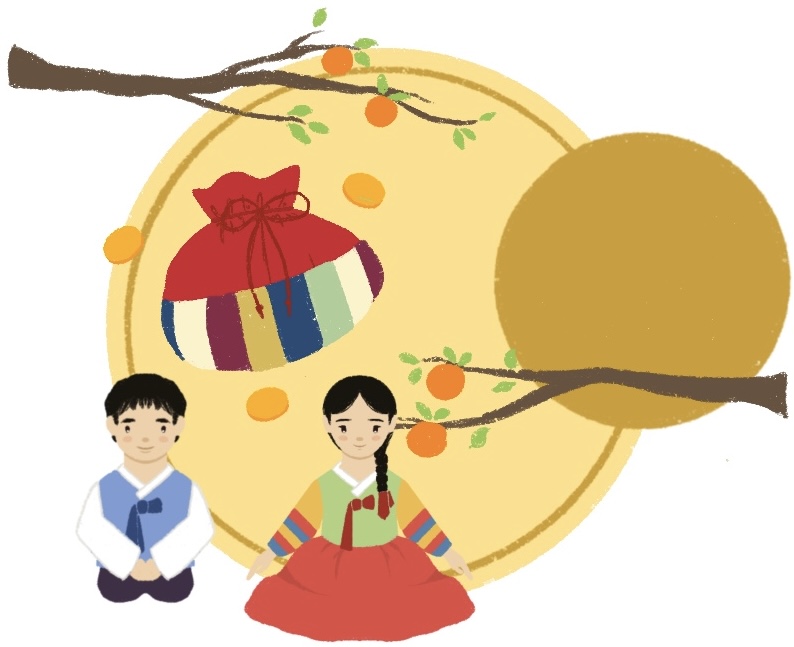
설날 New Year’s Day
 |
 |
 |
 |
 |
 |
| 설날 |
명절
|
세배
|
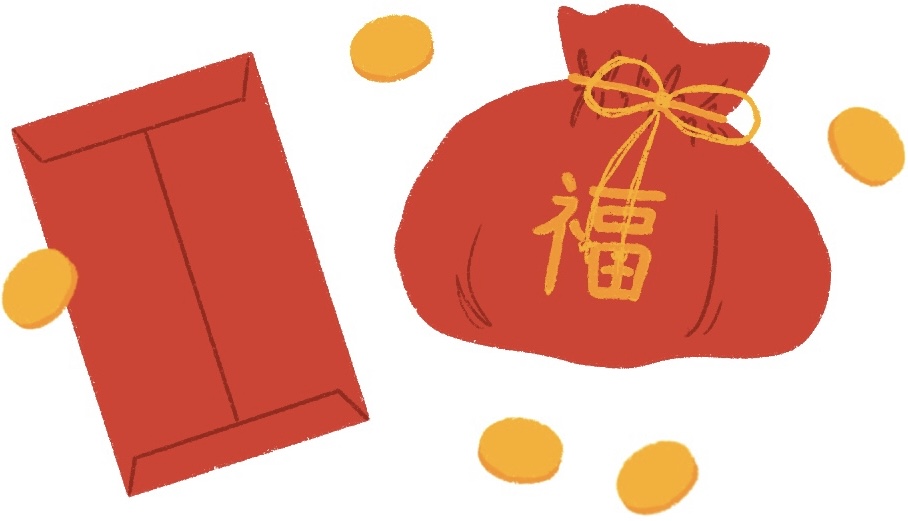
세뱃돈
|
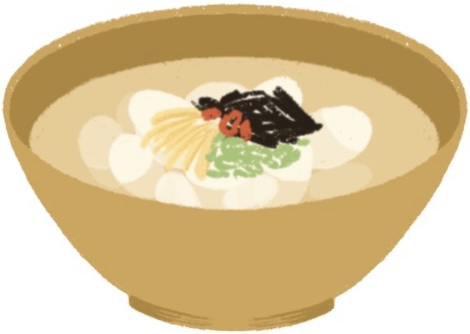
떡국
|
소원
|
| New Year’s Day |
traditional holiday
|
New Year’s bow
|
New Year’s gift money
|
rice cake soup
|
wish
|
새 단어와 표현 Other Vocabulary and Expressions
|
고향
|
hometown
|
방문(하다)
|
to visit
|
|
등록금
|
tuition
|
세우다
|
to make something stand/stop; to build (buildings); to make (plans)
|
|
반려동물
|
companion animal
|
이사(하다)
|
to move (household)
|
|
세배
|
New Year’s bow
|
이루다
|
to make (something) come true
|
|
예전
|
old days
|
기쁘다
|
to be joyful
|
|
장학금
|
scholarship
|
좁다
|
to be small/narrow
|
|
직장
|
workplace
|
행복(하다)
|
to be happy
|
|
해외여행
|
international travel
|
항상
|
always
|
|
바라다
|
to hope for
|
|
NOUN 만이다
|
it’s been NOUN
|
계획을 세우다
|
to make plans
|
|
세배를 드리다
|
to perform New Year’s bowing ritual
|
키가 크다
|
to be tall
|
복습 단어 Review
|
유학하다 /유학을 가다
|
to study abroad
|
건강해지다
|
to become healthy
|
|
인턴십하다
|
to do an internship
|
새 친구를 사귀다
|
to make new friends
|
|
외국어를 배우다
|
to learn a foreign language
|
가족하고 시간을 보내다
|
to spend time with family
|
단어 메모지 Vocabulary Notes
1. More Causative Verbs
In Lesson 8, we learned causative verbs that mean to make someone do something. We will learn two more causative verbs in this lesson; 키우다 (from 크다) to make something become big; to grow, to raise and 세우다 (from 서다) to make something stand up/stop; to build, to make.
| 반려동물을 키우기로 했어요. | I’ve decided to get a pet (Lit., I’ve decided to raise a pet). |
| 저 코너에 차를 세우세요. | Stop/park the car in that corner. |
| 새해 계획을 세웠어요. | I made new year’s plans. |
2. Review: 새해 복 많이 받으세요.
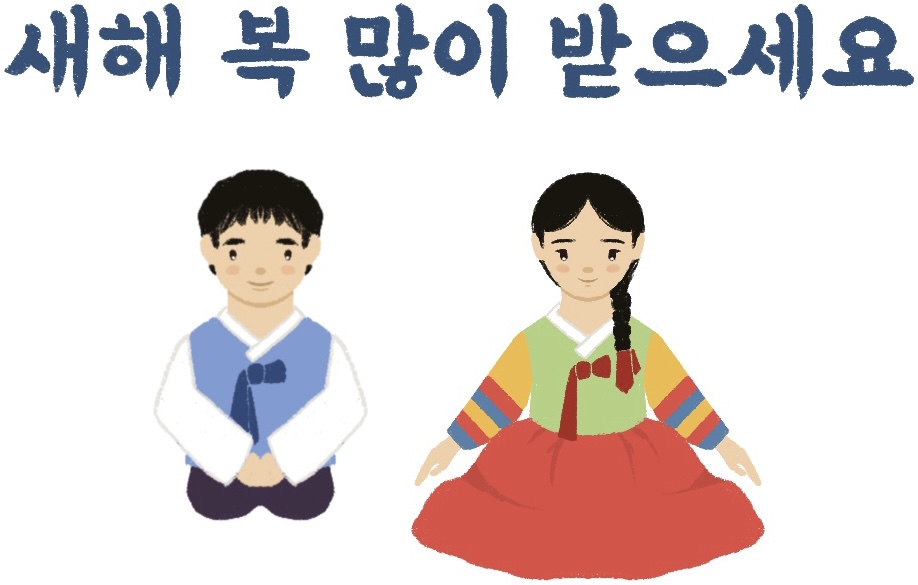
The New Year’s wish in Korean is 새해 복 많이 받으세요!, which means Receive a lot of New Year’s good fortune!
| 가: 현우 씨, 새해 복 많이 받으세요. | Hyunwoo, best wishes for the new year! |
| 나: 고마워요. 아키라 씨도 새해 복 많이 받으세요. | Thank you! Happy New Year to you too, Akira! |
3. TIME 만이다, TIME 만에
TIME 만에 means that much TIME has passed since something last happened, usually with a sense that it’s been a long time. 오랜만 and 오래간만 are idiomatic expressions that mean It’s been a long time!
| 친구가 돈을 10년 만에 갚았다. | The friend paid back the money after 10 (dang) years. |
| 기다리던 버스가 1 시간 만에 왔다. | The bus we were waiting for came after 1 (whole) hour. |
| 가: 오랜만이에요! | Wow, it’s been a long time! |
| 나: 정말 오래간만에 보네요. | We are seeing each other after such a long while! |
단어 연습
연습 1.
Connect each noun on the left with its related verb on the right. Then create short sentences using the two words.
연습 2.
| 계획 | 고향 | 떡국 | 복 | 설날 | 세배 | 세뱃돈 |
연습 3.
Using the expressions given in the box, talk about what Korean people and people in your culture do on New Year’s Day.
| 설날 | 명절 | 1월 1일 | 세배 | 세뱃돈 |
|
|
 |
|
 |
| 떡국 | 고향 | 소원을 빌다 | 방문하다 | 계획을 세우다 |
|
 |
|
 |
 |

소원을 빌다: to make a wish
1. V–게 되다 It Turns Out
1. Review: V–게 하다 make someone do
–게 added to adjectives describes in what way something progresses or something is done in the end (e.g., 예쁘게 만들어요, 바쁘게 살아요, 빨갛게 발라요). Used with the verbs 하다 and 만들다, it highlights the resultative sense “to bring about” and makes the grammatical long–form causative (someone causes someone else to act in a certain way).
| 어머니께서 설날에 친구 집에 가게 하셨다. | Mother had/let me go to a friend’s house on New Year’s Day. |
| 친구가 나한테 세배를 하게 만들었다. | My friend made me do a new year’s bow. |
2. V–게 되다 it turns out; came to be that
Pairing -게 with the verb 되다, you can focus on how a situation has arisen without addressing who or what made that happen.
| 월요일부터 새 직장에서 일을 시작하게 됐어! | (It turns out that) I am to start my new job on Monday! |
| 코비드 때문에 설날에도 가족을 방문하지 못하게 됐습니다. |
Because of COVID 19, I can’t get together with my family. |
Here are a few more sentences showing various English senses below:
| 가: 다음 학기에 장학금을 받게 됐어요. | (It looks like) I am getting a scholarship next semester. |
| 나: 와, 잘됐네요. 축하해요! | Wow, good for you! Congratulations! |
| 이번 학기에 그 수업 못 듣게 될 거 같아. | I don’t think I’ll be able to take that class this term. |
| 가: 나, 한국에 가게 됐다! | I get to go to Korea! (I’ve been wanting to, and now I have the chance/I have successfully come across money, etc.) |
| 나: 좋겠다. 나는 못 가게 됐어. | Good for you. It turns out I can’t go. (Something/someone is preventing me from going.) |
Here is the summary chart:
| 게 하다 | has/lets someone do X |
| 게 만들다 | makes someone do X |
| 게 되다 | comes to be in a position (either allowed or forced) to do X |
연습 1. –게 되다
Complete the sentences using the -아/어요 form of -게 되다 to describe recent changes or developments in Maya’s life.
연습 2. –게 되다
Joshua’s Life in Korea: Using –게 되다, compare Joshua’s past and present experiences since he started studying abroad in Korea.
(맛보기)
| 예전 Past | 지금 Present |
| 수업을 교실에서만 했다. | 온라인으로도 수업을 하다. |
⇒ 예전에는 수업을 교실에서만 했는데 지금은 온라인으로도 수업을 하게 됐다.
| 예전 Past | 지금 Present |
| 1. 한글을 하나도 못 읽었다. | 한글을 아주 잘 읽다. |
| 2. 동물을 무서워했다. | 반려동물을 키우다. |
| 3. 명절에 먹기만 했다. | 명절 준비를 많이 돕다. |
| 4. 한국 문화를 잘 몰랐다. | 한국 문화를 많이 알다. |
| 5. 설날에 세뱃돈을 많이 받았다. | 세뱃돈을 주다. |
| 6. 떡국을 못 먹어 봤다. | 한국에 와서 먹어 보고 좋아하다. |
| 7. 한국 친구가 없었다. | 한국에서 한국 친구를 많이 사귀다. |
1. __________________________________________________________.
2. __________________________________________________________.
3. __________________________________________________________.
4. __________________________________________________________.
5. __________________________________________________________.
6. __________________________________________________________.
7. __________________________________________________________.
연습 3. –게 되다
Answer the questions using –게 되다 or –게 하다. Think about what has led you to your current situation or state, or how you ended up doing what you are doing.
(맛보기) 가: 매운 음식을 잘 먹어요?
(맛보기) 나: 네. 한국에 와서 매운 음식을 많이 먹어서 이제는 잘 먹게 됐어요.
1. 가: 왜 한국어 수업을 들어요?
1) 나: ___________________________________________________________.
2. 가:지금 어디에 살아요? 왜 OO에 살아요?
2) 나: ___________________________________________________________.
3. 가: 무슨 동아리에 가입했어요? 왜 OO 동아리에 가입했어요?
3) 나: ___________________________________________________________.
4. 가: 어떤 배우/가수를 좋아하세요? 왜 좋아하세요?
4) 나: ___________________________________________________________.
5. 가: 어떻게 한국어를 그렇게 잘하세요?
5) 나: ___________________________________________________________.
6. 가: 왜 새집으로 이사했어요?
6) 나: ___________________________________________________________.
[Your own]
7. 가: ___________________________________________________________.
7. 나: ___________________________________________________________.
연습 4. –게 되다
1. Reflect on the transformations or changes you’ve experienced since childhood. Create at least 5 sentences using –게 되다.
(맛보기) 저는 어렸을 때는 고기를 잘 안 먹었는데 지금은 고기를 아주 좋아하게 됐어요.
- _______________________________________________________________.
- _______________________________________________________________.
- _______________________________________________________________.
- _______________________________________________________________.
- _______________________________________________________________.
2. How did your interest in Korean language and culture develop? Give some explanations using –게 되다.
(맛보기) 고등학교 때 친구하고 같이 K-pop 음악을 들으면서 한국어를 배우게 됐어요.
- _______________________________________________________________.
- _______________________________________________________________.
2. V–는 동안 During the Time/While (Someone is) Verb-ing

1. Noun 동안 during
You learned in Book 2 that (time duration N)+ 동안 means “during N”:
| 방학 동안 제주도를 방문하려고 해요. | I plan to visit Jeju Island during the vacation. |
| 명절 동안 문을 닫은 가게들이 많습니다. | Many stores close during traditional holidays. |
2. V–는 동안 while
To say “during the time (someone) is/was VERBing” or, “while VERBing,” you use the noun-modifying form V-는 with 동안. A natural English translation is sometimes when if the sense of time passing is clear:
| 고향에 있는 동안 매일 친구들을 만났어요. | While I was staying in my hometown, I met with my friends every day. |
| 반려동물을 키우는 동안 해외여행은 가기 힘들다. | It is difficult to travel abroad while/when raising a pet. |
| 저는 한국에 있는 동안 너무 바빠서 한국어를 배울 기회가 없었습니다. | I was so busy when I was in Korea — I did not have an opportunity to learn Korean. |
The connector –(으)면서 from Lesson 22 of Book 2 highlights two simultaneous actions by the same subject. On the other hand, –는 동안 sets up a background time frame, where the activities may be done by different agents. The subject of the –는 동안 clause needs to have a subject particle.
| 나는 떡국을 끓이면서 불고기도 만들었습니다. | I cooked rice cake soup while making bulgogi. |
| 친구가 떡국을 끓이는 동안 나는 불고기를 만들었습니다. |
While my friend was cooking rice cake soup, I made bulgogi. |
3. Conjugation
Verb stems do not change before –는 동안 as it begins with a consonant, ㄴ. For ㄹ–ending verbs, drop ㄹ before –는 동안.
| Dictionary Form | –는 동안 | Dictionary Form | –는 동안 |
| 방문하다 | 끓다 | ||
| 키우다 | 살다 | ||
| 끝내다 | 굽다 |
<Answer Key> 방문하는 동안, 키우는 동안, 끝내는 동안, 끓는 동안, 사는 동안, 굽는 동안
연습 1. –는 동안
Complete the following sentences using –는 동안.
기자: reporter
연습 2. –는 동안
You and your roommate are getting ready to celebrate traditional New Year’s Day in Korea. Choose chores from the to-do list below, and use –는 동안 to ask your partner what to do, as shown in the example below.
(맛보기) 내가 집을 청소하는 동안 시장을 봐 줘.
To-do list:
| (맛보기) 집을 청소하기 | 시장을 보기 |
| 1. 은행에 가서 돈을 찾기 | 과일하고 떡을 준비하기 |
| 2. 전을 부치기 | 떡국을 끓이기 |
| 3. 고기를 볶기 | 야채를 썰기 |
| 4. 부모님께 전화하기 | 친구에게 새해 카드 쓰기 |
| 5. 강아지를 먹이기 | 강아지를 산책 시키기 |
| 6. 냉장고를 정리하기 | 쓰레기 버리기 |
1. __________________________________________________________.
2. __________________________________________________________.
3. __________________________________________________________.
4. __________________________________________________________.
5. __________________________________________________________.
6. __________________________________________________________.
연습 3. –는 동안
Share your holiday traditions and preparations for New Year holiday celebrations using –(으)면서 and –는 동안.
(맛보기) 새해가 오기 전 날에 파티를 하면서 새해를 축하해요. 그리고 파티를 하는 동안…
_______________________________________________________________.
_______________________________________________________________.
_______________________________________________________________.
_______________________________________________________________.
_______________________________________________________________.
3. V–기(를) 바라다 Hope For

1. V–기(를) 바라다 wish (something good for someone else)
바라다 (to wish) and 기대하다 (to expect, anticipate) need a noun object. When a grammatical verb or adjective is the object, the 기 nominalizer is needed.
| 새해 복 많이 받으시기 바랍니다. | I wish you a lot of good fortune in the new year./I hope you get… |
| 꿈을 이루기를 바랍니다. | I am wishing your dream comes true. |
| 행복하기를 바라. | I hope you are happy! Wishing you happiness! |
| 생일 선물로 스포츠카를 기대하고 있어. | I’m anticipating/hoping for a sports car for my birthday present. |
| 새 대통령이 새 세상을 열기를 기대합니다. | I expect the new president to open up a new world! |
In real life, many Koreans people say 바래 instead of 바라.
| 가 행복하기 바래. | I want you to be happy. |
2. 원하다 vs. 바라다 want vs. wish (for someone else)
Just like English want and wish, Korean 원하다 expresses a general desire for oneself, and 바라다 expresses a wish for a specific situation that nobody has control over:
| 새 친구를 원해. | I want a new friend. |
| 원하시는 일 다 이루시길 바랍니다. | It is my wish that you accomplish everything you want to do./ I hope … |
연습 1. –기(를) 바라다
|
하다
|
보다 |
낫다
|
이루다 | 있다 | 만나다 | 행복하다 | 건강하시다 | 기다리다 |
연습 2. –기(를) 바라다
Who would wish for this? Match the individuals with the wishes they might, and create sentences following the example below.
(맛보기) 등록금 때문에 아르바이트하는 룸메이트 – 다음 학기에 장학금을 받다 –> 다음 학기에 장학금을 받길 바랄게!
|
Person
|
Wish | ||||
| 1. | (맛보기) 등록금 때문에 아르바이트하는 룸메이트 |
|
_______ |
|
다음 학기에 장학금을 받다 |
| 2. | 농구를 좋아하는 초등학생 |
|
|
맛집으로 유명해지다 | |
| 3. | 새 식당을 연 요리사 |
|
|
키가 많이 커서 농구 선수가 될 수 있다 | |
| 4. | 졸업하는 대학생 |
|
|
건강하시고 오래 사시다 | |
| 5. |
세배를 받으시는 할머니
|
|
|
원하는 직장에 취직하다 | |
| 6. |
해외여행을 가는 친구
|
|
|
소원을 이루다 | |
| 7. |
유튜버가 되고 싶어 하는 동생
|
|
|
즐거운 시간을 보내다. |
1. __________________________________________________________.
2. __________________________________________________________.
3. __________________________________________________________.
4. __________________________________________________________.
5. __________________________________________________________.
6. __________________________________________________________.
7. __________________________________________________________.
구독자: subscriber
초등학생: elementary school student
대학원생: graduate student
연습 3. –기(를) 바라다
What would be your wish for each of the following people? Write two sentences as shown in the examples.
(맛보기) [선생님] 선생님, 항상 건강하시기를 바랍니다.
(맛보기) [룸메이트] 이번 학기에는 일찍 일어나서 수업에 늦지 않기를 바라.
1. [부모님]
2. [할머니, 할아버지]
3. [회사 동료]
4. [선생님]
5. [누나, 언니, 형, 오빠, 동생]
6. [한국어 수업 친구]
7. [제일 친한 친구]
8. [your own] ______________________
4. 종합 연습 Role Play
Create a role play with your partner using the key grammar expressions and new vocabulary from this lesson. Include 5 to 6 meaningful rounds of dialogue. Take turns and feel free to add details to make the conversation lively and real.
- Context: Two classmates are reunited in class for the first time since New Year’s Day and are catching up. Update each other with new events in your lives and share New Year’s wishes.
- Participants: Two people who are in the same class for their continuing education.
- Key Expressions: –게 되다, –(으)면 좋겠다, –기 바라다
- Sample dialogue:
 |
 |
 |
 |
Interpretive Task 1. 듣기
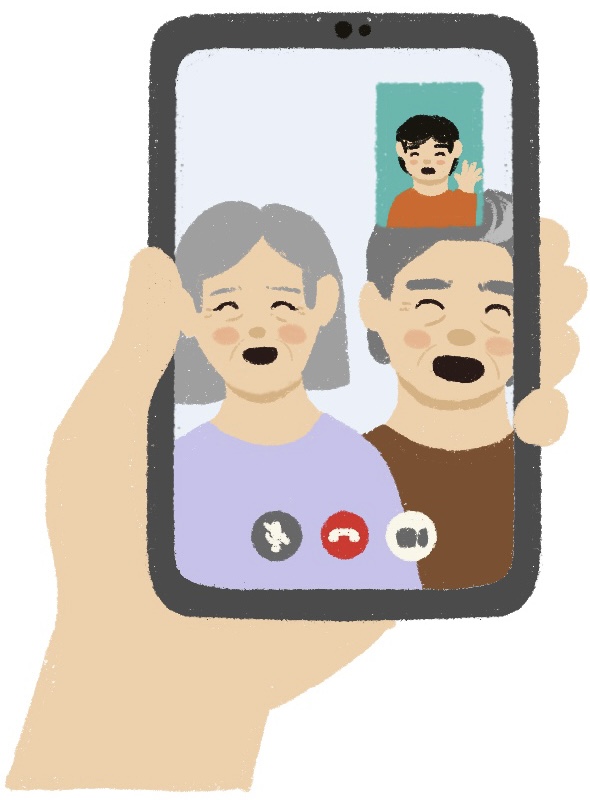
It is the New Year’s holiday season, and Maya is talking with her grandparents in Korea via video conference.
1. Listen to the conversation and write as much as you recall in Korean.
- __________________________________________________________.
- __________________________________________________________.
- __________________________________________________________.
- __________________________________________________________.
- __________________________________________________________.
2. Listen to the conversation again and answer the questions in English.
- What are some things Maya hopes to achieve in the near future?
- What is Grandpa planning to send Maya, and how?
- What does Maya want to do with her grandparents next year?
Helpful Vocabulary
장학금: scholarship
학기: semester
Interpretive & Interpersonal Task 2. 읽고 쓰기
New Year’s Card Message
1. You received a new year’s card from one of your classmates in the Korean program. Read the card message.
| 마야 씨, 새해 복 많이 받으세요!
올해 한국어반에서 마야 씨를 알게 되어서 너무 좋았어요. 같이 한국어 공부도 하고 여행도 하면서 좋은 추억 많이 생긴 것 같아요. 고마워요! 내년에도 언제나 건강하고, 행복하기 바랄게요. 그리고 원하는 일들도 모두 이루기 바라요. 20OO년 1월 1일 유코 |
2. Now write a new year’s card to the classmate in Korean.
|
|
Interpersonal & Presentational Task 3. 말하고 발표하기
Intercultural Table
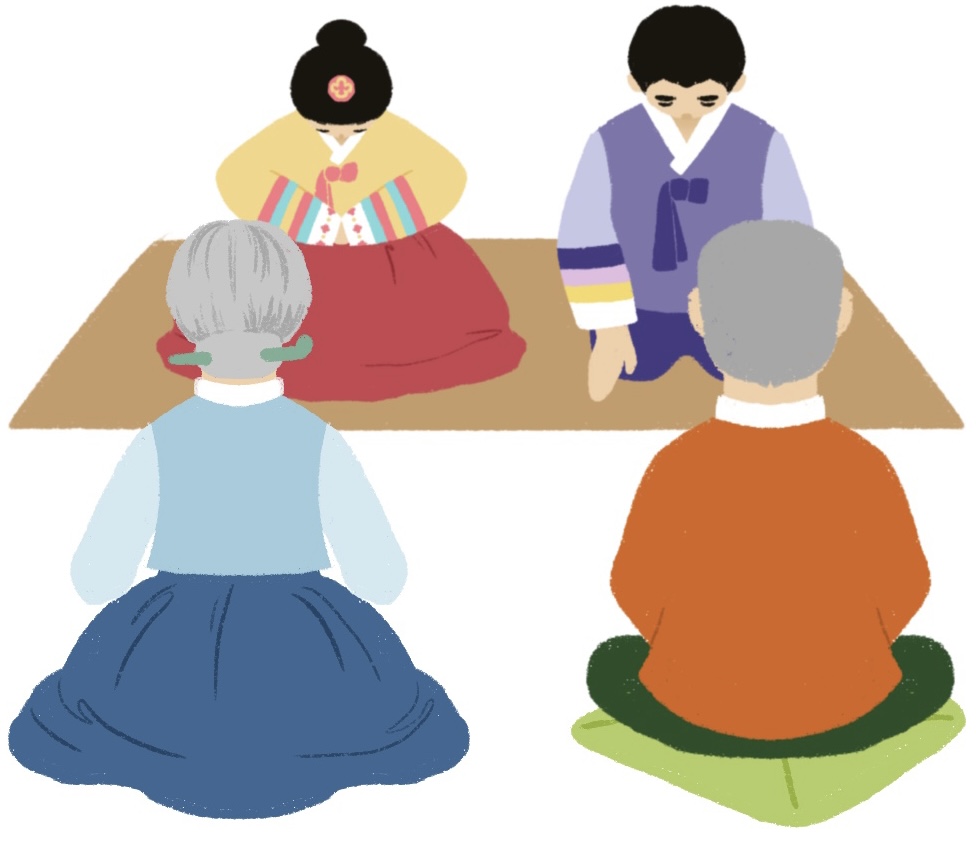
- Welcome back everyone. The topic of this week is New Year celebrations. Let’s talk and learn how people in the world celebrate the new year.
- In your culture, how do you say “Happy New Year”?
- What do you commonly say as new year’s greetings or wishes to other people?
- How do you celebrate the new year?
- Is there any special food eaten at the new year?
- [Your questions]
Coffee and Talk
- You are a member of ‘Coffee and Talk,’ a well-being club where members talk about various topics to vent to and support each other while drinking coffee or tea together at a café in Korea. Today is the first gathering of this year.
- Reflecting on yourself and your life over the last year, what were some of the highlights and challenges?
- Are there things you couldn’t do before but became able to do? Or vice versa?
- This new year, do you have things you would like to try?
- Do you have a wish list or a bucket list for the new year?
- Do you make new year’s resolutions? Why or why not?
- Do you have any questions, tips, or advice for your friends?
Language Point: Use of Markers Afters a Noun – Topic Particle –은/는 1
So… when are markers used? In written Korean they are usually used, and in spoken Korean they are usually left out. When they are said in spoken Korean, it is to serve a specific purpose; to express a certain meaning, to achieve a certain goal, as you will see.
You may have heard the same sentence said some times with 은/는 and other times with 이/가.
| 오빠는 집에 없어요. | My older brother is not at home. |
| 오빠가 집에 없어요. | My older brother is not at home. |
The English translation is sometimes the same. The two sentences above are fundamentally different to native Korean speakers, however.
Here is the summary:
| marks … | is called … | |
| –은/는: | TOPIC / old information | topic marker (particle) |
| –이/가: | FOCUS / new information | subject marker (particle) |
| –을/를: (for emphasis in spoken Korean) (by default in written Korean) |
OBJECT
|
object marker (particle) |
–은/는 Topic
–은/는 marks what is called OLD information, that is, what has been previously introduced into the dialogue or what the speaker and the listener already know about. Once you have brought something up, you can talk about it, and when you do, it gets the TOPIC marker, because the topic is what the rest of the clause is about.
오늘 학교에서 개 한 마리를 봤어요. 그 개는 꼬리가 없었어요.
I saw a dog at school today. The dog (which I saw at school) did not have a tail.
저는 오빠가 세 명 있는데 큰 오빠는 대학생이고 둘째하고 셋째 오빠는 고등학생이에요.
I have three older brothers – the big brother (one of the three that I just introduced) is a college student, the second and the third ones are high school students.
Because the topic is old or shared information, the particle 은/는 is often used in Korean in contexts where English would use the (e.g., “the guy (we are talking about),” “the teacher,” “the country”). It is generally not used in situations where English would use a (e.g., “a guy,” “a teacher”)*.
| *Except when you are defining the category:
A teacher is someone who teaches. 선생님은 가르치는 사람이다. |
겨울에는 대부분의 나무가 옷을 벗는다. 옷을 벗은 나무는 바람이 불면 추위에 떨지만…
Most trees take off their clothes in the winter. The trees that take off their clothes shiver in the wind, but…
Because the topic marker is used when you have just introduced the noun into the conversation, it is also often used in Korean where you would use a pronoun in English.
동생이 책을 한 권 생일 선물로 받았어요. 그 책은 한국 역사에 대한 책이었어요.
My younger sibling received a book as a birthday gift. It was about Korean history.
Some things are always available as topics, even if they have not yet been mentioned in the conversation; for example, “I”, “you”, “today”, “here”, etc., and also nearby physical objects (“this desk”). And if the real-world context is appropriate, other things can be topics without first being mentioned (e.g. the teacher, when you’ve gotten out of class).
| 오늘은 왜 이렇게 추워? | What’s up with today? Why is it so cold? |
| 이 책상은 누구 거예요? | What about this desk? Whose is it? |
Objects can be topics, too, again either to change the topic or to emphasize:
| 가: 커피 드실래요? | Do you want some coffee? |
| 나: 아, 커피는 안 마시는데요. | Oh, coffee I don’t drink. |
Conclusion:
So in the sentence, 오빠는 집에 없어요, there must have already been some mention of the older brother or of the speaker’s family members. Older brother could then be a Topic, and the sentence just adds some information about his whereabouts.
(In 오빠가 집에 없어요, the whole sentence is new information – we are surprised to notice that he is not at home, or someone just asked about older brother’s whereabouts specifically.)
한국 문화 길잡이
한국의 명절 (Korean Traditional Holidays)
There are many traditional holidays that Koreans used to celebrate, but the main holidays in modern Korea are 설날, New Year’s Day, and 추석, the harvest celebration in the fall. In Korean traditions (perhaps due to Confucian influences), family is central. In turn, traditional holidays are centered around family–and of course feasting together. Korean people celebrate these two holidays for three days, starting from the day before each holiday, often resulting in a week of vacation when combined with the weekend. Consequently, more and more people use this opportunity to take a trip either in Korea or abroad.
설날
설날, New Year’s Day, –– on the lunar calendar, originally –– is a celebration of a new start in the Eastern zodiac, when people think about their luck and destiny for the coming year.
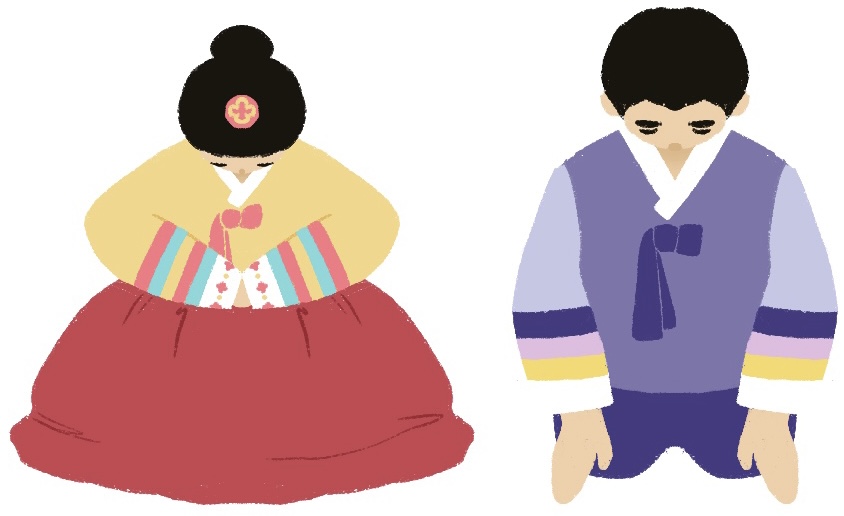
In a ritual stemming both from ancient Korean ancestor worship and from Confucianism, on New Year’s day, children are expected to make a full formal bow, 세배 (kneeling, then prostrate on the floor) for their parents, to show thanks and respect, and the parents in turn give children a sum of money for the coming year.
Koreans eat 팥죽, red bean porridge/soup with soft 떡 (rice cake) in it, on New year’s Eve (그믐날). The color red is believed to scare away evil spirits. Then on New Year’s Day, Koreans eat 떡국 [만국 in North Korea], the white 떡 symbolizing purity and austerity for the new year and the length of the 떡 representing a wish for long life. Traditionally, everyone ages by one year (at the same time) on New year’s day, and since Koreans consider babies to be “one year old” at birth, there may be a two-year difference, depending on the date, between one’s “Korean age” and their “American/Western age.”
추석
Clearly stemming from old farming practices is the autumn Harvest Festival, 추석, a three-day holiday centered on the full moon in the middle of the 8th month of the lunar calendar, right at the Autumn Equinox. 추석 features a family feast where Koreans visit their hometowns and older relatives to celebrate the harvest. It is much like American Thanksgiving, but 추석 is also a time to pay respects to one’s elders and ancestors.
Ancestral worship rituals, 차례, are performed early in the morning. Many Koreans will also visit the tombs of their immediate ancestors for 벌초, trimming the grass, pulling weeds and generally cleaning up the area around the burial mounds. They also leave offerings of symbolic foods, drinks, and crops.
추석 is also a time to enjoy the full moon. Koreans say that on the face of the full moon, there are two rabbits pounding rice with a mortar and pestle to make 떡. If you make a wish on the full moon, Koreans (traditionally) believe, it will come true.
One of the main foods prepared and eaten during the 추석 holiday is 송편, a crescent-shaped 떡 which is steamed on pine needles. Other dishes commonly prepared are 잡채, 불고기, and of course, fresh fruits and vegetables.
There are also folk games and customs that some may engage in at festival gatherings, such as 강강술래 (circle dance (an intangible cultural heritage, designated by UNESCO in 2009)) and 줄다리기 (tug-of-war). People, especially children, may also dress in 한복, and there may be traditional music, singing and drumming.
For more information about Korean traditional holidays, visit Korea.net:
https://www.korea.net/AboutKorea/Korean-Life/Festivals
할 수 있어요! I Got This!
Check to see if you can do the following:
- Share new year’s plans and wishes.
- Talk about changes of events and new developments.
- Recognize how Korean people celebrate Korean New Year.
| Listening Script
|
|
| 마야: | 할머니, 할아버지, 새해 복 많이 받으세요! 세배받으세요. |
| 할머니: | 됐어, 됐어. 뭘 비디오로. |
| 마야: | 아니에요. 세배받으세요. [세배한다] |
| 할머니: | 그래, 우리 마야도 새해 복 많이 받고 좋은 일 많이 생기길 바란다. |
| 할아버지: | 그래, 건강하고 원하는 거 다 이루길 바란다. |
| 마야: | 네, 네. 감사합니다. 할머니, 할아버지도 새해에 건강하세요! |
| 할아버지: | 그래, 그래. 고맙다. 세뱃돈은 은행으로 보내 줄게. |
| 마야: | 아, 감사합니다! 잘 쓸게요. |
| 할아버지: | 그래. 별일 없고? |
| 마야: | 사실, 여름 방학에 한국에 교환학생으로 가게 됐어요! |
| 할머니: | 정말이야? 잘 됐구나! 얼마 동안 있게 돼? |
| 마야: | 유월부터 팔월까지 세 달 동안 있게 돼요. 한국에 있는 동안 할머니, 할아버지 많이 뵙고 싶어요! |
| 할머니: | 그래, 그럴 수 있으면 정말 좋겠다. |
| 마야: | 제가 한국에 가면 같이 뭐 해 보시고 싶으세요? |
| 할아버지: | 나? 우리 마야랑 같이 제주도에 여행도 가고 등산도 하고, 같이 시간을 보내고 싶지. 너는? |
| 마야: | 저도 제주도에 꼭 같이 여행 가면 좋겠어요. 그리고 한국에서 좋은 인턴십도 찾으면 좋겠어요. |
| 할머니: | 그래, 꼭 그렇게 되길 바란다. 학교는 시작했어? |
| 마야: | 네, 지난주에 벌써 시작했어요. |
| 할아버지: | 그렇구나. 올해도 건강해라. |
| 할머니: | 잘 있어~ |
| 마야: | 안녕히 계세요! 또 연락 드릴게요! |