2 Lesson 2: 같이 한국어 공부하면 좋겠어요.
같이 공부하면 좋겠어요.
학습 목표 Goals
By the end of this lesson, you will be able to:
- Share your experiences in learning Korean
- Ask and answer questions about your wishes
들어가기 Setting Up
Lesson Focus
- INGREDIENTS – 단어 Vocabulary
- Classes and School Activities
- RECIPE – 문법과 표현 Grammar
- V-(으)ㄴ 지
- A/V–지 않다/못하다 Long-form negation
- A/V–(으)면 좋겠다
- LET’S COOK – 해 봐요! Classroom Tasks
- Interpretive Task 1. A conversation at the welcoming reception
- Interpretive & Interpersonal Task 2. Text messages between Noah and Dami
- Interpersonal & Presentational Task 2. Fall semester opening party/Students’ promotional presentation for Korean class
- KOREAN FLAVORS – 한국어와 한국 문화 Korean Language and Culture
- Language Point: Irregular conjugation: ㅂ–irregulars
- Culture: College life in Korea
- NOW YOU TRY! – 스스로 해봐요! Async. Practices and Tasks
- Communicative Tasks Link
- WB Link
짝하고 얘기해 봐요! Share your thoughts!
How do you introduce yourself in Korean? What information would you share with someone you are meeting for the first time?
Now let’s read these two dialogues. What are they talking about?
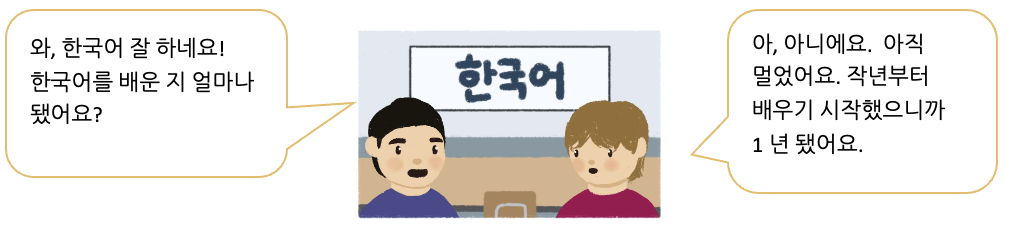 |
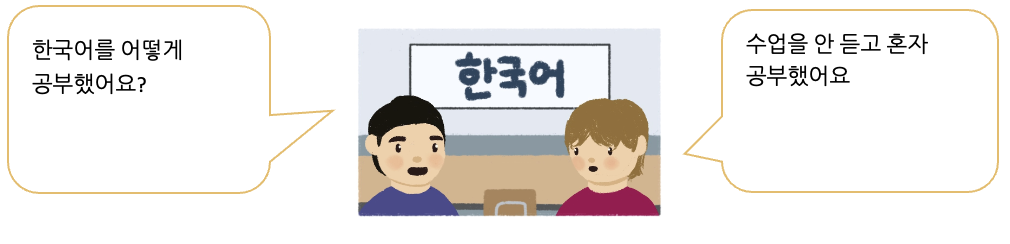 |
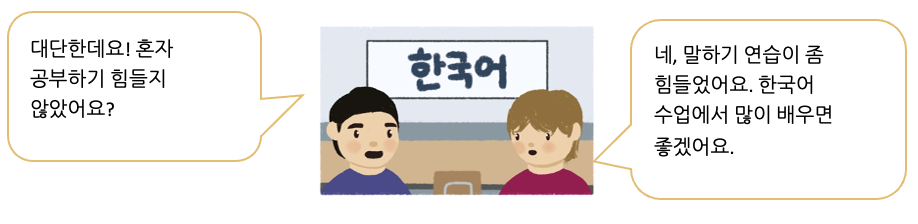 |
대학 강의 College Classes
 |
 |
 |
 |
 |
| 강의(실) | 교재/교과서 | 교수(님) | 과제 | 성적 |
| lecture (hall), class(room) | textbook | professor | assignment | grade |
 |
 |
 |
 |
 |
| 발표 | 중간 시험 | 기말 시험 | 질문 | 내다 |
| presentation | midterm exam | final exam | question | to submit |
새 단어와 표현 New Vocabualry and Expressions
| 단어 | vocabulary | 맞다 | to be correct (verb) |
| 라운지 | lounge | 수고하다 | to do a good job |
| 자기 소개 | self-introduction | 외우다 | to memorize |
| 문법 | grammar | 잊어버리다 | to forget |
| 실력 | capability | 대단하다 | to be remarkable |
| 언어 교환 | language exchange | 시끄럽다 [ㅂ irregular] | to be loud |
| 초등학교 | elementary school | 조용하다 | to be quiet |
| 늘다/늘리다 | to expand/to stretch something out | 바로 | right away |
| 도와주다 | to help out | –와/과 | and, with |
| 실력이 늘다/실력을 늘리다 | one’s skills have improved/ to improve one’s skills | 수고했어요! | Good job! Thank you for your hard work! |
| 아직 멀었어요. | I still have a long way to go. | 한 번 더 말씀해 주세요. | Please say that one more time. (to professor) |
단어 메모지 Vocabulary Notes
1. 수업과 강의 classes and lectures
We have learned a few school–related terms in Books 1 and 2. The following words are frequently used in a college setting.
| K-8 School | College | Meaning | K-8 School | College | Meaning |
| 수업 | 강의 | class (lecture) | 교과서 | 교재 | textbook |
| 교실 | 강의실 | classroom | 선생님 | 교수님 | teacher/professor |
| 숙제 | 과제 | homework, assignment, task | 개학(하다) | 개강(하다) | start of school |
2. 실력 applicable skills
실력 means ‘applicable skill, proficiency, capability’ and is often used with foreign languages, sports, and other activities that require practice and training. Here are some handy examples:
| 외국어 실력 | foreign language skills | 요리 실력 | cooking skills |
| 노래 실력 | singing skills | 운동 실력 | sports skills |
| 실력이 좋다 | to have good skills | 실력이 늘다 | skills have improved |
| 실력을 늘리다 | to improve one’s skills | 실력이 안 되다 | skill is not quite (good) enough |
3. –와/과 and, with
You already know two other markers that mean “and”; they are –하고 and –(이)랑. The third (and luckily the last!) “and“ marker is used more often in writing. –과 is used after nouns ending in consonants, and –와 after vowel–ending nouns. This is the OPPOSITE of what you might expect, so keep it in mind.
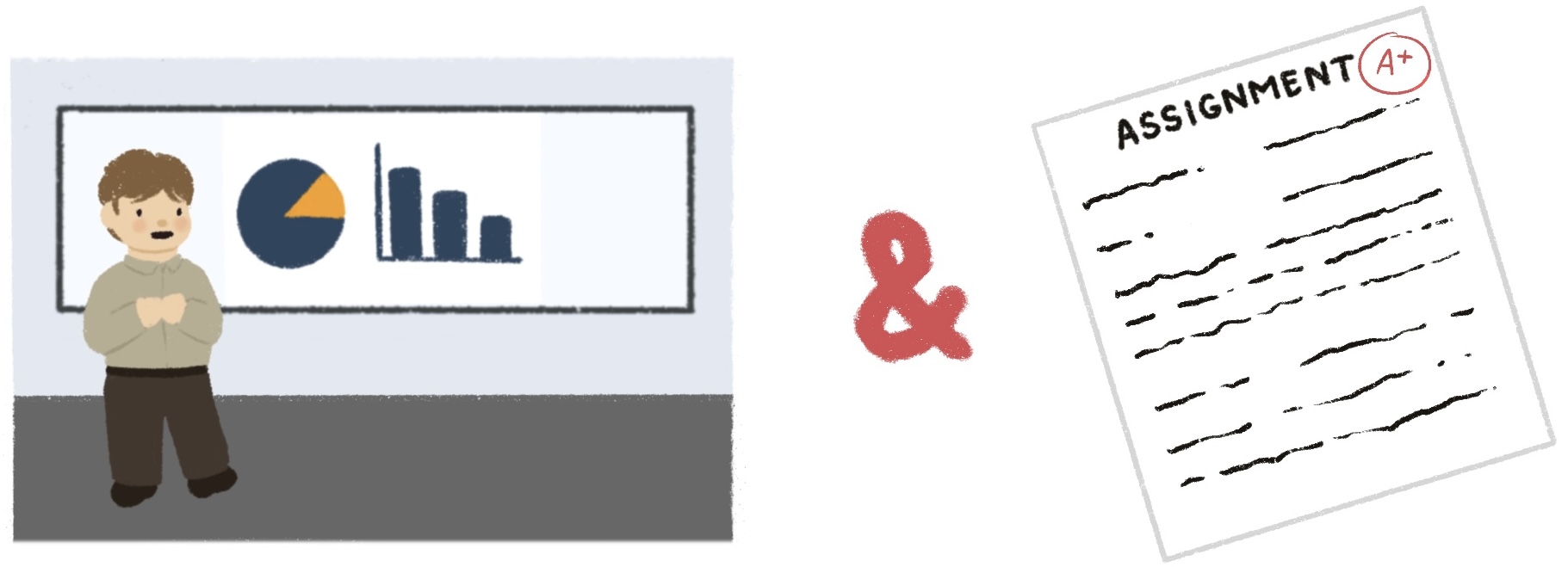 |
과제와 발표 | assignments and presentations |
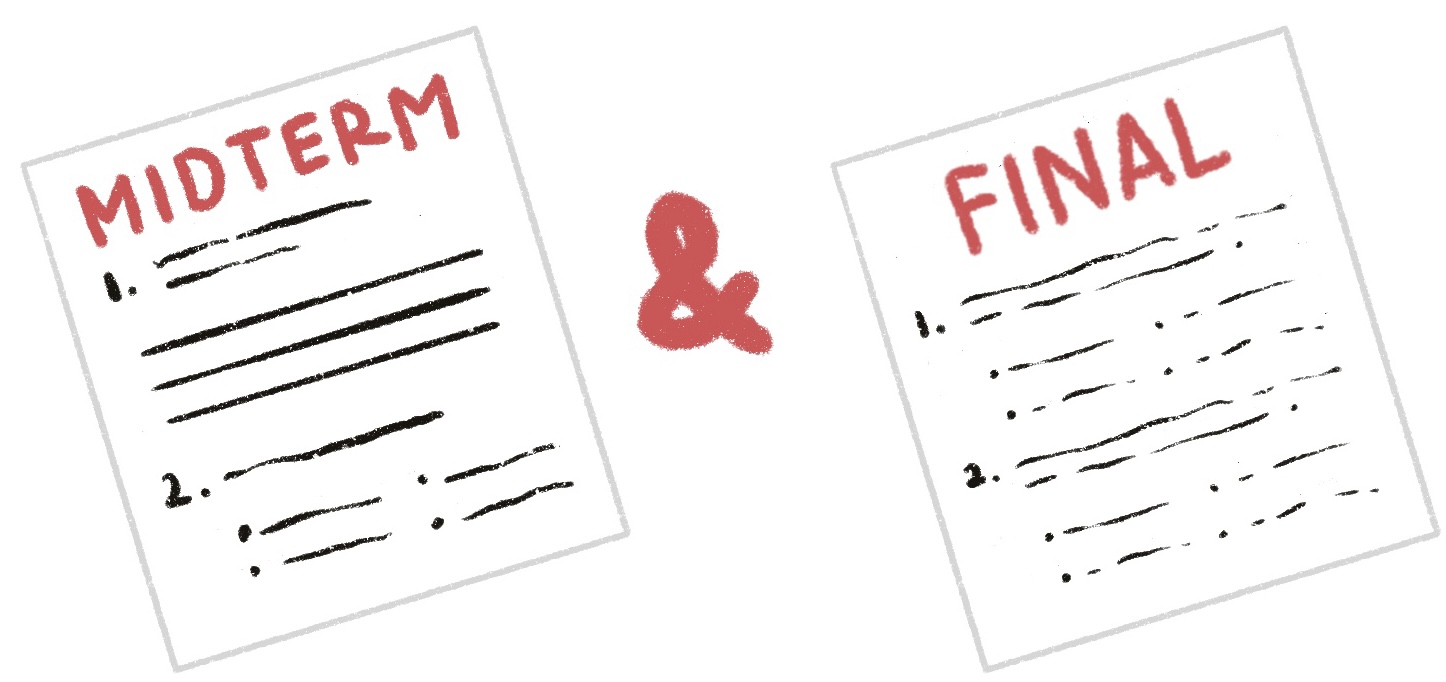 |
중간 시험과 기말 시험 | midterm exam and final exam |
단어 연습 Vocabulary Exercises
연습 1. New Vocabualry and Expressions
연습 2. New Vocabulary and Expressions
중급: intermediate
연습 3. New Vocabulary and Expressions
Complete the following bubbles.
연습 4. New Vocabulary and Expressions
Mark True or False for the following statements about yourself. Then, ask your classmate and find out how many items you have in common.
| 나 | 반 친구 | |
| 1. 문법 공부가 재미있습니다. | ||
| 2. 단어 외우기가 어렵습니다. | ||
| 3. 과제를 잘 잊어버립니다. | ||
| 4. 언어 교환을 하고 있습니다. | ||
| 5. 시끄러운 곳에서 공부를 못 합니다. | ||
| 6. 자기소개를 한국어로 할 수 있습니다. | ||
| 7. 할 일을 바로 합니다. | ||
| 8. 이번 학기에 한국어 실력을 늘리고 싶습니다. |
1. V–(으)ㄴ지 How long have you been…/How long has it been since…?
1231212

1. Review: V-(으)ㄴ
As we learned in Lesson 22 in Book 2, – (으)ㄴ is used on a verb when we want to describe an action that WAS completed at a specific point in the past.
Consonant-ending stem
 |
읽다 | 친구가 읽은 교재 | the textbook that my friend read |
Vowel-ending stem
 |
하다 | 내가 한 숙제 | the homework that I did |
 |
외우다 | 내가 외운 단어 | the vocabulary that I memorized |
Irregular verbs
 |
듣다 | 오늘 아침에들은 뉴스 | the news that I heard this morning |
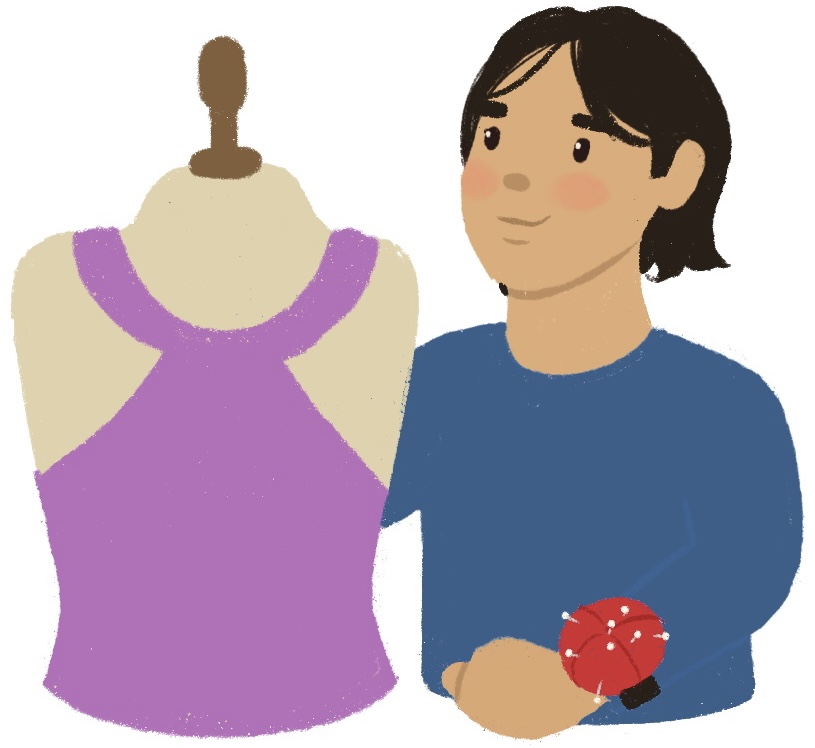 |
만들다 | 동생이 만든 옷 | the clothes that my younger sibling made |
2. V–(으)ㄴ 지 Since
The same –(으)ㄴis used in “–(으)ㄴ 지 얼마나 (오래) 됐어요?” The phrase can have two slightly different interpretations. One is “How long have you been VERBing?” (That is, “how long has it been since you started doing something?”) and the other is “How long has it been since the last time you did something ?” You can figure out which by the context.
As you typically answer the question “How long has it been…?” your focus will be on ‘how long’ something has been going on or how long it has been since something began. See the difference in the answers:
| 가: 벌써 개강했어요? | Has college already started? |
| 나: 네, 개강한 지 이주일 됐습니다. | Yes, it’s been two weeks since school started. |
| 나: 네, 이주일 전에 개강했습니다. | Yes, school started two weeks ago. |
| 가: 여기 산 지 얼마나 오래 됐어요? | Have you been living here long? |
| 나: 살기 시작한 지 1년밖에 안 됐어요. | It’s been only a year since I began living here. |
| 나’: 1년 전에 이사 왔어요. | I moved in a year ago. |
When you focus on the duration ‘how long’, the person does not get as much attention. This means you will usually use the subject (not topic) marker with the –(으)ㄴ 지 time expression.
| 저는 한국어를 혼자 3년 동안 공부했어요. | I studied Korean on my own for 3 years. |
| 제가 한국어를 혼자 공부한 지 3 년 됐어요. | It’s been 3 years that I’ve been studying Korean on my own. |
Conjugation Practice
For verbs that end in consonants, add –은 지, and for verbs that end in vowels, add –ㄴ 지. For ㄹ–ending verbs,-ㄴ지 is used.
| Dictionary Form | –(으)ㄴ지 | Dictionary Form | –(으)ㄴ지 |
| 내다 | 낸 지 | 듣다 | 들은 지 |
| 취직하다 | 살다 | ||
| 도와주다 | 굽다 |
<Answer key> 취직한 지, 산 지, 도와준 지, 구운 지
연습 1. –(으)ㄴ지
Read each sentence to your partner. They will change the sentence as in 맛보기, using –(으)ㄴ 지.
| (맛보기) 한국어를 10년 가르쳤어요. | I (have) taught Korean for 10 years. |
| → 한국어를 가르친 지 10년 됐어요. | It’s been 10 years since I began teaching Korean. |
1) 내 룸메이트를 2년 전에 처음 만났어요. →
2) 지민은 대학교를 4년 전부터 다녔어요. → 지민이
3) 부모님이2주전에새집으로이사하셨어요. → 부모님이
4) 저는 5일 전에 과제를 냈어요. → 제가
5) 우리 누나는 1년 전에 취직했어요. → 우리 누나가
6) 저는 고등학교를 작년에 졸업했어요. → 제가
7) 수영이는 세 달 전부터 BTS 노래를 듣고 K–POP에 관심이 생겼어요1. → 수영이가
1. 생기다: to form, be created
연습 2. –(으)ㄴ지
Go around the classroom and find a classmate who knows how long it has been since the following events took place or started.
| (맛보기) 한국 사람들이 미국으로 처음 이민 오다. |
| 가: 한국 사람들이 미국에 처음 이민 온 지 얼마나 됐어요? |
| 나: 1903년에 하와이에 왔어요. 그러니까 120년 됐어요. |
1) 라이트 형제가 비행기를 처음 만들다.
2) 닐 암스트롱이 달에서 처음 걷다.
3) 한국에서 올림픽이 열리다.
4) 세종 대왕이 한글을 만들다.
5) 비트 코인이 생기다.
6) 하와이가 미국의 주 (state)가 되다.
7) BTS의 “Dynamite” 노래가 나오다.
8) Make up your own!
Hint: The above events each happened in one of these years:
| 1443 | 1903 | 1959 | 1969 | 1968 | 2009 | 2020 |
형제: brothers
열리다: to be held
연습 3. –(으)ㄴ지
Talk to your classmates and find out how long it has been since they did each of the following activities.
| (맛보기) 과제를 내다 |
| 가: 한국어 과제를 낸 지 얼마나 됐습니까? |
| 나: 하루 됐습니다. |
1) 대학교에 다니다
2) 초등학교를 졸업하다
3) 한국어 공부를 시작하다
4) 강의실에 들어오다
5) 기말 시험을 보다
6) 언어교환 친구를 만나다
7) 열두 시 전에 자보다
8) Make up your own question.
초등학교: elementary school
2. A/V–지 않다/못하다 Long Form Negative

1. –지 않다/–지 못하다 Long Form Negative
–지 is a negative suffix you know from –지 마세요 (Please don’t do…).. It is also a used before the negative verb 않다 to make a long form negative sentence. The long negative form –지 않다 is typically used in written Korean; in spoken Korean, it is more frequently used with adjectives than verbs. Markers–은/는 and -도 are often used with –지:
| 그 라운지는 별로 조용하지 않아요. | That lounge is not very quiet |
| 시험이 적지는 않지만 어렵지도 않습니다. | The amount of tests is not few, but they’re not hard, either. |
Just like the difference in usage between 안and 못, when the speaker has no control over the event, –지 못하다 is used instead of –지 않다.
| 아직도 새 단어를 다 외우지 못했습니다. | I still haven’t been able to memorize all of the new vocabulary. |
–고 싶어요 is usually negated with –지 않아요.
| 교재가 너무 비싸서 사고 싶지 않아요. | The textbook is too expensive, so I don’t feel like buying it. |
2. A/V–지 않아요 Question
–지 않아요 is used to ask for agreement in questions. Its nuance is neutral and not as naggy or negative as English.
| 가: 한국어 문법이 좀 어렵지 않아요? | Isn’t Korean grammar a bit difficult? |
| 나: 쉽지는 않지만 공부하면 괜찮아요. | It’s not easy, but it’s okay if I study. |
00
연습 1. –지 않다/못하다
| (맛보기) 어제 아침에 일찍 일어났어요. |
| → 어제 아침에 일찍 일어나지 않았어요. |
| → 어제 아침에 일찍 일어나지 못했어요. |
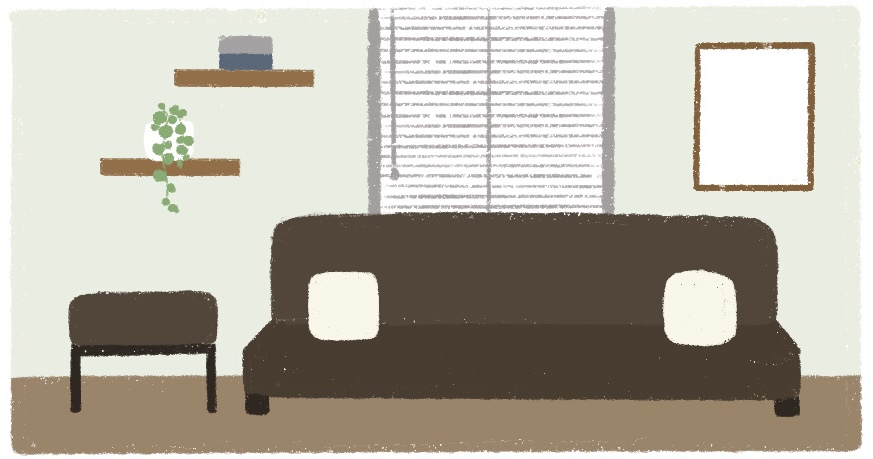
연습 2. –지 않다/못하다
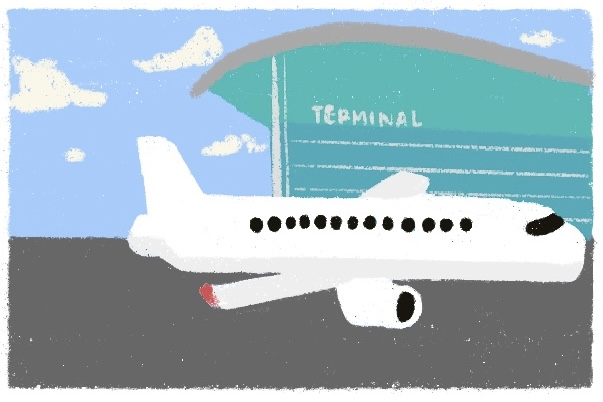
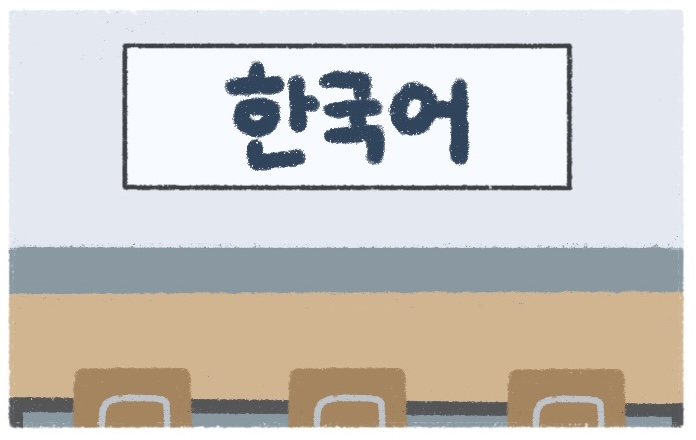
What can you not do at the given places? Use –지 못합니다.
| (맛보기) [기숙사 방] |
| 기숙사 방에서 파티하지 못합니다. |
 |
 |
 |
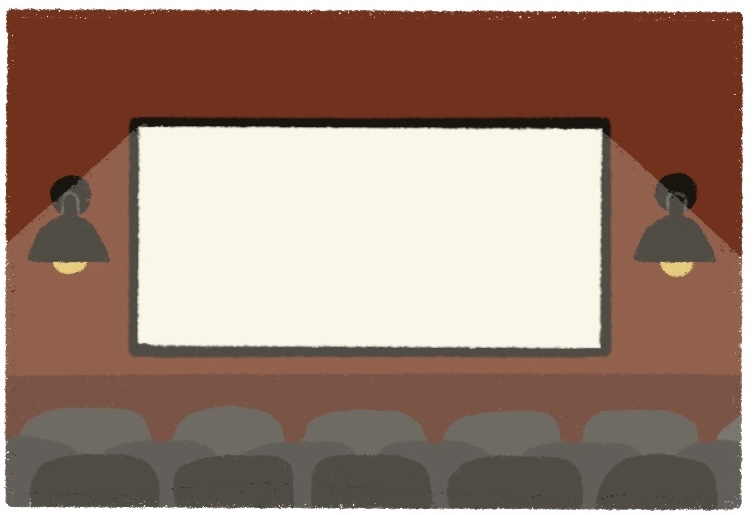 |
| 1) 도서관 | 2) 비행기 | 3) 한국어 수업 | 4) 영화관 |
 |
 |
 |
|
| 5) 라운지 | 6) 수영장 | 7) 우리집/내방 | 8) Your own |
연습 3. –지 않다/못하다
With a partner, ask and answer questions based on the provided topic. Express your disagreement in the answers.
| (맛보기) Fact: tuition (학비): cheap |
| 가: 학비가 싸지요? |
| 나: 아니요. 학비가 싸지 않아요! |
1) Your dorm–room/apartment: big
2) Korean class: boring
3) Kimchi: sweet
4) Korean midterm: difficult
5) My friend’s Korean capability: remarkable
6) Disney movie ‘Frozen’: scary
7) Student lounge: noisy
8) Make up your own dialogue.
연습 4. –지 않다/못하다
Come up with your own reaction to the situation, using –지 않아요
| (맛보기) 강의실에 가야 하는데 기숙사에서 걸어서 20분 걸립니다. |
| → 강의실이 너무 멀지 않아요? |
1) 역사학 강의가 하루에 3 시간을 합니다.
2) 친구가 또 약속을 잊어버렸습니다.
3) 동생이 내일 중간 시험이 있는데 하루 종일 게임을 합니다.
4) 라운지에서 공부를 하려고 하는데 옆 사람이 큰 소리로 얘기합니다.
5) 친구하고 교재를 샀는데 교재가 한 권에 150 달러입니다.
6) 내일 단어 시험이 있는데 외울 단어가 100개입니다.
7) 룸메이트가 생물학 수업 중간 시험과 기말 시험에서 모두 A를 받았습니다.
Make up your own dialogue.
연습 5. –지 않다/못하다
Tell us 5 things you decided not to do anymore using –지 않을 거예요 As shown in 맛보기.
| (맛보기) 밤에 늦게 자지 않을 거예요 |
| 룸메이트하고 싸우지 않을 거예요. |
| 시험 전날 파티에 가지 않을 거예요 |
| 드라마 보면서 공부하지 않을 거예요. |
| 수업 시간에 문자 보내지 않을 거예요 |
1) _________________________________________________________________.
2) _________________________________________________________________.
3) _________________________________________________________________.
4) _________________________________________________________________.
5) _________________________________________________________________.
3. A/V–(으)면 좋겠다 It’d be great if…; I sure hope..; I wish
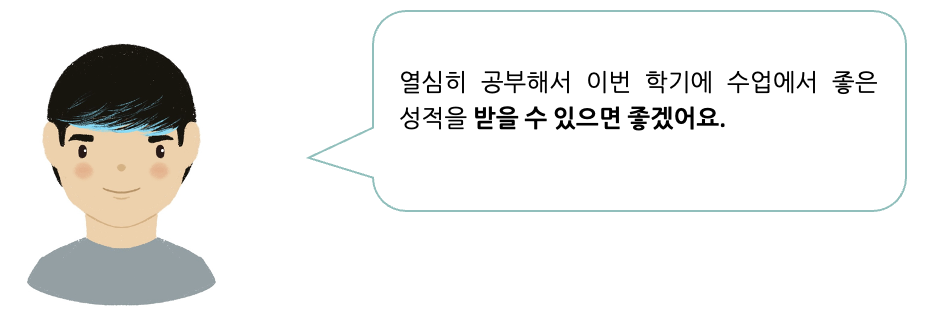
1. A/V–(으)면 좋겠다좋겠다 means “It would be good.” and if you combine 좋겠다 with a phrase ending in –(으)면, the total effect is: “If … happens, it would be good” or, more naturally, “I hope…” or “I wish …”
| 중간 시험이 쉬우면 좋겠습니다. | I hope the midterm exam is easy. |
| 교재가 비싸지 않으면 좋겠어요. | I hope the textbook is not expensive. |
| 듣기와 말하기 실력을 늘릴 수 있으면 좋겠는데… | I hope I can improve my listening and speaking skills. |
By putting the –(으)면 in the “past” tense, you can express a stronger uncertainty, as well as a stronger desire or hope. There is no clear distinction between hope and wish in Korean, but there is more doubt,uncertainty, or sense of ‘not under my control’ (especially when “I” am the doer) with a “–ㅆ으면,” so you might get that nuance here:
| 중간 시험이 쉬웠으면 좋겠습니다. | I do hope that the midterm exam is easy… |
| 교재가 비싸지 않았으면 좋겠어요. | I hope the textbook is not expensive. (I kinda doubt it, though) / I wish the textbook weren’t (so) expensive. |
| 듣기 실력을 늘릴 수 있었으면 좋겠는데… | I really hope I can improve my listening skills…(but it’s been very difficult, and I don’t expect it to get easier any time soon) |
| 좀 잤으면 좋겠다. | I wish I could sleep (but I can’t). |
Here are a few more examples:
| 가: 교환학생으로 공부하면서 뭐 하고 싶으세요? | What do you want to do while studying as an exchange student? |
| 나: 좋은 친구를 많이 사귀었으면 좋겠어요. 그리고 이번 학기에 한국어 실력을 많이 늘렸으면 좋겠습니다. | I hope to make many good friends. And I hope I can improve my Korean skills this semester. |
연습 1. –(으)면 좋겠다
| Look at the following pictures and express your wishes as shown in 맛보기.
(맛보기) (쉬는 그림) 너무 피곤해서 좀 쉬고 싶어요. |
| → 좀 쉬면 좋겠어요/좀 쉬었으면 좋겠어요. |
 |
 |
 |
|
| 1) 한국어 실력을 늘리고 싶어요. | 2) 어제 못 자서 오늘은 푹 자고 싶어요. | 3) 내일 발표를 잘하고 싶어요. | 4) 기말 시험에서 A를 받고 싶어요. |
 |
|
 |
|
| 5) 단어를 잘 잊어버려서 잘 외우고 싶어요. | 6) 그 교수님 강의를 음악을 듣고 싶어요 | 7) 5월에 졸업하고 싶어요. | 8) Your own! |
연습 2. –(으)면 좋겠다
What do you hope for? Answer the following questions using –(으)면 좋겠어요.
rgogr
1) 대학에서 뭐 하고 싶어요? [새 친구를 많이 사귀다]
2) 여름방학에 한국에 가세요? 네, [한국에서 여러 곳을 여행하다]
3) 요즘 한국어 수업을 들어요? 네, [한국어를 원어민처럼 할 수 있다]
4) 한국어 단어를 많이 아세요? 아니요, [단어를 잘 외울 수 있다]
5) 강의실이 가까워요? 아니요, [좀 가깝다]
6) 라운지가 조용해요? 아니요, [좀 조용하다)
7) 언제 졸업해요? 5월에 해요. [빨리 졸업하다]
8) 어떤 회사에 취직하고 싶어요? [저는 _______회사에 취직하다]
원어민: native speakers
연습 3. –(으)면 좋겠다
희망 사항 (Wish List): Let’s be idealistic! Make a sentence about features that would be nice to have in each of the following cases. Exchange ideas with your partner.
| (맛보기) 룸메이트 |
| 우리 방에 룸메이트의 친구가 매일 안 왔으면 좋겠습니다 |
1) 우리 학교
2) 나의 일/아르바이트
3) 내가 사는 곳
4) 여름/겨울 방학
5) 나 자신(self)
6) 졸업해서
7) 은퇴해서
8) Make up your own.
연습 4. –(으)면 좋겠다
Your fairy godmother will grant five wishes for you. Use “었/았으면 좋겠습니다” and create your wish list.
| (맛보기) 졸업하고 좋은 직장에 취직하면 좋겠습니다. |
| 사랑하는 사람이 있으면 좋겠습니다. |
| 2학년 한국어 수업에서 A를 받았으면 좋겠습니다. |
| 코로나 바이러스가 없어졌으면 좋겠습니다. |
| 한국어 말하기 실력이 빨리 늘었으면 좋겠습니다. |
1) ________________________________________________________________.
2) ________________________________________________________________.
3) ________________________________________________________________.
4) ________________________________________________________________.
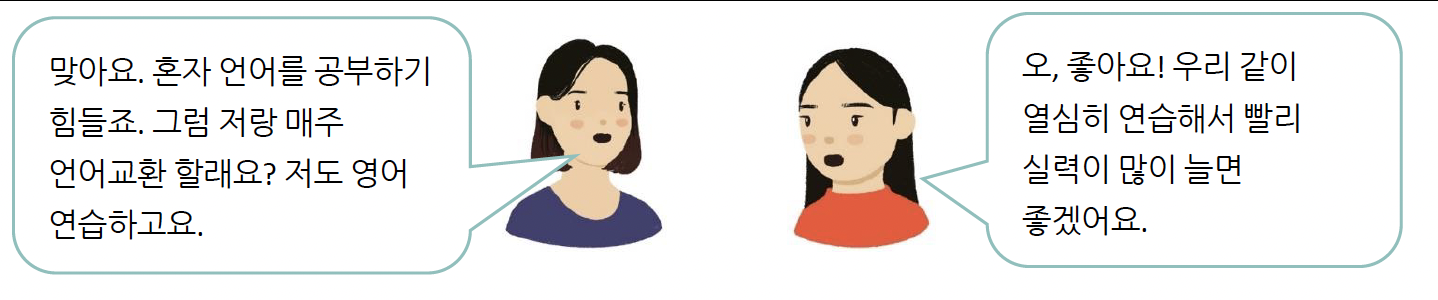
4. 종합 연습 Role Play
Create a role play with your partner using the key grammar expressions and new vocabulary from this lesson. Include 5-6 meaningful rounds of dialogue.
Context: During the department’s welcome party, an exchange student, who has been studying Korean for a while, encounters a new local friend. Share details about their language studies and collaborate to plan language exchange sessions.
Key Expressions: –(으)ㄴ 지, –(으)면 좋겠다, –지 않다/못하다
Sample dialogue:
 |
 |
 |
 |
해 봐요! Let’s Cook!
Interpretive Task 1. 듣기 Listening
Noah and Dami are at the welcoming reception hosted by the Office of International Students. Listen to the dialogue and answer the following questions in Korean.
1. What are they talking about in this dialogue? Summarize their dialogue based on what you heard. Try to give as much information as you can.
Now, listen to the dialogue one more time and try to get more detailed information:
- Noah’s major
- Dami’s major
- Who do you think is an exchange student? Dami or Noah?
- What was Dami’s compliment to Noah? And what was Noah’s response to it?
- What did they say they wish to do in terms of their career related to their majors?
- Did they agree to do something together? What was it? What did they plan at the end of the conversation?
Helpful Vocabulary
번역(하다): to translate
Interpretive & Interpersonal Task 2. 읽고 쓰기
As Noah and Dami agreed at the welcoming reception, Noah texted Dami to follow up with their conversation. Read and answer the following questions in Korean.
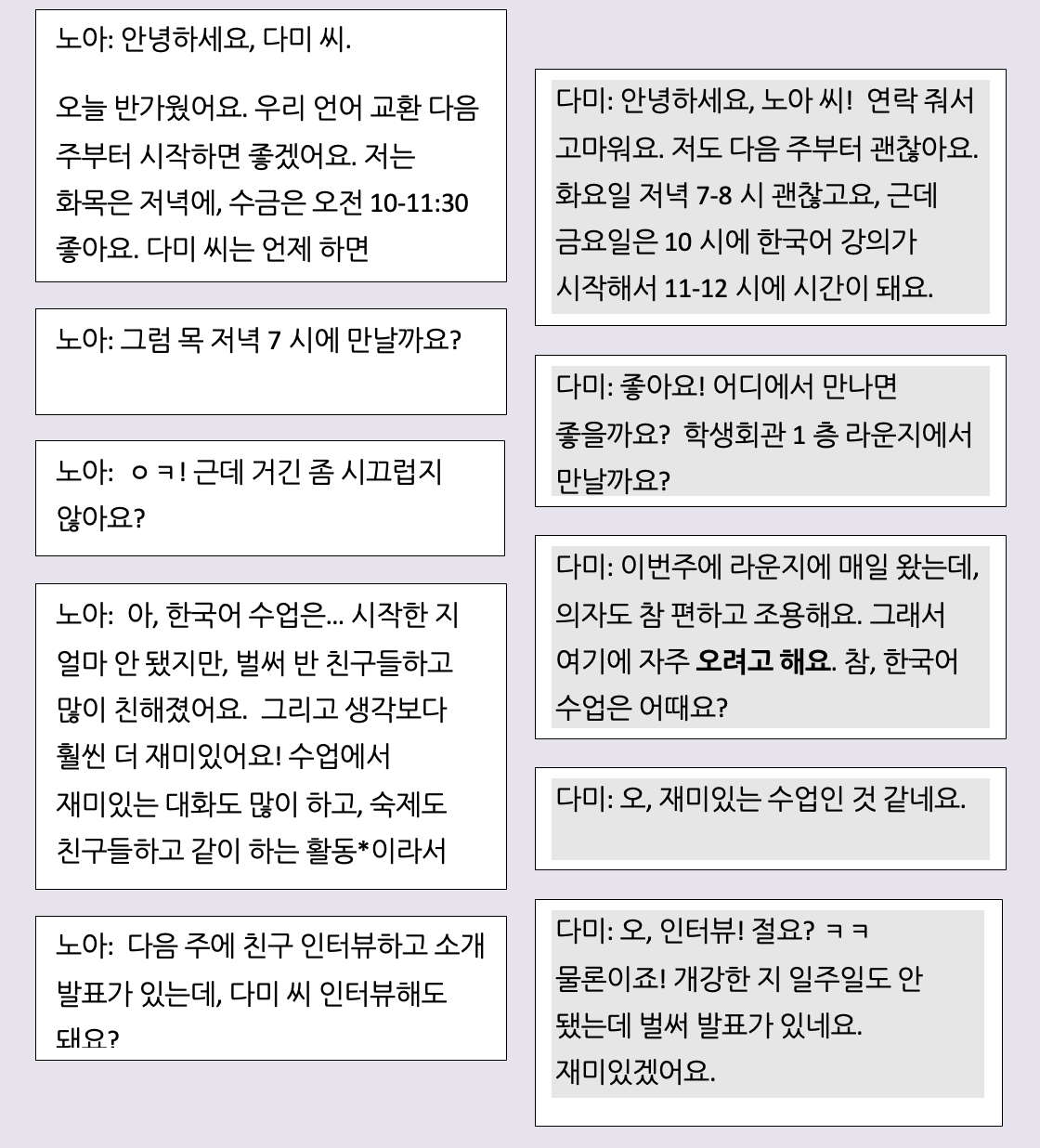
- State the time and location at which Noah and Dami agreed to have their English exchange.
- How is the Student Union lounge, in Dami’s opinion?
- What does Noah think about his Korean class? Why?
- What favor did Noah ask of Dami?
Interpersonal/Presentational Task 3. 말하고 발표하기
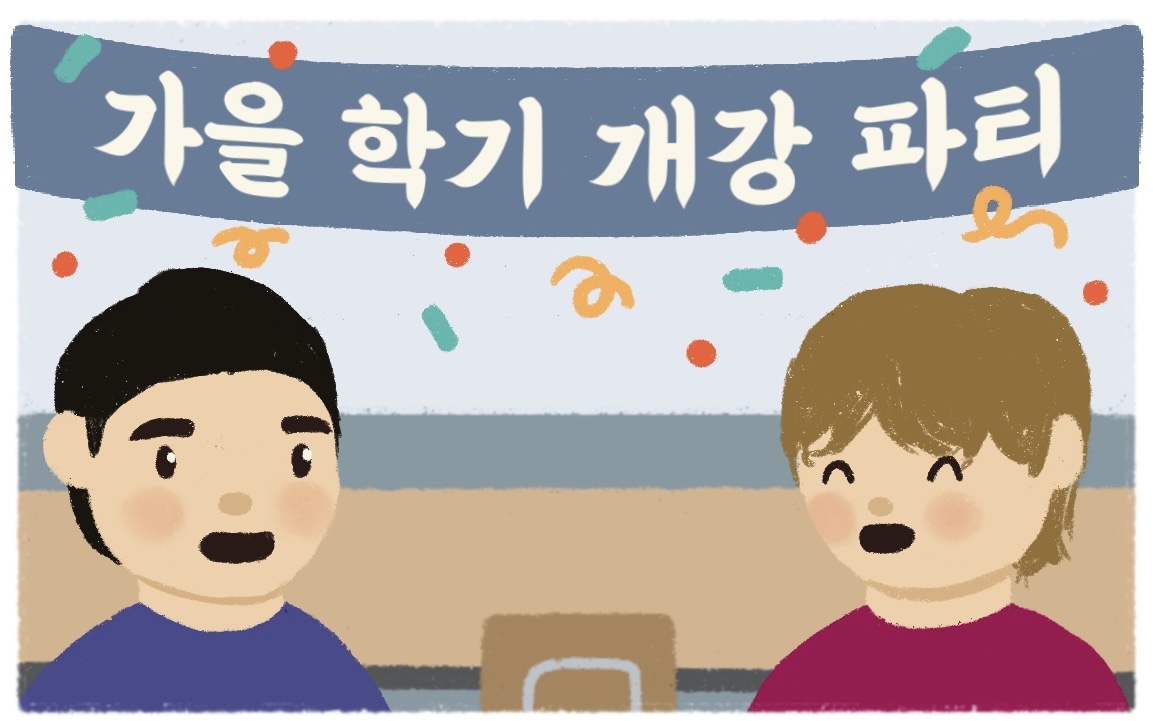
1. 가을학기 개강 파티 Fall Semester Opening Party
You are at your college’s Fall Semester Opening Party, which is the first in–person gathering of your college since the pandemic. Meet and greet your friends and classmates, professors, and graduate students. Also, talk and ask about the classes this semester.
Utilize vocabulary related to this topic:
| 평가 evaluation | 필수 mandatory | 선택elective | 대면 in–person/face–to–face |
| 비대면 virtual/online | 등록 register | 정원 cap | 학점 credit |
| 면담 시간 office hours | 연구실 professor’s office | 조교 TA | 수강 신청 course registration |
| 마감일 deadline |
2. Students’ Promotional Presentation for the Korean Class
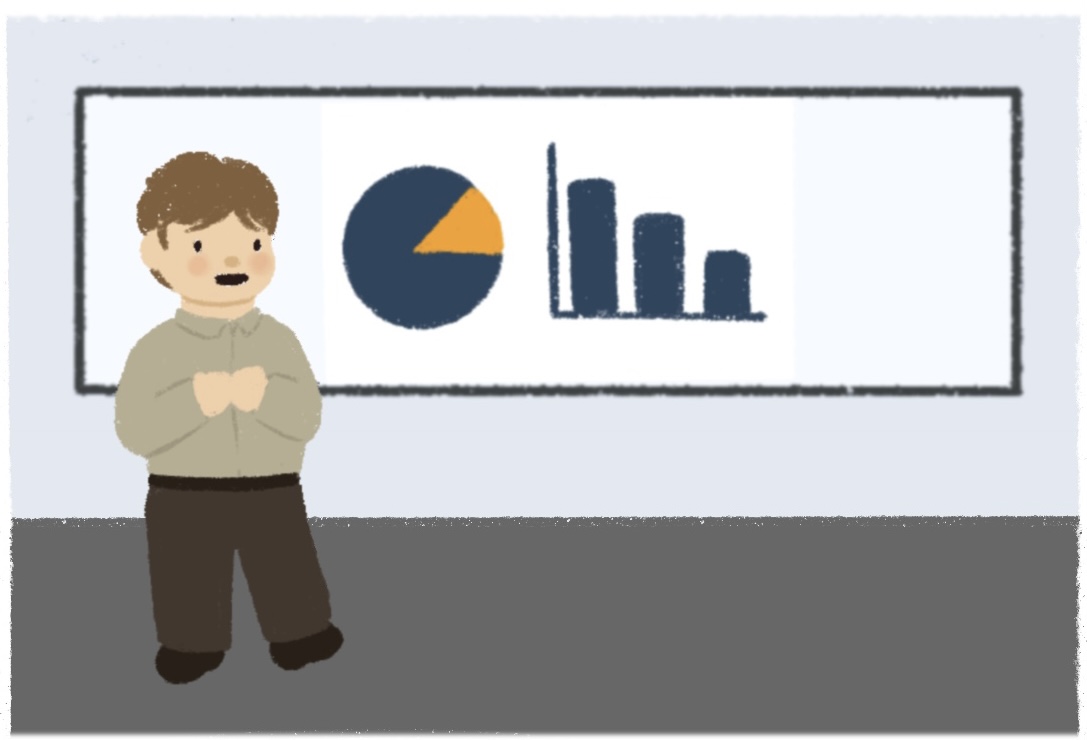
You and your Korean class classmates create an introductory presentation about the course for your college’s course catalog. First, present the content from a students’ perspective as a rehearsal. Then, you may produce either a poster or a video with a detailed description and highlights of the of the course (by the scheduled time).
한국어와 한국 문화 Korean Flavors
Language Point: Irregular Conjugation: ㅂ-Irregulars
In Books 1 and 2, you learned several types of “irregular” verbs and adjectives. To move forward, you need to keep track of: 1) which verbs and adjectives are irregular, and, 2) how the irregulars conjugate in different conditions (with different endings). Let’s start with how ㅂ–irregulars conjugate.
ㅂ–irregulars are verbs and adjectives whose roots end in ㅂ in the citation form and other consonant–initial forms, but whose ㅂ turns into ㅜ with vowel-suffixes 아/어–suffixes and 으 suffixes,(and 으 drops out).
Conjugate the examples using the given suffixes
| -아/어 suffixes | -으 suffixes | Consonant-initial suffixes | |
| 춥다 “cold” | + 아/어요 → | + (으)면→ | + 고→ |
| 돕다 to help | + 아/어서→ | + (으)니까→ | + 지→ |
| 굽다 to broil | + 아/어 → | + (으)러→ | + 네→ |
Some ㅂ- irregulars (Learn the meanings!):
| 돕다 | 눕다 | 굽다 | 줍다 | 쉽다 | 어렵다 | 덥다 |
| 춥다 | 더럽다 | 즐겁다 | 가볍다 | 무겁다 | 외롭다 | 귀엽다 |
| 어둡다 | 가깝다 | 두껍다 | 아름답다 | 시끄럽다 | 반갑다 | 고맙다 |
| 괴롭다 | 곱다 (to be fine, refined, fancy) |
Remember there are also ㅂ-final REGULAR verbs and adjectives – that keep their ㅂ in all forms:
| 입다 | 잡다 | 뽑다 (to pluck, pull out) | 집다 (to pick up with fingers) |
| 업다 (to carry on one’s back) | 씹다 (to chew) | 좁다 | 넓다 |
한국 문화 길잡이
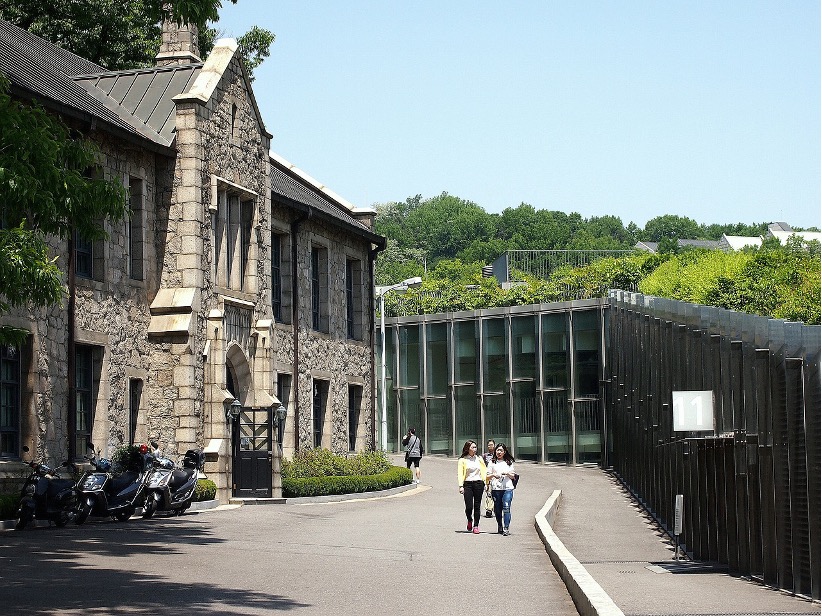
Pixabay로부터 입수된 tragrpx님의 이미지 입니다.
While graduating classes are a big deal in the U.S., people make a lot of hoopla when you enter a school in Korea. In college, based on your entry year you get a 학번 – a student number that defines your relationship with your seniors (those who started before you) called 선배. and your juniors (those who started after you) called 후배. Those who start school in 2025will be assigned a 25–학번. This number will also be used later in life for others to determine your age, thus what style of speech and terms of address to use when they speak with you.
선배 take on the role of mentor, like an older sibling looking out for their 후배. 후배, then, can be friendly with their 선배, but they must respect – and to some extent, follow the suggestions of – the선배. It is somewhat comparable to the relationship between younger and older students in an American fraternity or sorority, where the younger students may have to do favors for the older ones, but the older ones are expected to “look out for” the younger ones and help with job placements, etc. Interestingly, it is the 선배who would pay for coffee, drinks or shared meals; this reflects the care–taking role. 선배–후배 relationships are maintained throughout one’s lifetime with schoolmates: once a 선배, always a 선배.
Another important aspect of one’s schooling is one’s 학연 or affiliation (or alma mater, where you went to school). This information becomes part of your social persona, defining many of your future social relations as well. In addition to various (5–year, 10–year, etc.) high school 동문회 (alumni/school reunions), one also attends more or less formal entering–class reunions 동창회 , departmental 동문회, and many other class–based social gatherings. Many of a Korean person’s most lasting friendships stem from their 동창 relationships.
할 수 있어요! I Got This!
Check to see if you can do the following.
- Share your experiences of learning Korean
- Ask and answer questions about your wishes
| Listening Script
노아: 안녕하세요? 한국에서 오셨지요? 저는 노아라고 합니다. 반갑습니다. 다미: 안녕하세요? 저는 김다미라고 합니다. 한국어를 참 잘하시네요! 노아: 아, 아닙니다. 아직 멀었어요. 다미: 한국어 배운 지 얼마나 됐어요? 노아: 혼자 공부한 지 일 년쯤 됐어요. 그런데 이번 학기부터 한국어 수업을 듣기 시작했어요. 다미: 아, 그래요? 한국어 공부 어렵지 않아요? 노아: 문법하고 단어 외우기가 조금 어렵지만 재미있어요. 다미: 수업은 어때요? 노아: 수업 시작한 지 3일밖에 안 돼서 아직 잘 모르겠지만 참 좋아요. 반 친구들하고 연습할 수 있어서 재미있어요! 다미: 아, 그래요? 노아 씨 전공은 뭐예요? |