1 Lesson 1: 반갑습니다. 이삭 리라고 합니다.
반갑습니다. 이삭 리라고 합니다.
학습 목표 Goals
By the end of this lesson you will be able to:
- Introduce yourself in the formal speech style
- Share your personal information and background
- Ask and answer questions about essential personal information
들어가기 Setting Up
Lesson Focus
- INGREDIENTS – 단어 Vocabulary
- Life Cycle Expressions
- RECIPE – 문법과 표현 Grammar
- A/V-(스)ㅂ니다
- V-아/어서 sequential actions
- V-기 시작하다 decide to, start to
- LET’S COOK – 해 봐요! Classroom Tasks
- Interpretive Task 1: A conversation at the cafeteria
- Interpretive & Interpersonal Task 2: A message from an exchange student
- Interpersonal & Presentational Task 3: New member recruitment
- KOREAN FLAVORS – 한국어와 한국 문화 Korean Language and Culture
- Language Point: Occupations
- Three basic ending types for verbs and adjectives
- Culture: 첫 만남 First Meeting
- Language Point: Occupations
- NOW YOU TRY! – 스스로 해봐요! Async. Practices and Tasks
- Integrated Performance Task Link
- WB Link
짝하고 얘기해 봐요! Share your thoughts!
How do you introduce yourself in Korean? What information would you share with someone you are meeting for the first time?
Now let’s read these two dialogues. What are they talking about?
 |
 |
 |
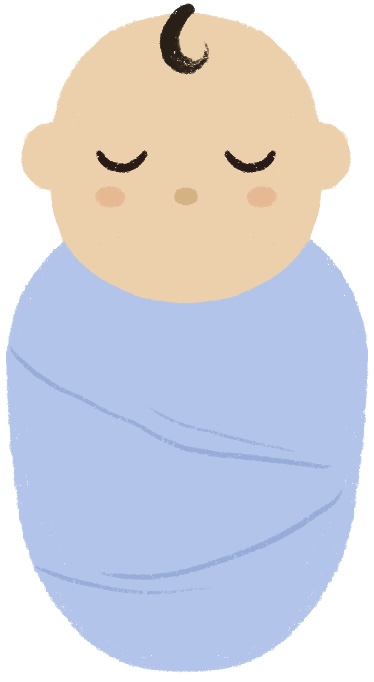
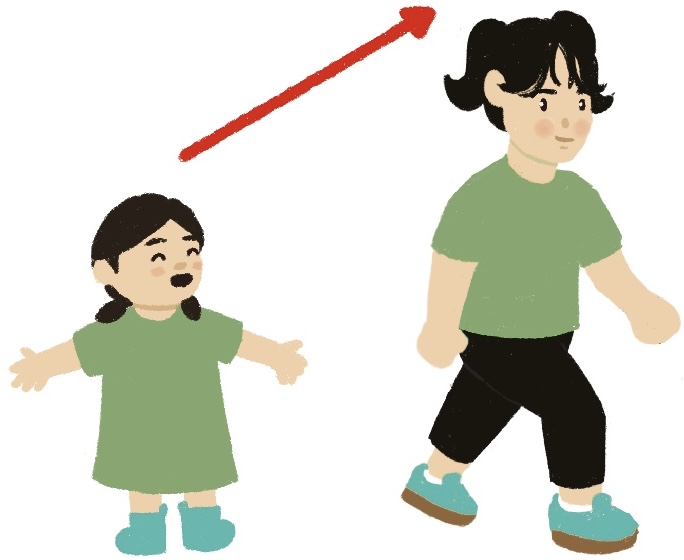
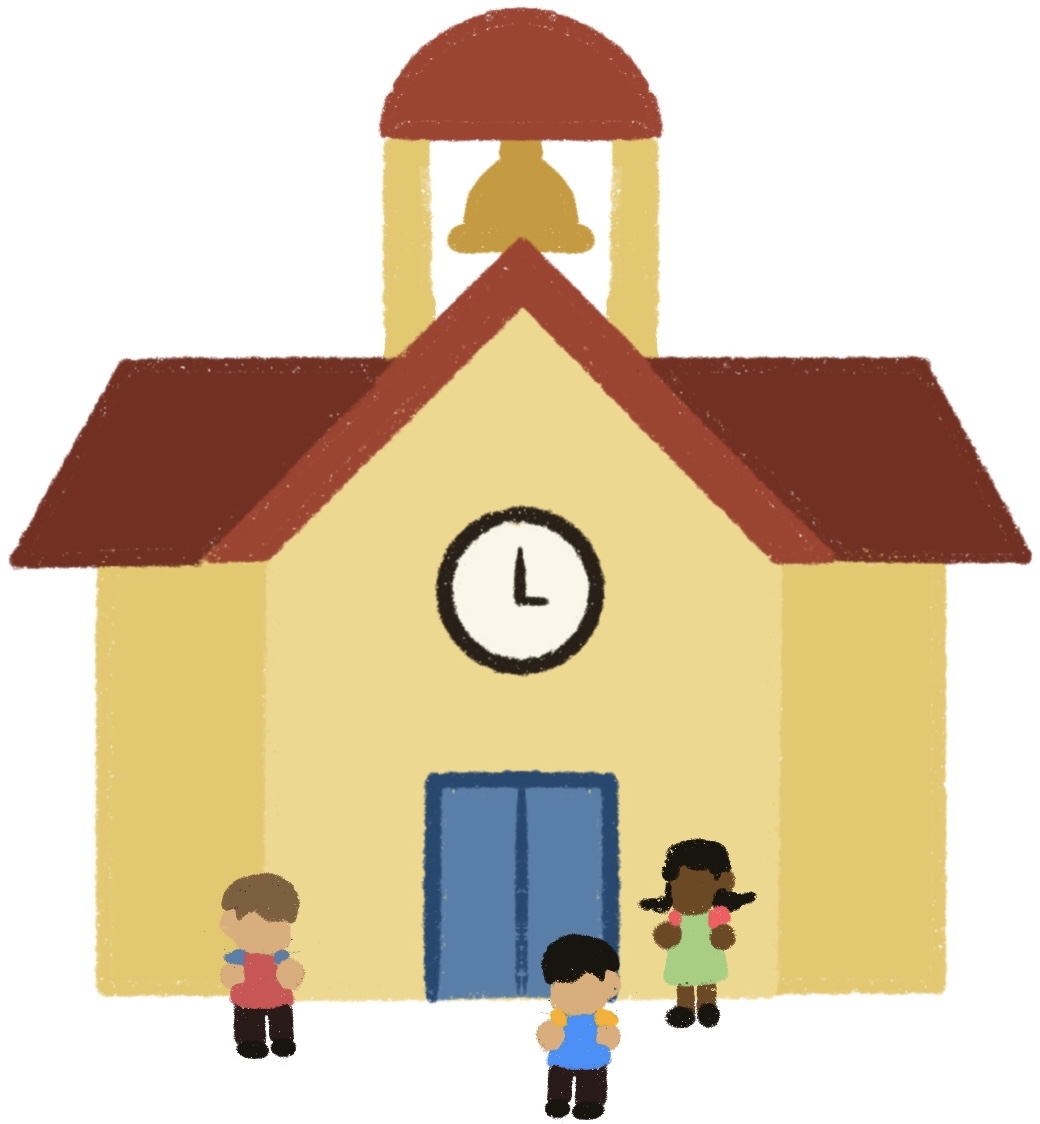
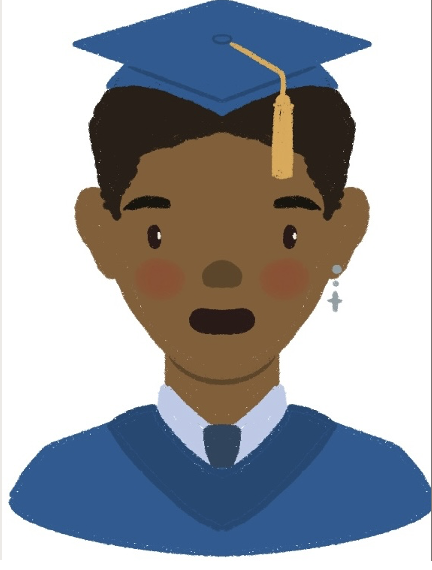
Life Cycle
 |
 |
 |
 |
 |
 |
| 태어나다 | 자라다, 크다 | 다니다 | 전공(하다) | 졸업(하다) | 취직(하다) |
| to be born | to grow up | to attend regularly (school, work) | to major | to graduate | to get hired |
대학 전공 College Majors
 |
 |
 |
 |
 |
 |
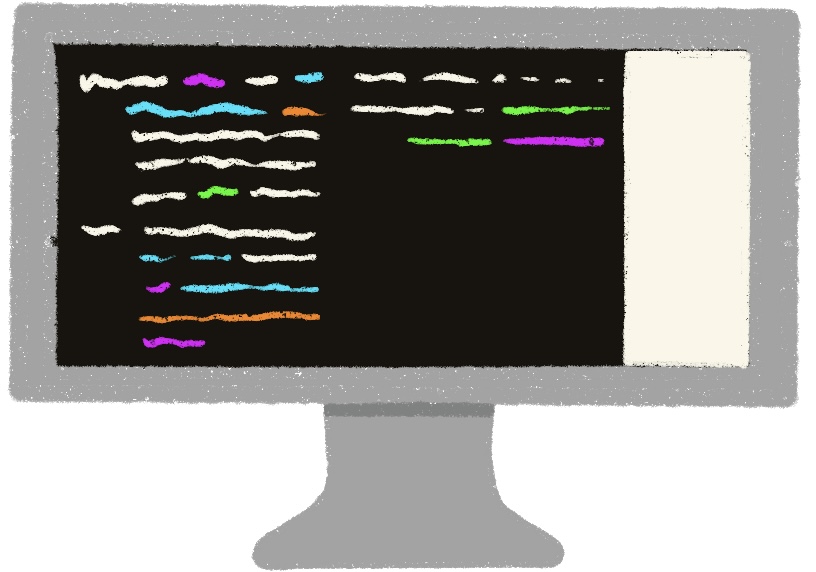 |
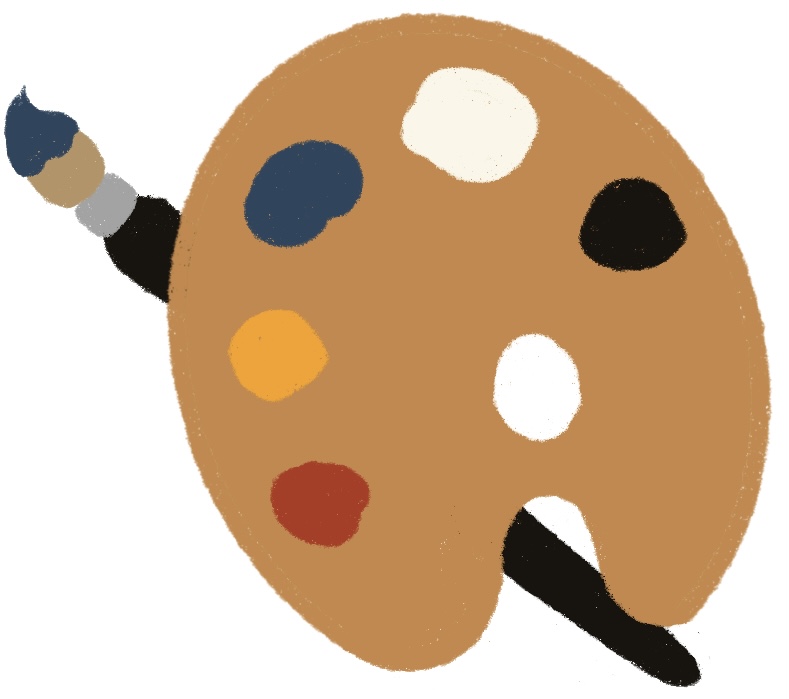
| 한국학 | 경영학 | 영문학 | 역사학 | 생물학 | 미술 | 컴퓨터 공학 |
| Korean studies | Economics | English literature | History | Biology | Fine arts | Computer engineering |
새 단어와 표현 Other Vocabulary and Expressions
| 관심 | interest | 취미 | hobby |
| 교환학생 | exchange student | 나가다 | to go out, to take part (in) |
| 대학원 | graduate school | 돌아가다/돌아오다 | to return |
| 올해 | this year | 부탁(하다) | to ask a favor (of someone) |
| 자기 소개 | self-introduction | 소개(하다) | to introduce |
| 작년 | last year | 시작(하다) | to start, to begin |
| 전 | before | 환영(하다) | to welcome |
| NOUN에 관심이 있다 | to be interested in NOUN | NOUN(이)라고 하다. | is/are called NOUN |
| 나이가 어떻게 되세요? | How old are you? | 무슨 일 하세요? | What do you do for a living? |
| 잘 부탁드립니다. | Much obliged; Thank you in advance (for taking care of me). | 처음 뵙겠습니다. | First time seeing you. |
단어 메모지 Vocabulary Notes
1. 나이가 어떻게 되세요? How old are you?
This is an appropriate expression to use to talk about the age of your peers and those who are younger than you. The honorific form of the word is 연세, but try not to ask for one’s 연세, if you can avoid it (it’s rude). For written documents, you will see 연령 [열령] to mean “age.” When you ask for someone’s age, 어떻게 되세요 is frequently used instead of 몇 살이에요.
| (나이가) 몇 살이에요? | How old are you? |
| 나이가어떻게되세요? | |
| 연세가 어떻게 되세요? |
2. 교환학생 Exchange student
If you are studying in a foreign sister university that has an official relationship with your own school, you are a 교환학생 (exchange student), and you should be able to transfer credits back to your school. If there is no official relationship and you are simply taking classes as an individual in a foreign country, you are a (해외) 유학생 (study abroad student). FYI: 교환 교수 means “exchange professor,” 방문교수 means “visiting scholar/professor.”
3. NOUN-(이)라고 합니다. I am called NOUN.
When you introduce your name, you can say -(이)라고 합니다. Can you guess when to say -이라고 합니다 vs. -라고 합니다 based on the following examples?
| 안녕하세요? 저는 김세영이라고 합니다. 반갑습니다. |
| 안녕하세요? 저는 알리사 스미스라고 합니다. 반갑습니다. |
4. 직업 Occupation
Here are some common occupation terms.
| 경찰관 | police officer | 소설가 | write, novelist |
| 소방관 | firefighter | 예술가 | artist |
| 교사 | teacher | 화가 | painter |
| 교수 | professor | 공무원 | government employee |
| 간호사 | nurse | 은행원 | banker |
| 의사 | doctor | 농부 | farmer |
| 약사 | pharmacist | 청소부 | sanitary worker |
| 변호사 | lawyer | 군인 | military person, soldier |
| 회계사 | accountant | 정치인 | politician |
단어 연습 Vocabulary Exercises
연습 1. Majors and Occupations
외교관: diplomat
연습 2. Interview
Write down your answers to the following questions. Then, interview your partner and find any commonalities between you and your partner.
| 나 | 반 친구 | |
| 나이가 어떻게 되세요? | ||
| 어디에서 태어났어요? | ||
| 어디에서 자랐어요? | ||
| 어느 고등학교를 졸업했어요? | ||
| 무슨 일 하세요? | ||
| 취미가 뭐예요? | ||
| 학교에서 뭐를 전공해요? | ||
| 언제부터 한국어를 배웠어요? |
연습 3. 자기 소개
Introduce yourself using the following expressions.
- 처음 뵙겠습니다.
- –(이)라고 합니다
- -에서 태어나서 자랐습니다.
- -에 다닙니다.
- -을/를 전공합니다.
- -을/를 졸업했습니다.
- 잘 부탁드립니다.
1. Formal Speech Style (격식체): A/V–(스)ㅂ니다
1231212
FORMAL SPEECH STYLE
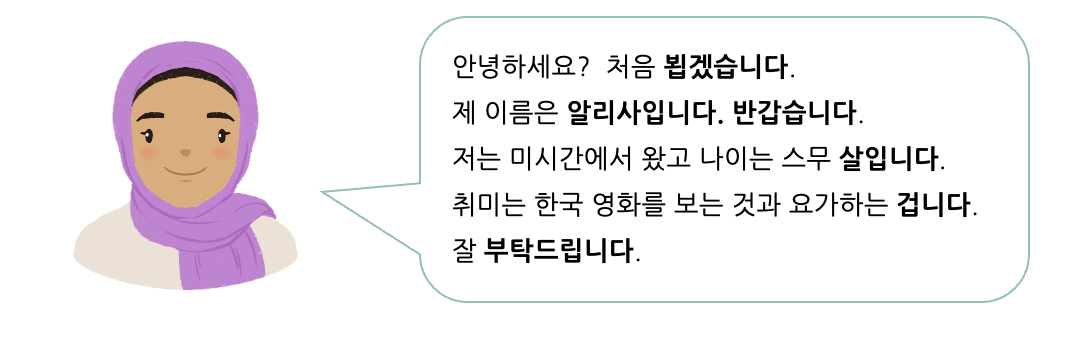
Every language has formal and informal ways of communicating. In English, service personnel at a formal restaurant or a receptionist at a hotel would never say to a customer, “What’s your problem?” or “Whattaya want?” He or she would say: “What seems to be the problem?” or, “How may I help you?” In Korean, ways of speaking more or less formally are clearly encoded in grammatical forms, including sentence endings.You already know about when to use or drop the ending –요, for example. This type of sentence ending, then, is the manifestation of “speech styles” in Korean, reflecting the relationship between the speaker and listener, how formal or distanced it is, or, how polite the speaker needs to be depending on whom they are talking to. Can you figure out who this person is talking to?
| 안녕? 내 이름은 알리사야. | Hello. My name is Alicia. |
| 안녕하세요? 제 이름은 알리사예요. | |
| 안녕하십니까? 제 이름은 알리사입니다. |
–습/ㅂ니다 (–습/ㅂ니까 for questions) is a Formal sentence ending that shows yet more formality and social distance between the speaker and the listener than –요. The Formal Speech Style is used in the military, in news broadcasts and when talking to one’s boss or another socially “higher” person, although, some use it between colleagues (that is, not only when addressing their superiors) at work. It is also often used by people in service positions towards their clients and in official settings, including when giving speeches.
There are personal preferences and dialectal variations involved as well; some people prefer to remain formal in more situations or for a longer time than others. Some will also assume that this is the (only) sentence ending a foreigner knows, as some of the formal, introductory expressions are often introduced fixed in this style (e.g. 처음 뵙겠습니다. 안녕하십니까? 고맙습니다. 감사합니다). Luckily, conjugation for this sentence style is rather simple.
Note: In a conversation, –어요 can be sprinkled here and there, mixed in with –습/ㅂ니다, especially once the ice is broken. However, some men (especially those who recently served in the military or who had a somewhat traditional or strict upbringing) may insist on sticking with the –습/ㅂ니다 ending. Women tend to use –습/ㅂ니다 less often, usually limited to service/business/work interactions.
CONJUGATION (PRESENT TENSE)
Let’s learn the conjugation then. The Formal sentence ending uses the regular stem of verbs and adjectives.
Add –습니다 [pronounced 씀니다] if the verb or adjective stem ends in a consonant and add –ㅂ니다 if it ends in a vowel. ㄹ–ending verbs and adjectives drop their ㄹ before the Formal sentence ending:
| Verb Root | Dictionary Form | Conjugation Rule | Final Form | Examples |
| Consonant–ending root | 듣다 있다 덥다 |
Add 습니다 | 듣습니다 있습니다 덥습니다 |
외국어 수업을 듣습니다. I am taking a foreign language class. |
| Vowel–ending root | 이다 가다 하다 |
Add ㅂ니다 | 입니다 갑니다 합니다 |
카이는 교환학생입니다. Kai is an exchange student. |
| ㄹ–ending root | 살다 놀다 |
Delete ㄹ, add ㅂ니다 | 삽니다 놉니다 |
미국인이지만 호주에 삽니다. I’m American, but I live in Australia. |
QUESTIONS
Formal questions take a slightly different ending: –습/ㅂ니까?
| 가: 이번 학기에 외국어 수업을 안 듣습니까? | Do you not take foreign language classes this semester? |
| 나: 한국어 수업을 듣습니다. | Yes, I took Lee seonsaengnim’s class. |
CONJUGATION (PAST AND FUTURE TENSE)
For the past tense, conjugate the verb or adjective past tense stem as you would for the polite –어/아요 ending and then add –습니다:
| 가: 작년에 한국어 수업을 들었습니까? | Did you take a Korean class last year? |
| 나: 네, 이 선생님 수업을 들었습니다. | Yes, I took Lee seonsaengnim’s class. |
For the future tense, use –을/ㄹ 겁니다, which you will recognize as the formal form of “–을 거예요.” It expresses definite future plans or conjectures about the future about which you are relatively certain. Conjugate verbs and adjectives as you would before “–을 거예요.” In formal writing, “–을/ㄹ 것입니다” is more appropriate.
| 가: 언제 졸업할 겁니까? | When will you be graduating? |
| 나: 내년 5월에 졸업할 겁니다. | I will be graduating in May next year. |
| C–ending | V–ending | |
| Present | 습니다 | ㅂ니다 |
| Past | 었/았습니다 | (어/아)ㅆ습니다 |
| Definite future | 을 것입니다 (written) | ㄹ 것입니다 (written) |
| Definite future | 을 겁니다 (spoken) | ㄹ 겁니다 (spoken) |
Try it on your own:
| Dictionary Form | Formal present –(스)ㅂ니다 | Formal past –ㅆ습니다 | Formal future (Plan) –(으)ㄹ 겁니다 |
| 먹다 | 먹습니다 | 먹었습니다 | 먹을 겁니다 |
| 가다 | 갑니다 | 갔습니다 | 갈 겁니다 |
| 시작하다 | |||
| 듣다 | |||
| 다니다 | |||
| 반갑다 | |||
| 살다 | |||
| NOUN 이다 |
연습 1. Polite Formal Speech Style
(맛보기)
| Situations | –어요/아요 | –습니다 |
| You are meeting your supervisor on the first day of your summer internship. | ✓ | |
| You are odering coffee at a coffee shop. | ✓ |
연습 2. Polite Formal Speech Style
자기 소개: Read each sentence to your partner. Ask them to change the –아/어요 ending to the –(스)ㅂ니다 ending.
(맛보기) 만나서 반가워요. 잘 부탁드려요. ⇒ 만나서 반갑습니다. 잘 부탁드립니다.
- 저는 알리사 존슨이라고 해요. ⇒
- 저는서울에서태어나서자랐어요. ⇒
- 한국 영화를 보고 나서 한국 문화에 관심이 생겼어요. ⇒
- 지금 학교 근처 아파트에서 살아요. ⇒
- 나는 매일 한국 음악을 들어요. ⇒
- 어제는 제 생일이었어요. 스물 한 살이 됐어요. ⇒
- 친구를 만나면 저녁을 먹고 보통 노래방에 가서 노래를 불러요. ⇒
- 우리 언니는 대학에서 생물학을 전공했어요. 지금은 시카고에서 학교에 다니고 있어요. ⇒
- 한국어 쓰기를 잘 하고 싶어서 매일 한국어로 일기를 써요. ⇒
- 저는 대학을 졸업하고 나서 내년부터 뉴욕에 있는 회사에 다닐 거예요. ⇒
연습 3. Polite Formal Speech Style
Part 1: With a partner, take turns reading the following self–introductions using Formal endings.
(맛보기) 안녕하세요? ⇒ 안녕하십니까?
- 안녕하세요? 제 이름은 제레미 포터예요. 저는 호주 사람이고 시드니에서 태어나서 자랐어요. 지금은 직장에 다니고 있어요. 그리고 강남 (South of Han River)에 살고 있어요.
- 나이는 32살이에요. 잘 부탁해요.
- 처음 뵙겠어요. 제 이름은 제임스예요. 저는 영국에서 태어났어요. 한국에는 교환학생으로 왔어요. 한국어를 열심히 공부할 거예요.
Part 2: Introduce yourself to your partner using the Formal ending.
연습 4. Polite Formal Speech Style: Welcome to Korea! 환영합니다!
Part 1: Do a mini role–play with a partner, where one of you asks the questions to new members as the Korean culture club president, and the other answers. Take turns. Use the formal style.
(맛보기) 가: 이름이 뭡니까?
0000000000001나: 네, 저는_________라고 합니다.
- Where are you from?
- How old are you?
- What are your hobbies?
- What are you majoring in?
- Do you know any Korean singers or actors?
- Make up your own!
Part 2: Report the result to other classmates.
2. V–아/어서 Sequential Actions (Verb and Then/There)
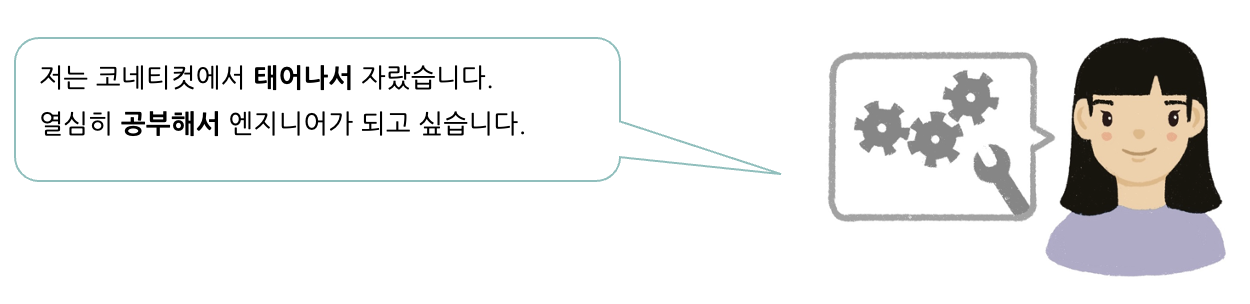
Review: A/V–아/어서 because
The sentence connector –서 connects to the –어/아 form of the verb and means something close to the English “having done …or since.”
| 한국 문화에 관심이 있어서 한국어를 배우기 시작했습니다. | I started to learn Korean since I got interested in Korean culture. |
–어서/아서 SEQUENTIAL
–어서/아서 is also used as the meaning of (having come/gone…) and then and there. Generally, when the verb before –어서 expresses movement, the second clause expresses not so much a reason/result relationship but instead what happened at the movement’s end or destination:
| 필리에 와서 새 친구를 많이 사귀었어요. | I came to Philly and made many new friends. |
The following verbs are typically used with this sentence connector:
| 가다 | 오다 | 일어나다 | 앉다 | 눕다 (to lie down) |
| 태어나다 | 자라다 | 졸업하다 | 만나다 | 사다 |
In fact, for verbs that show directional movement (가다, 오다, etc.) –어/아서 can only be used when there is an immediate temporal and spatial connection between going (or coming) to some place and the following action. If the place you go to is NOT the same place where you engage in an activity, you have to use the connector –고.
| A: 미라 씨, 오늘 뭐 해요? | What are you doing today, Mira? |
| B: 학교에 가서 공부해요. | I go to school and study (there). |
| B’: 학교에 가고 공부해요. | I go to school, and (I also) study (somewhere else). |
Clauses linked by –고 do not express any inherent connection between the events—no ordering and no reason–result. This applies to a series of past events as well:
| 어제 학교에 갔고 축구를 했어요. | I went to school and I played soccer (probably not at school). |
As you see in a sentence like 저는 도서관에 가서 공부했어요, –어/아서 does NOT conjugate for the past tense. Remember this!
연습 1. –아/어서
| (맛보기) |  |
⇒ | 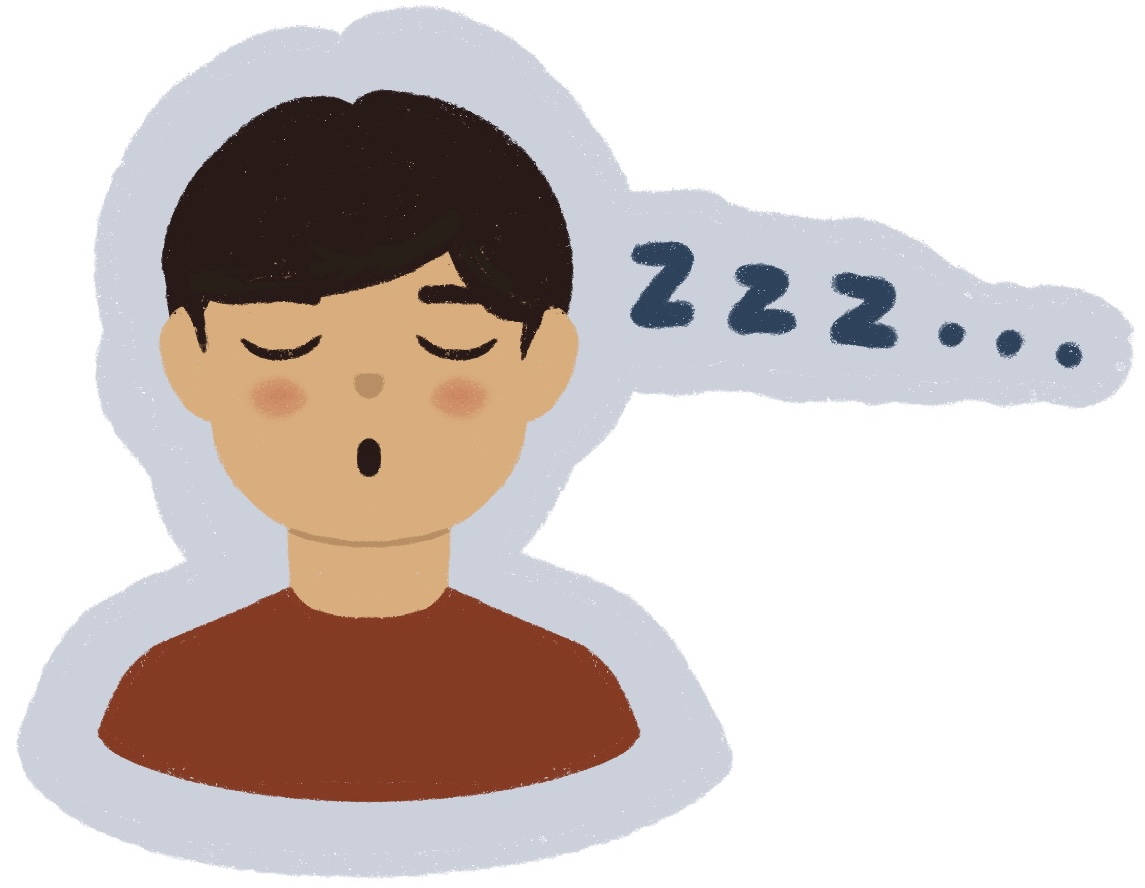 |
집에 가서 낮잠을 잤습니다. |
| 집에 가다 | 낮잠을 자다 | |||
| 1) | 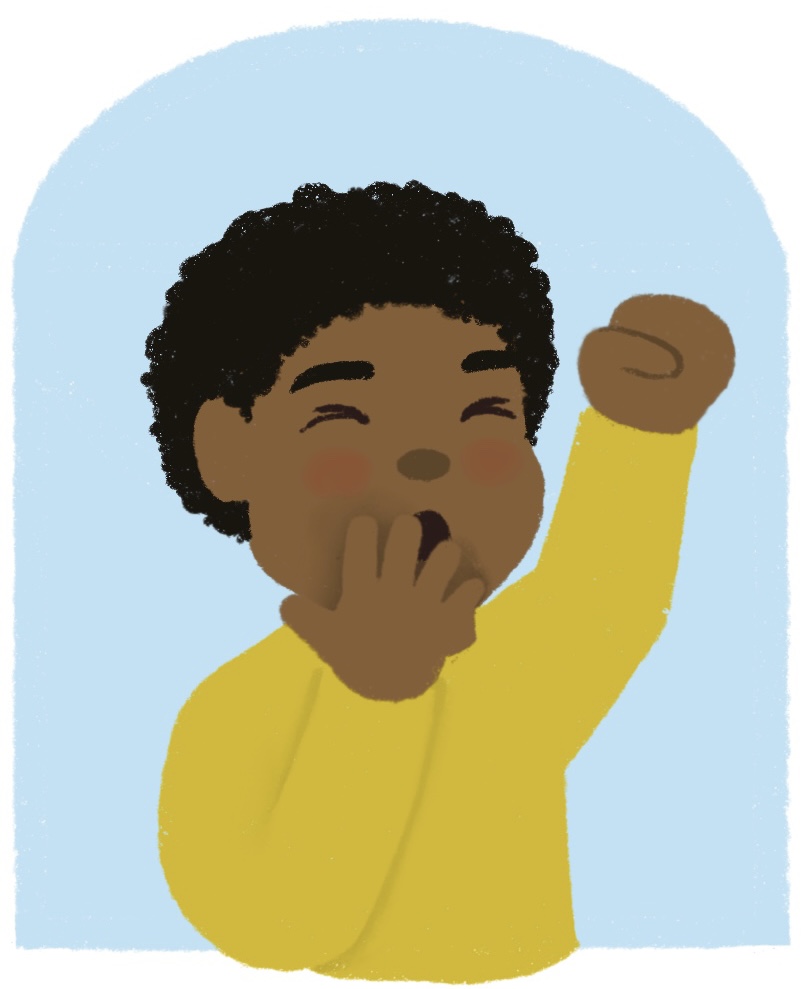 |
⇒ | 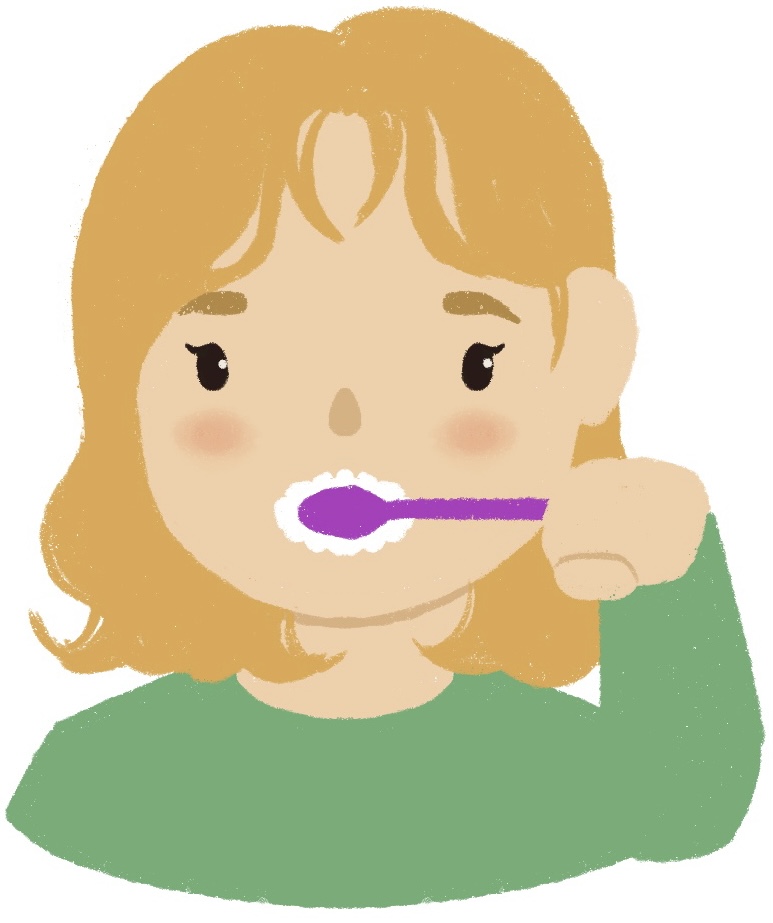 |
|
| 아침에 일어나다 | 이를 닦다 | |||
| 2) | |
⇒ | 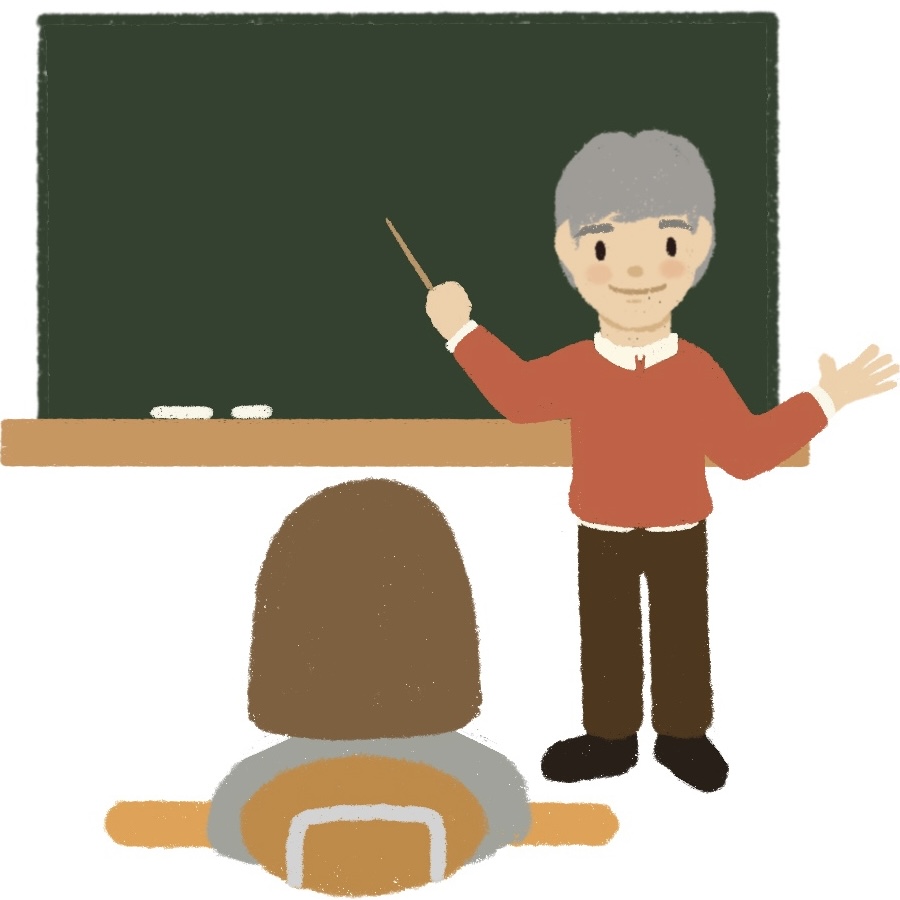 |
|
| 역사학을 전공하다 | 역사 선생님이 되다 | |||
| 3) |  |
⇒ |  |
|
| 학교에 오다 | 수업을 듣다 | |||
| 4) | 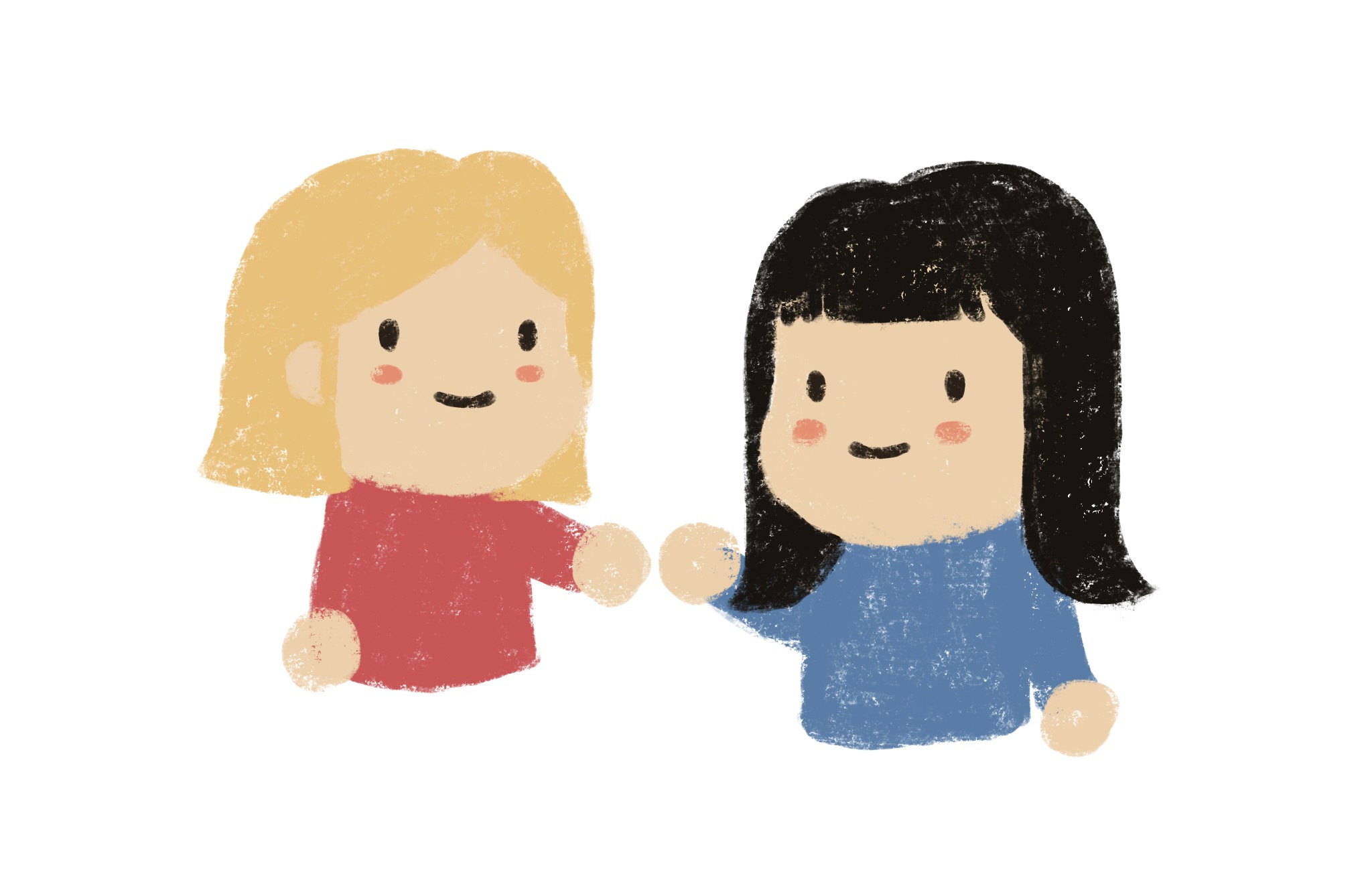 |
⇒ | 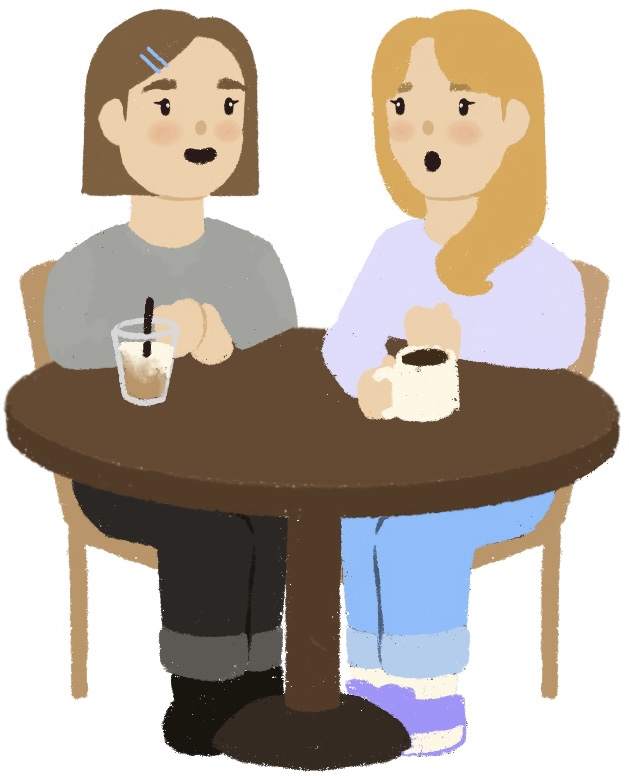 |
|
| 친구를 만나다 | 같이 시간을 보내다 | |||
| 5) | 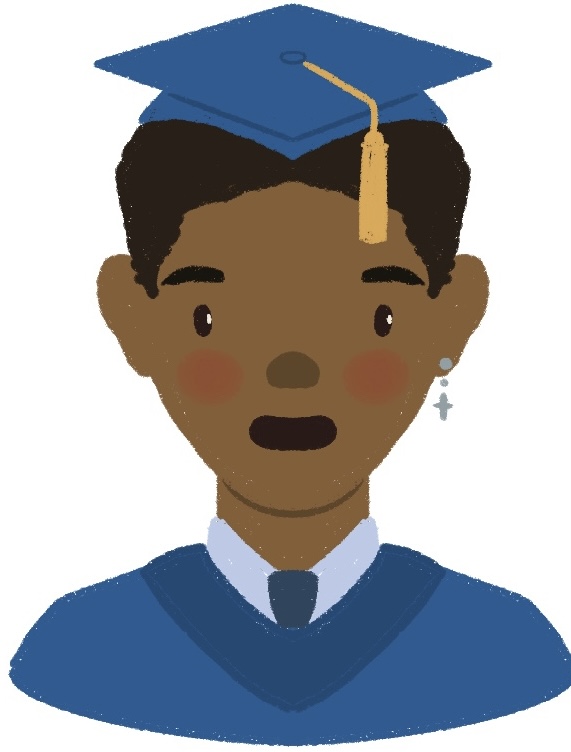 |
⇒ |  |
|
| 졸업하다 | 의사가 되다 | |||
| 6) | 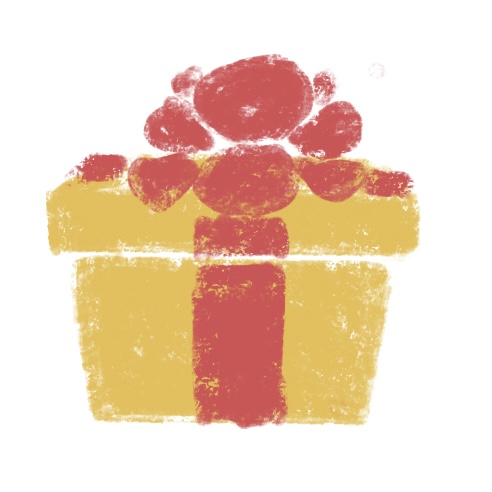 |
⇒ |  |
|
| 선물을 사다 | 친구에게 주다 |
낮잠: nap
연습 2. –아/어서
| (맛보기) 어제 아침에 일찍 (일어나다) / 숙제했어요. ⇒ 어제 아침에 일찍 일어나서 숙제했어요. |
연습 3. 지난 주말에 뭐 했어요?
What did you do last week? Answer the question “지난 주에 뭐 했어요?” with –아/어서. Say (and write) at least five sentences. Use the following verbs as much as possible.
| (돌아)가다 | (돌아)오다 | 일어나다 | 앉다 | 눕다 (to lie down) |
| 만나다 | 요리하다 | 만들다 | 만나다 | 사다 |
| (맛보기) 저는 지난 주에 학교 수영장에 가서 수영했습니다. | 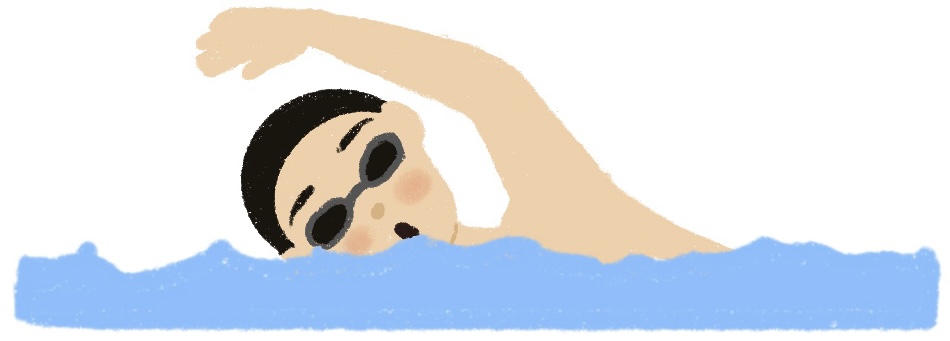 |
__________________________________________________________________________.
__________________________________________________________________________.
__________________________________________________________________________.
__________________________________________________________________________.
__________________________________________________________________________.
연습 4.
Talk about yourself using –아/어서 (sequential events) as shown in the example.
| (맛보기) 태어나다: 저는 세인트 루이스에서 태어나서 자랐습니다. |  |
- 태어나다
- 한국어를 배우다
- 대학교에 오다
- 전공하다
- 학교를 졸업하다
- 취직하다
- 돈을 많이 벌다
- Your own
3. V–기 시작하다 Decide to; Start to
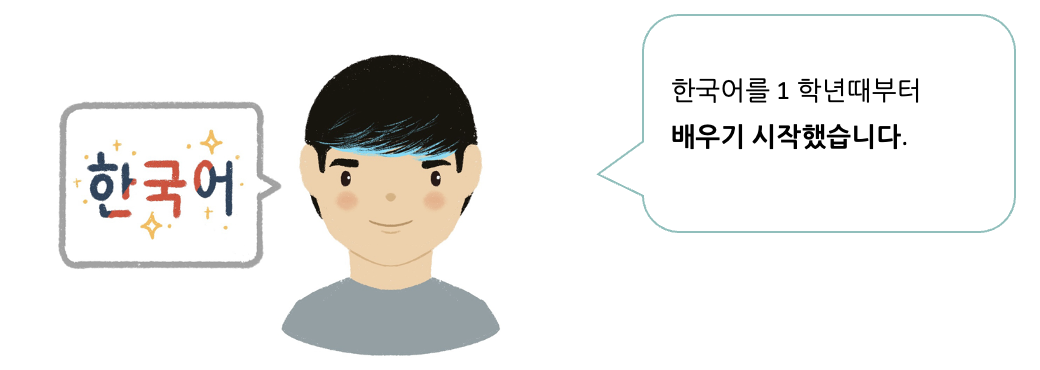
Review: A/V–기
In Book 2, you learned 기 to be a nominalizer that enables verbs (or occasionally adjectives) to work like nouns in a sentence. You saw –기 전에 as an example:
| 학교를 졸업하기 전에 한국어 수업을 많이 듣고 싶습니다. | Before graduating from school, I would like to take many Korean classes. |
–기 is also used idiomatically before such adjectives as 쉽다, 어렵다, 힘들다, and 싫다.
| 이 스마트폰은 쓰기(가) 쉽습니다. | This smartphone is easy to use. |
| 요즘 취직하기(가) 어렵습니다. | It is difficult to get a job these days. |
V–기(를) 시작하다 start VERBing
Another useful expression to learn is –기 시작하다, which means to start VERBing. The –기 turned nouns can take case particles just like regular nouns.
| 16 살때부터 운전하기(를) 시작했습니다. | I started to drive at 16. |
| 웨이는 이번 학기부터 컴퓨터 공학을 전공하기(를) 시작했습니다. | Wei started majoring in Computer Engineering this semester this semester. |
연습 1. -기 시작하다
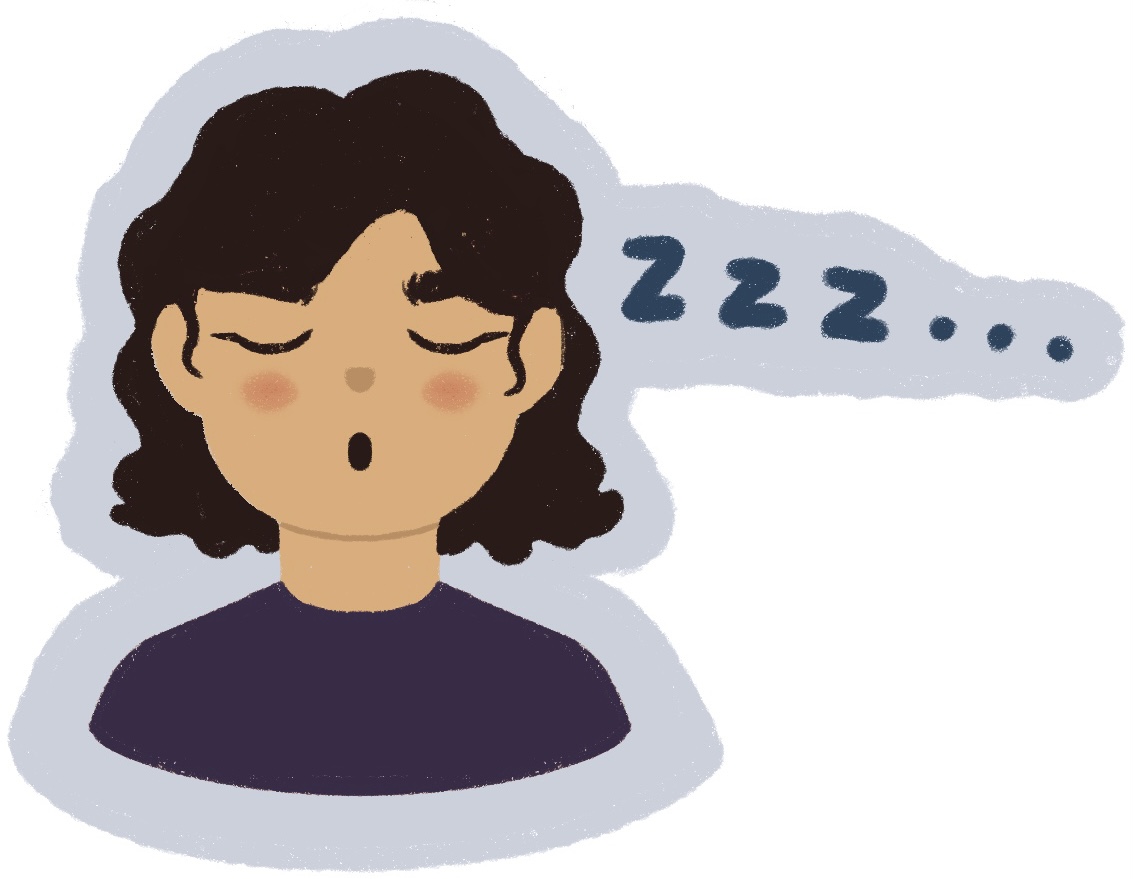
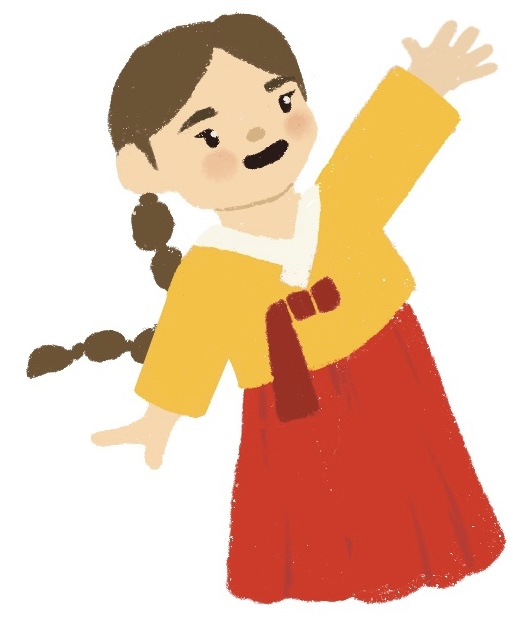
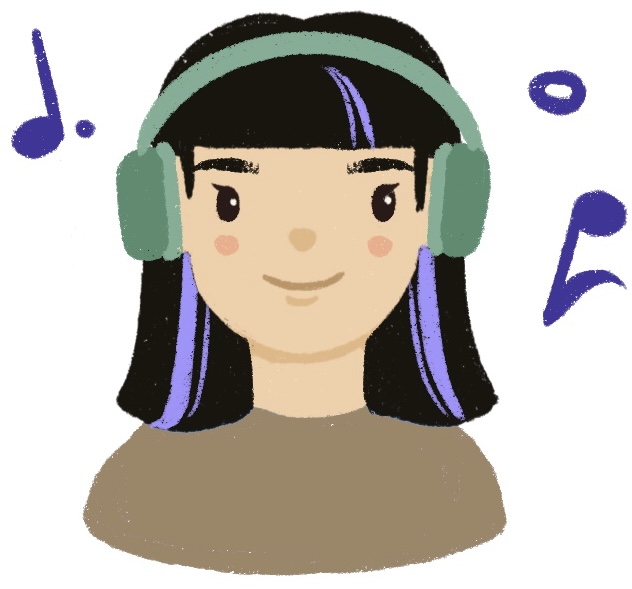
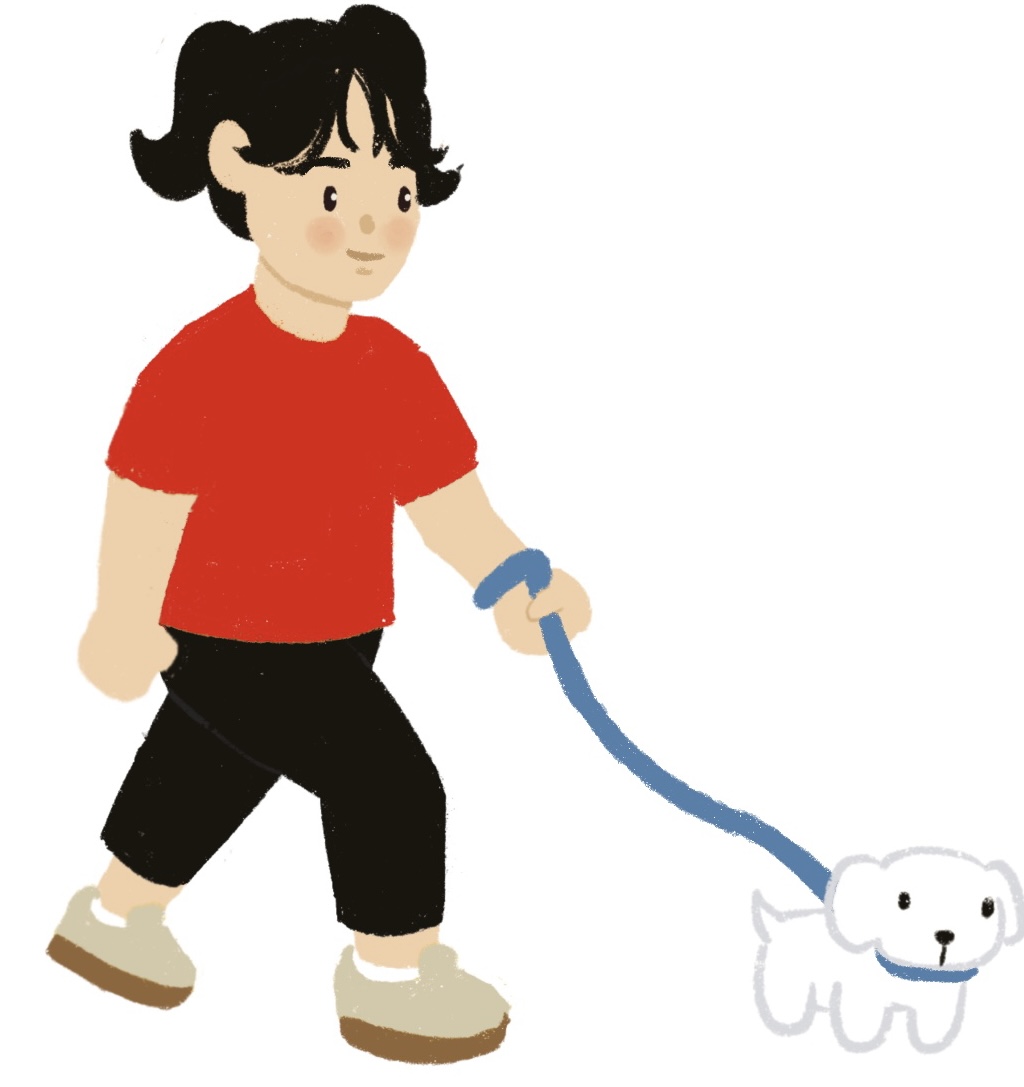
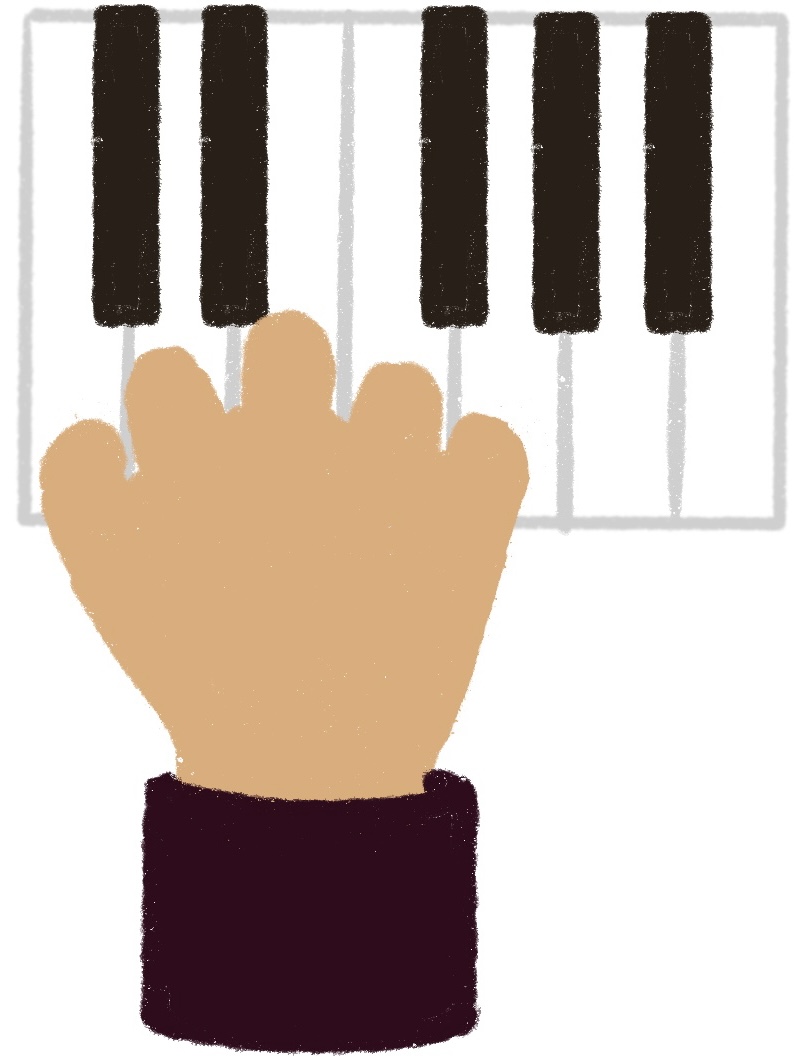
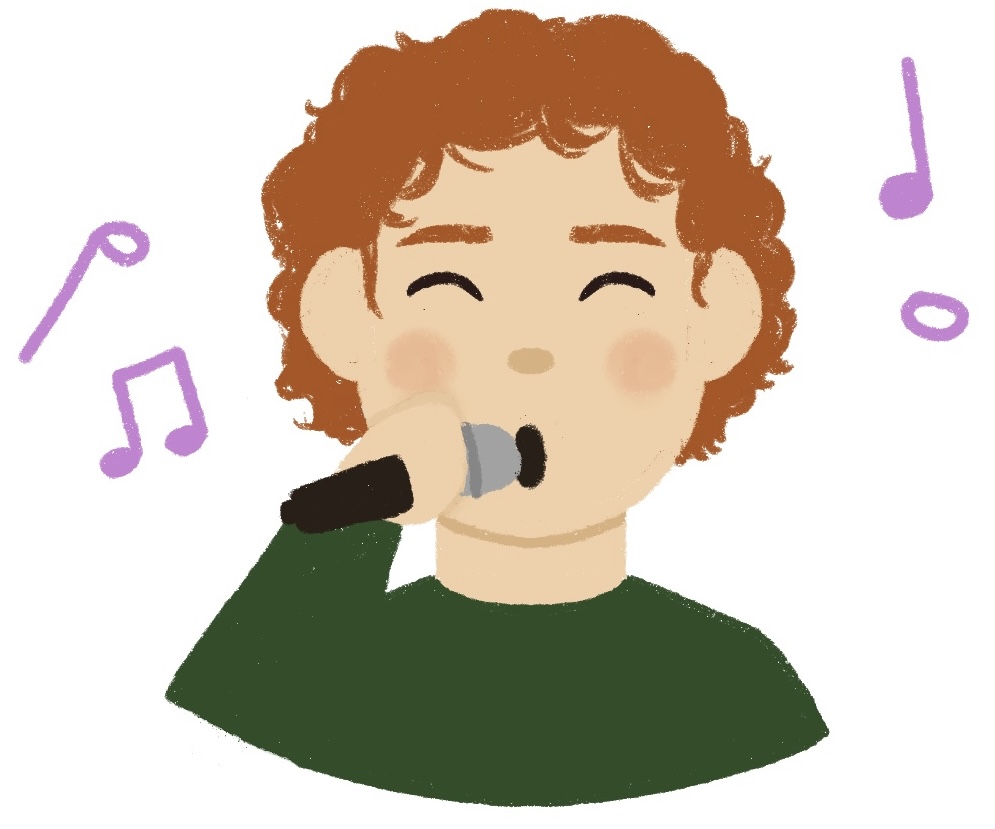
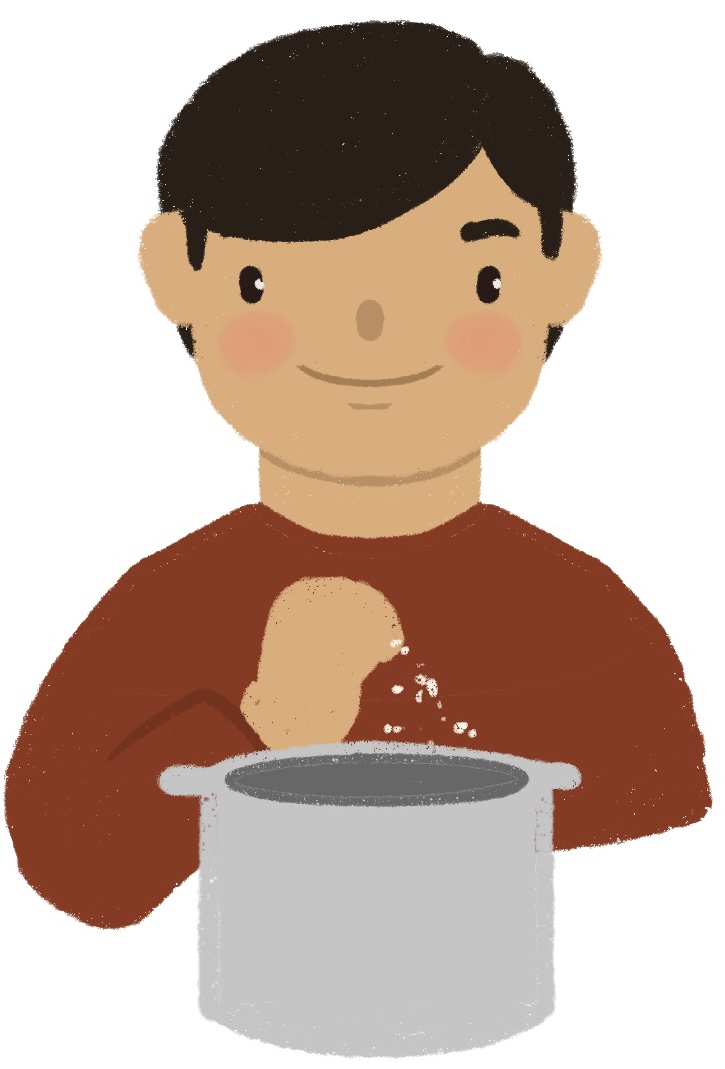
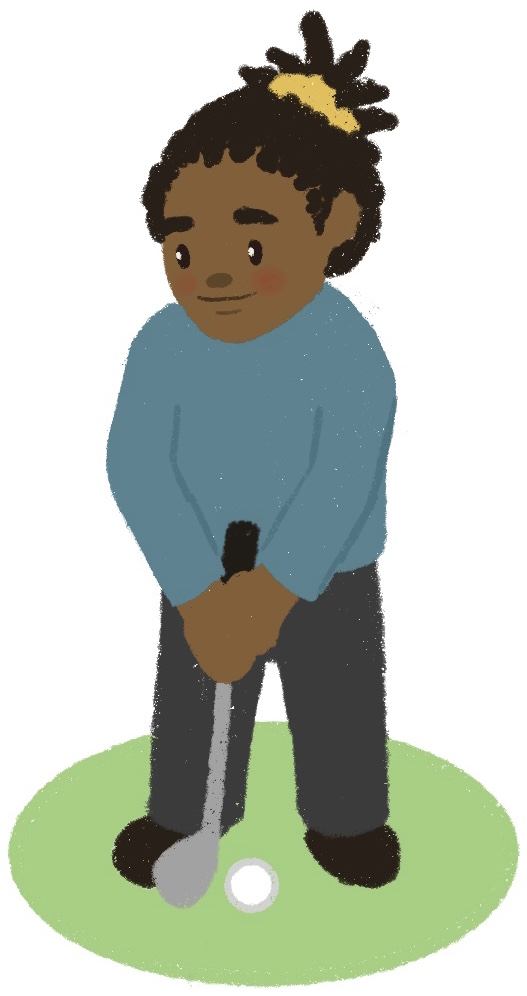
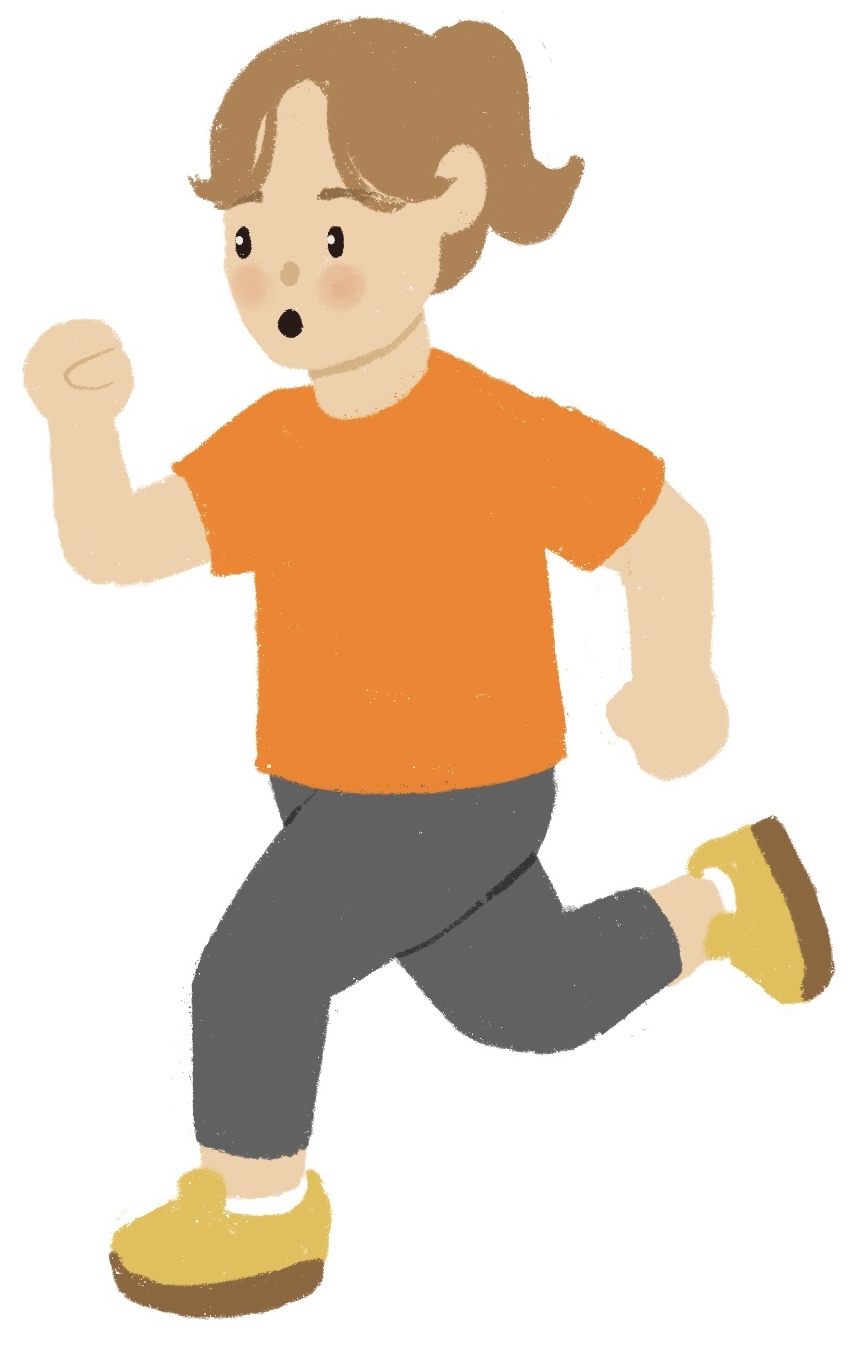
뭐 하기 시작했어요? Work with a partner and ask and answer what the person in the picture started doing.
| (맛보기) (숙제하다)
(맛보기) 가: 미류는 뭐 하기 시작했어요? (맛보기) 나: 숙제하기 시작했어요. |
|
 |
 |
 |
 |
 |
| 1) 지수 | 2) 사라 | 3) 보라 | 4) 수빈 | 5) 건우 |
 |
 |
 |
 |
 |
| 6) 빈 | 7) 해진 | 8) 쿠안 | 9) 해나 | 10) 다영 |
연습 2. -기 시작하다
Work with a partner. Ask your partner when the following people started doing the given actions using –기 시작하다.
| (맛보기) (여동생 – 컴퓨터 공학을 전공하다– 지난 봄)
가: 여동생은 언제부터 컴퓨터 공학을 전공하기 시작했습니까? 나: 지난 봄부터 전공하기 시작했습니다. |
- (호세 – 회사에 나가다 – 지난 3월)
- (형 – 취직시험을 준비하다 – 지난 학기)
- (룸메이트 – 랩 공연을 하다 – 일년 전)
- (알리사 – 한국어 2급 수업을 듣다 – 이번 학기)
- (나탈리아 – 한국 역사를 전공하다 – 작년)
- (웨이 – 매일 아침 6시에 일어나다 – 삼년 전)
- (세라 – 필라델피아에 살다 – 어렸을 때)
- (나 – 대학원에 다니다 – 2주 전)
랩 공연: rap performance
급: level
연습 3. -기 시작하다
Work with a partner. Ask your partner when the following people started doing the given actions using –기 시작하다.
| (맛보기) [한국어를 배우다]
가: 한국어를 배우고 있습니까? 가: 그럼 언제부터 한국어를 배우기 시작했습니까? |
나: 네, 배우고 있습니다. 나: 일년 전부터 배우기 시작했습니다. |
- 한국어를 배우다
- 운전하다
- 요리하다
- 아르바이트하다
- 한국 음악을 듣다
- 식물을 키우다
- (musical instrument/sports) 배우다
- Make up your own!
연습 4. 종합연습 Role Play
Create a role play with your partner using the key grammar expressions and new vocabulary from this lesson. Include 5 to 6 meaningful rounds of dialogue. Take turns and feel free to add details to make the conversation lively.
- Context: An exchange student is meeting their buddy for the first time at an orientation meeting for new international exchange students. Greet each other warmly and exchange personal information.
- Participants: A new exchange student and their buddy at the university in Korea.
- Key Expressions: –(스)ㅂ니다, –아/어서 sequential actions, –기 시작하다
- Sample dialogue:
 |
 |
 |
 |
Interpretive Task 1. 듣기 Listening
Jina just saw Isaac at the school cafeteria and started having a brief conversation. Listen to the dialogue and answer the following questions in Korean.
1. How does Jina know Isaac?
2. Introduce Jina based on the dialogue. Write as much as you heard.
3. Introduce Isaac based on the dialogue. Write as much as you heard.
4. What did Jina suggest and how did Isaac respond?
Helpful Vocabulary
동갑: same age
Interpretive & Interpersonal Task 2. 읽기 Reading
안녕하십니까? 제 이름은 이지훈이라고 하고, 스무 살입니다. 한국 서울에서 왔습니다. 한국에서는 서연대학에서 경제학을 전공하고 있습니다. 올해에 3학년이 되는데 이번 학기에 교환학생으로 와서 영어를 배우고 있습니다. 앞으로 1년 동안 친구들도 많이 사귀고 싶고, 다양한 수업들도 들어보고 싶습니다. 그리고 아시아 문화 동아리에도 가입해서 활동하기 시작했습니다. 한국에 돌아가서 졸업 후에 무역회사에서 일할 수 있으면 좋겠습니다.
| Helpful Vocabulary | |
| 다양하다 to be various | 활동하다 to act, to work, to be active |
| 무역회사 trade company | 가입하다 to join (clubs, etc.) |
add h5p
Interpersonal & Presentational Task 3. 말하고 발표하기
New Member Recruitment
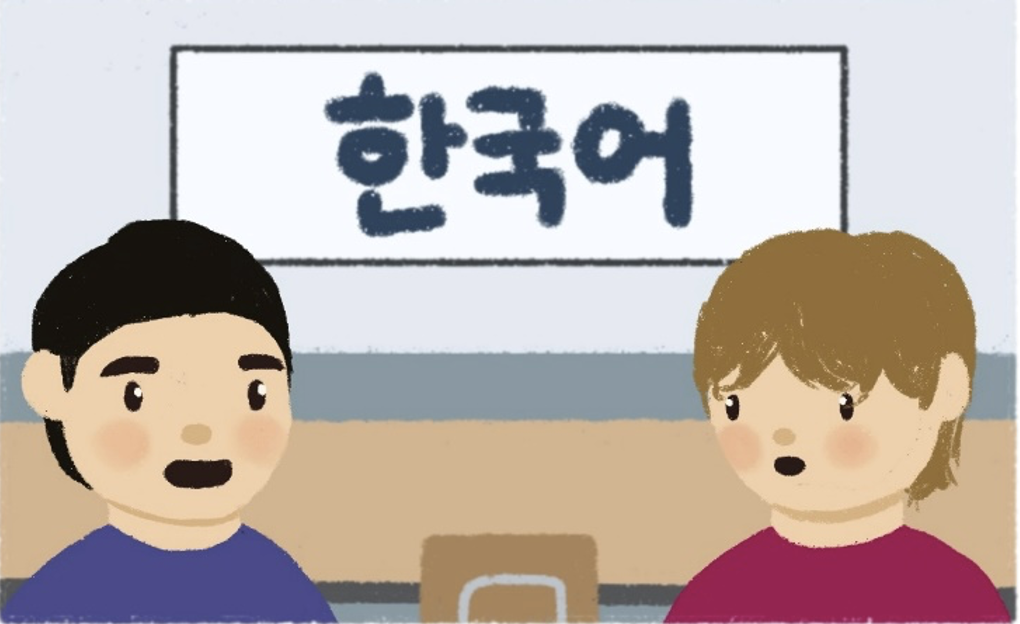
The Korean Cultural Center in your local community is recruiting members. You are a board member of this organization and assigned to conduct interviews. Meet two member candidates and ask them questions. Then present an introduction about each person you interviewed to the board members.
Language Point: Three basic ending types for verbs and adjectives
Reflecting on what you learned from Books 1 and 2, you should notice that there are 3 basic kinds of verb/adjective endings:
(1) Those that take the –아/어 stem (usually memorized with –아/어 as part of the ending), such as –아/어서, –아/어요. We will refer to these endings using the 어–based version (e.g. –어서). You will need to remember that the initial –아/어 harmonizes with the preceding verb root’s vowel.
(2) Those that start with –으, which drops out sometimes (e.g. –(으)면, –(으)니까, –(은)데). We will not put the 으 in parentheses henceforth – you will need to remember when 으 drops out.
(3) those that start with a consonant (e.g. –고 나서, –지만, –네, –는데). Some endings are final and come at the end of the sentence (e.g. –어요, –네, –지), and others connect clauses (e.g. –고 나서, –으니까). We’ll call the former type sentence endings and the latter type connectors. There is a set pattern to how each type of verb or adjective conjugates, meeting different endings and connectors. Fill in the chart and see what generalizations you can make. See what patterns you have learned well, have intuitions about, OR… need to practice some more! Read the following sentences, rewrite the connectors and endings used in the underlined parts, and label them as (아/어–type), (으–type), or (Consonant–type).
- 오늘은 날씨가 나빠서 하루 종일 집에 있을 거예요.
- 여름에는 비행기 표가 비싸니까 봄이나 가을에 여행을 하자.
- 시애틀은 겨울에 춥지 않지만 비가 많이 와요.
- 다리가 아프기 때문에 더 걸을 수 없어요.
- 경치가 너무 좋네요!
- 한국어를 잘 하고 싶으면 매일 한국어 연습을 해야 돼요.
- 내일 시간이 있을 때 웹에서 싼 비행기 표를 알아 볼게요.
- 겨울에 알라스카에 가는데 너무 춥지 않을까요?
- 내일파티에가서재미있게놀래요!
Culture Guide
첫 만남 FIRST MEETING
If you are studying Korean, you must be planning to meet Korean people and introduce yourself. What do they want to know about you – and when – and how will you interact and get to know them? These are difficult questions to answer, but a few cultural differences should be considered.
Most of the same basic questions will be asked and answered during introductions; your name, hometown, college or university and major, and hobbies. You may be more surprised about how directly or suddenly you are asked about your marital and dating status or age. These points are relevant to determine your place in the social hierarchy that dictates how you should interact with others. They also provide topics for conversation.
You might be asked:
무슨 띠세요? What is your sign?
00000(in the Chinese zodiac, where the signs are arranged in a cycle of twelve years)
– 몇 학번이세요? /학번이 어떻게 되세요? What (college entering) class are you? or What is your student number?
The next point to determine might be whether or not you are married, partly because general terms of address (아줌마 and 아저씨) are based at least partly on marital status. It is acceptable to date in public and to talk about dating, but expectations about marriage are still relatively conservative – one is expected to marry (the opposite sex) by a certain age, and have children.To round out an understanding of your social standing, it will be important to know your schooling background.
– 학교는 어디 나오셨어요?/다니셨어요? What college did you attend?
– 전공이 어떻게 되세요? 0000000000000-What was your major?
– 실례지만 무슨 일 하세요? 00000000-0_-Where do you work?
Once you have started to get to know a person, you will determine together how you will address each other, starting out with the level of formality that your ages and stations in life dictate, and moving to less formal speech styles as you become more friendly. This is a tricky social tango in Korean, but here are some examples to get you started thinking about it (you may want to discuss these with a language partner or other Koreans)”A professor will use _____________ while teaching, but in office hours, with an individual student, might use ________________.Colleagues (at a bank, for example), will use __________________ at work, _______________ during meetings but then _______________ if they go out for drinks after work.A younger student will use ____________ toward an older student, but the older student might answer using ________________.
There is a system of asking to speak more casually as well. It may be surprising that it is the socially LOWER person in a relationship who will suggest that the HIGHER person speak more casually or easily: 말씀 놓으세요./말씀 편하게 하세요. It may not be appropriate to ask this during the first meeting, but these days it is generally welcomed as a respectful gesture; it is as though the lower person is simultaneously humbling him/herself and being friendly (You needn’t speak formally with me; please do whatever is easiest for you).
In a relationship between peers becoming friends, one would say 우리 말 놓을까요? /우리 말 놓자, at which point one might still continue to mix polite and plain forms for some time. If you don’t really like a person, you can use language to show this and maintain a more distanced relationship by continuing to use –요!
Of course it all depends on the individual and the social situation –– some people have a tendency to be very friendly, casual, intimate or blunt and others more arm’s–length. At the same time, it is generally NOT acceptable to speak in 반말 in an office situation, no matter how friendly you might be outside the workplace.1r
할 수 있어요! I Got This!
Check to see if you can do the following:
- Introduce myself in the formal speech style.
- Share my personal information and background.
- Ask and answer questions about basic personal information.
| Listening Script
주디: 안녕하세요? 우리 어제 모임에서 봤지요? 이삭: 네, 안녕하세요? 저는 이삭 스미스라고 합니다. 만나서 반갑습니다. 주디: 저는 주디 왕이라고 합니다. 미국 필라델피아 대학에 다니고 있고 2학년입니다. 이번에 한국대에 교환학생으로 왔어요. 만나서 반갑습니다. 이삭: 아, 네, 저도 교환학생입니다. 호주 멜버른에서 왔습니다. 주디: 와, 한국어를 아주 잘하시네요…. 한국어를 얼마 동안 배우셨어요? 이삭: 고맙습니다. 한국 문화에 관심이 있어서 작년부터 배우기 시작했습니다. 주디 씨도 한국어 잘하시는데요. 주디: 아, 고맙습니다! 이삭 씨는 몇 학년이세요? 이삭: 2 학년입니다. 주디 씨는 나이가 어떻게 되세요? 주디: 저는 열아홉 살이에요. 이삭: 저도요. 동갑이네요! 주디: 네! 다음 주에 교환 학생 모임 있는데 같이 갈까요? 이삭: 네, 좋습니다! 제 전화번호 드릴게요. 전화 주세요. |