Main Body
1 Lesson 11: 한국에 가고 싶어서 열심히 공부해요.
학습 목표 Goals
By the end of this lesson, you will be able to:
- Ask and answer questions about wishes and plans for a new year.
- Ask and answer “why” questions.
- Talk about sequences of events and activities.
들어가기 Setting Up
Lesson Focus
- INGREDIENTS – 단어 Vocabulary
- New Year’s plan
- RECIPE – 문법과 표현 Grammar
- V–고 싶다
- A/V–아/어서
- V–기 전에
- LET’S COOK – 해봐요! Classroom Tasks
- 듣기 Listening
- 읽기 Reading
- 말하기 Speaking
- KOREAN FLAVORS – 한국어와 한국 문화 Korean Language and Culture
- Language point: 되다 Idioms
- Culture: New Year’s resolutions in Korea
- I GOT THIS! – 할 수 있어요!
- Check to see if you can do the following
- Listening script
- NOW YOU TRY! – 스스로 해봐요! Async. Practices and Tasks
짝하고 얘기해 봐요! Share your thoughts!
What are your new year’s (or new semester’s) resolutions? How about your classmates?
Now let’s read these two dialogues. What are they talking about?
 |
 |
|
|
|
In this lesson, you will learn how to express your wishes and sequential events.
새해 계획 New Year’s Plan
 |
 |
 |
 |
 |
| 가족하고 시간을 보내다 | 건강해지다 | 새 친구를 사귀다 | 수업을 듣다 | 열심히 공부하다 |
| to spend time with family | to become healthy | to make new friends | to take a class | to study hard |
 |
 |
 |
 |
 |
| 외국어를 배우다 | 유학(하다)/유학을 가다 | 인턴십(하다) | 한국어를 잘하다 | K-pop 콘서트에 가다 |
| to learn a foreign language | to study abroad | to do an internship | to speak Korean well | to go to a K-pop concert |
새 단어와 표현 New Vocabulary and Expressions
| 계획 | plan | 보내다 | to spend, to send |
| 디저트 | dessert | 연습(하다) | to practice |
| 문자 | text | 아프다 | to be sick |
| 새해 | new year | 새 | new |
| 순두부찌개 | spicy tofu stew | 꼭 | definitely |
| 여름 | summer | 늦게 | late |
| 표 | ticket | 열심히 | hard, diligently |
| 되다 | to become | 일찍 | early |
| 물론이죠. | Of course. | 잘됐어요. | Whew! Just in time. Good for you. |
| 새해 복 많이 받으세요. | I wish you a lot of luck in the new year (Happy New Year). | 잠깐만요. | Wait a minute. |
단어 메모지 Vocabulary Notes
1. 되다 to become, to be satisfactory
The verb 되다 means to become (in the sense of to turn into) and is typically used with 이/가:
| 새해가 됐어요! | It’s a new year! (Lit., it has become a new year!) |
The written conjugation form of 되다 is 되어요, but you will see the contracted form 돼요 (just like the first syllable of the word pig 돼지), and no one says 되어요 in spoken Korean.
| 우리는 친구가 됐어요. | We have become friends. |
The following idiom with 되다 is frequently used in everyday life:
| 잘 됐어요! | Whew! Just in time! Good for you! |
2. 사귀다 to make friends with, to go out with
We learned that the English word to play corresponds to different Korean words depending on its meaning:
| 게임을 하다 | to play games |
| 피아노를 치다 | to play the piano |
Likewise, “to make” can be translated into several Korean words and one of them is 사귀다 to make friends, to go out with.
| 새 학기에 친구를 많이 사귀었어요. | I made many friends in the new semester. |
3. 유학 and 여행 study abroad and travel
유학 and 여행 can be paired with either 가다 or 하다. Remember to select the appropriate particle accordingly, as shown below:
| 한국에서 여행하다 | to travel within Korea |
| 한국에 여행가다 | to go on a trip to Korea |
| 한국에서 유학할 거예요. | I will be studying abroad in Korea. |
| 한국에 유학갈 거예요. | I am going to study abroad in Korea |
발음 가이드 Pronunciation Guide
사귀어요
As you might have noticed, Korean words are not always pronounced as they are spelled in writing. For example, when people say 사귀어요, the 귀어 part is pronounced as [겨] to simplify.
사귀어요 [사겨요]
사귀었어요 [사겼어요]
사귈 거예요 [사귈 꺼에요/사길 꺼에요]
단어 연습 Vocabulary Exercises
연습 1. New Vocabulary and Expressions
Fill in the blanks to complete each sentence and make it true.
(맛보기) 저는 __________에서 새 친구를 사귀어요.
(맛보기) 저는 수업에서 새 친구를 사귀어요.
1. 저는 ___________에서 새 친구를 사귀어요.
2. 저는 ___________ 드라마를 봐요.
3. 저는 __________에 여행갈 거예요.
4. 저는 __________하고 시간을 보내요.
5. 저는 __________을/를 열심히 공부해요.
6. 저는 __________웹사이트에서 콘서트 표를 사요.
7. 이번 학기에 저는 ___________ 수업을 들어요.
연습 2. New Vocabulary and Expressions
Take turns with your partner asking what your partner will be doing this spring/summer break.
(맛보기) 가: 봄/여름 방학에 여행갈 거예요?
(맛보기) 나: 네, 갈 거예요./ 아니요, 안 갈 거예요.
| 네 | 아니요 | |
| 1. 여행가다 | ||
| 2. 인턴십하다 | ||
| 3. 친구하고 외식하다 | ||
| 4. K-pop 콘서트에 가다 | ||
| 5. 한국 드라마를 보다 | ||
| 6. 새 친구를 사귀다 | ||
| 7. 열심히 한국어를 공부하다 | ||
| 8. 시험을 보다 |
1. V–고 싶다

1. V–고 싶다 want to V
In this lesson, you will learn how to use –고 싶다 to mean want to, where –고 connects a main verb to the helping verb 싶다. Adjectives cannot be used with –고 싶다, only verbs. –고 싶어요 expresses a long-standing desire, wish or hope.
| 저는 새 친구를 사귀고 싶어요. | I want to make new friends. |
| 새해에는 새 외국어를 배우고 싶어요. | I want to learn a new foreign language in the new year. |
| Odd but true! space The following sentence are used interchangeably with the sentence above. What is different? space 저는 새 친구가 사귀고 싶어요. space 새해에는 새 외국어가 배우고 싶어요. |
2. V–고 싶어하다 (she/he/they) want to V
In the Korean language, talking about someone else’s feelings or desire is NOT possible. To describe someone else’s desire, another phrase (–고 싶어하다) should be used instead of –고 싶다.
| 언니는 한국 회사에서 인턴십하고 싶어해요. | My older sister wants to do an internship at a Korean company. |
| NOTE The obvious negative form 언니는 문학을 안 전공하고 싶어해 sounds childish. You will learn another way to express negative wishes in a later chapter. Also, the expression –고 싶다 cannot be used to mean I want a NOUN; for this you must use 원하다 (to want (a NOUN)), or 갖다 (가지다) plus –고 싶다 (갖고 싶다: to want to have): 갖고 싶어요. |
3. Conjugation Practice
Complete the following table with the appropriate –고 싶다 form.
| Dictionary Form | –고 싶다 | Dictionary Form | –고 싶다 |
| 보내다 | 보내고 싶다 | 놀다 | 놀고 싶다 |
| 배우다 | 유학하다 | ||
| 걷다 | 사귀다 | ||
| 쓰다 | 치다 |
<Answer key> 배우고 싶다, 유학하고 싶다, 걷고 싶다, 사귀고 싶다, 쓰고 싶다, 치고 싶다
연습 1. –고 싶다
Complete the dialogues using –고 싶다.
(맛보기) 가: 지금 뭐 하고 싶어요?
(맛보기) 나: 자고 싶어요.
 |
 |
 |
 |
 |
|
| 지금 | 지금 | 저녁에 | 한국에서 | 방학에 | 주말에 |
| 자고 싶어요. |
연습 2. –고 싶다
Seyoung is daydreaming about things she would like to do. Based on the table, construct sentences expressing her wants and then compare them to yours.
| Wishes | Seyoung | I |
| Go to Hawaii | 세영은 하와이에 여행 가고 싶어해요. | 나도 하와이에 가고 싶어요. or 나는 하와이에 안 가고 싶어요. |
| Make new friends | ||
| See a movie with friends | ||
| Spend time with her family | ||
| Sleep early and get up late | ||
| Meet K-pop stars1 | ||
| Live in Korea |
1 K-pop star: 케이팝 스타
연습 3. –고 싶다
Ask your partner what they want to do using the following sentence-openers. When your partner gives you a response, you should add what YOU would like to do. Use some of the expressions suggested below.
(맛보기) 봄 방학에…
(맛보기) 가: 봄 방학에 뭐 하고 싶어요?
(맛보기) 나: 한국에 여행가고 싶어요.
(맛보기) 가: 아, 그래요? 저도 한국에 여행 가고 싶어요. 그리고 저는 멕시코에도 여행가고
(맛보기) 싶어요.
Suggested Activities: 외식하다, 외국어를 배우다, 인턴십하다, 유학하다/가다, 여행하다/가다, 열심히 공부하다, 새 친구를 사귀다, 운동하다, 가족하고 시간을 보내다, etc.
1. 주말에
2. 올해에
3. 다음 학기에
4. 졸업하고
5. 여름 방학에
6. 이번 생일에
2. A/V–아/어서
1. A/V–아/어서 because
You learned to how to connect two sentences using the connectors –고 and –지만. 그래서 also corresponds to the connector –서, which can be attached to the 어/아 form of a verb or adjective to indicate a logical precedent for the following action.
| 다음 주 월요일에 시험을 봐요. 그래서 주말에 공부를 많이 해요. | There is a test next Monday, so I am studying a lot this weekend. |
| 다음 주 월요일에 시험을 봐서 주말에 공부를 많이 해요. |
Here are a few more examples:
| 늦어서 죄송합니다. | I am sorry that I am late. |
| 아파서 콘서트에 못 가요. | I cannot go to a concert because I am sick. |
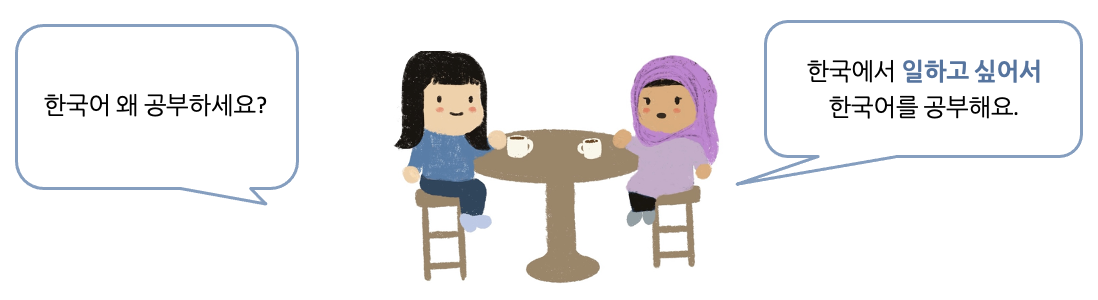
–아/어서 is often used to provide reasons to answer “왜” questions.
| 가: 왜 한국어를 공부해요? | Why do you study Korean? |
| 나: 한국에서 일하고 싶어서 공부해요. | Because I want to work in Korea, I study Korean. |
Remember to conjugate the verb in the –아/어 form to add the connector –아/어서!
| Dictionary Form | 어/아 Form | Final Form | Example |
| 먹다 | 먹어 | 먹어서 | 점심을 안 먹어서 배고파요. I am hungry because I did not eat lunch. |
| 걷다 | 걸어 | 걸어서 *ㄷ–irregular verbs convert their ㄷ to ㄹ AND use the full ending. |
|
| 살다 | 살아 | 살아서 | |
| 보다 | 봐 | 봐서 | 어제 장을 봐서 오늘 냉장고에 음식이 많아요. I went grocery shopping yesterday, so I have a lot of food in my fridge today. |
| 아프다 | 아파 | 아파서 | |
| 하다 | 해 | 해서 | |
| N 이다 | N(이)라 | N(이)라서 *The verb 이다 has alternate forms for this suffix. |
학생이라서 돈이 없어요. I don’t have money because I am a student. |
2. A/V–어/아서 Past tense
When sentences are connected with the shortened marker –아/어서, the past tense/perfective marker ㅆ can only be used in the sentence-final verb or adjective. That is, a verb can’t be in the past tense with –아/어서.
| 어제는 시험이 두 개 있었어요. 그래서 바빴어요. | I was busy because I had two tests yesterday. |
| ⇒ 어제는 시험이 두개 있어서 바빴어요. |
| 세영은 운동을 매일 했어요. 그래서 건강해졌어요. | Seyoung worked out every day, so she became healthy. |
| ⇒ 세영은 운동을 매일 해서 건강해졌어요. |
3. Conjugation Practice
Complete the following table with the appropriate –아/어서 form.
| Dictionary Form | –아/어서 | Dictionary Form | –아/어서 |
| 보내다 | 보내서 | 놀다 | 놀아서 |
| 배우다 | 유학하다 | ||
| 걷다 | 사귀다 | ||
| 쓰다 | 치다 |
<Answer key> 배워서, 유학해서, 걸어서, 사귀어서, 써서, 쳐서
연습 1. –아/어서
연습 2. –아/어서
연습 3. –아/어서
Answer these why questions using –아/어서 as shown in the example.
(맛보기) 가: 왜 커피를 안 마셔요? (밤에 못 자다)
(맛보기) 나: 밤에 못 자서 안 마셔요.
1. 왜 늦게 일어났어요? (어제 12시에 잤어요)
2. 왜 열심히 운동해요? (건강해지고 싶다)
3. 왜 어제 학교에 안 왔어요? (어제 아팠다)
4. 왜 한국어를 배워요? (한국 음악을 좋아하다)
5. 왜 오늘은 안 걸어요? (어제 많이 걸었다)
6. 왜 전화했어요? (친구 생일이다)
3. V–기 전에

1. –기 a Nominalizer
We learned that the suffix –기 makes verbs and adjectives function like nouns.
| 자전거 타기는 어려워요. | Riding a bicycle is difficult. |
| 요리하기는 쉬워요. | Cooking is easy. |
| 저는 말하기는 잘 하지만 쓰기는 잘 못 해요. | I am good at speaking but not very good at writing. |
Can you change the following expressions into –기 forms?
 |
 |
|
|
|
| 새 친구를 사귀다 | 외국어를 배우다 | 음악을 듣다 | 한국에서 유학하다 | 열심히 공부하다 |
2. –기 전에 before
기 전에 is a phrase that attaches to a verb stem to mean before VERB-ing. Add –기 전에 to the root of the verb (without 어/아!) whether it ends in a consonant or a vowel.
| 밖에 나가기 전에 점심 먹어요. | Before going outside, I eat lunch. |
| 점심 먹기 전에 숙제를 해요. | Before eating lunch, I do my homework. |
| 한국에 유학가기 전에 한국어를 열심히 연습할 거예요. | Before going to study abroad in Korea, I will work hard to practice Korean. |
When a whole sentence with its own subject is used, –기 전에 means ‘before (someone/something) VERBs’:
| 수업이 끝나기 전에 숙제 내세요! | Before class ends, turn in your homework! |
3. Conjugation Practice
Complete the following table with the appropriate –기 전에 forms.
| Dictionary Form | –아/어서 | Dictionary Form | –아/어서 |
| 타다 | 타기 전에 | 먹다 | 먹기 전에 |
| 배우다 | 보다 | ||
| 걷다 | 마시다 | ||
| 쓰다 | 만들다 |
<Answer key> 배우기 전에, 보기 전에, 걷기 전에, 마시기 전에, 쓰기 전에, 만들기 전에
연습 1. –기 전에
Ask and answer questions using –기 전에 as shown in example 맛보기.
(맛보기) 유학가다
(맛보기) 가: 유학가기 전에 뭐 할 거예요?
(맛보기) 나: 한국어를 열심히 공부할 거예요.
1. 가: 수업에 오기 전에 뭐 했어요?
1) 나: ____________________________
2. 가: 여행하기 전에 뭐 해요?
1) 나: ____________________________
3. 가: 콘서트에 가기 전에 뭐 해요?
1) 나: ____________________________
4. 가: 어제 밤에 자기 전에 뭐 했어요?
1) 나: ____________________________
5. 가: 인턴쉽 찾기 전에 뭐를 해요?
1) 나: ____________________________
6. 가: 여름이 되기 전에 뭐 할 거예요?
1) 나: ____________________________
7. 가: 한국어 수업을 듣기 전에 어떻게 한국어를 공부했어요?
1) 나: ____________________________
연습 2. –기 전에
Ask and answer questions using –기 전에 as shown in example 맛보기.
(맛보기) 자다 – 샤워하다
(맛보기) 가: 자기 전에 뭐 해요?
(맛보기) 나: 자기 전에 샤워해요.
1. 수업에 오다– 숙제를 하다
2. 샤워하다 – 운동하다
3. 친구를 만나다 – 수업을 듣다
4. 말하기 시험을 보다 – 친구하고 연습하다
5. 새해가 되다 – 파티하다
6. K-pop 콘서트에 가다 – 웹사이트에서 표를 사다
7. 유학을 가다 – 외국어를 배우다
8. 시험을 보다 – 열심히 공부하다
Interpretive Task 1. 듣기 Listening
Wei and Alyssa are talking about their upcoming break. Listen to the dialogue and answer the following questions in Korean.
1. What will Alyssa do during the break?
2. What does Wei want to do during the break?
3. How did Alyssa and Wei solve the problem?
4. What did Alyssa and Wei plan to do together? Be specific.
Helpful Vocabulary
| 신난다 | Wow, great! |
Interpretive Task 2. 읽기 Reading
Read Seyoung’s New Year’s resolution on her blog post and answer the questions.
새해 계획
벌써 2021년이 됐어요. 나는 새해에 열심히 살고 싶어요! 새 외국어도 배우고 싶어요! 그리고 운동도 매일 해서 건강해지고 싶어요!
봄 방학하고 여름 방학 계획도 벌써 다 있어요. 봄 방학에는 케이팝 콘서트에 갈 거예요. 내가 좋아하는 케이팝 그룹이 콘서트하러 와요. 그래서 벌써 표도 샀어요. 콘서트에 가기 전에 노래를 열심히 듣고 춤도 연습할 거예요. 그리고 여름 방학에는 한국에 갈 거예요. 한국에 여행가고 싶어서 아르바이트도 많이 했어요. 여행 가기 전에 비행기 표를 사고 한국어 연습도 더 열심히 할 거예요. 올해는 아주 재미있는 한 해가 될 거예요!
1. What are two of Seyoung’s New Year’s resolutions?
2. Why did Seyoung do a lot of part-time jobs?
3. When is Seyoung planning to go to Korea?
4. What will Seyoung do before going to Korea?
Interpersonal Task 3. 읽기 Reading
Read the text messages below between Alyssa and her roommate Sarah. Then, answer the following questions.
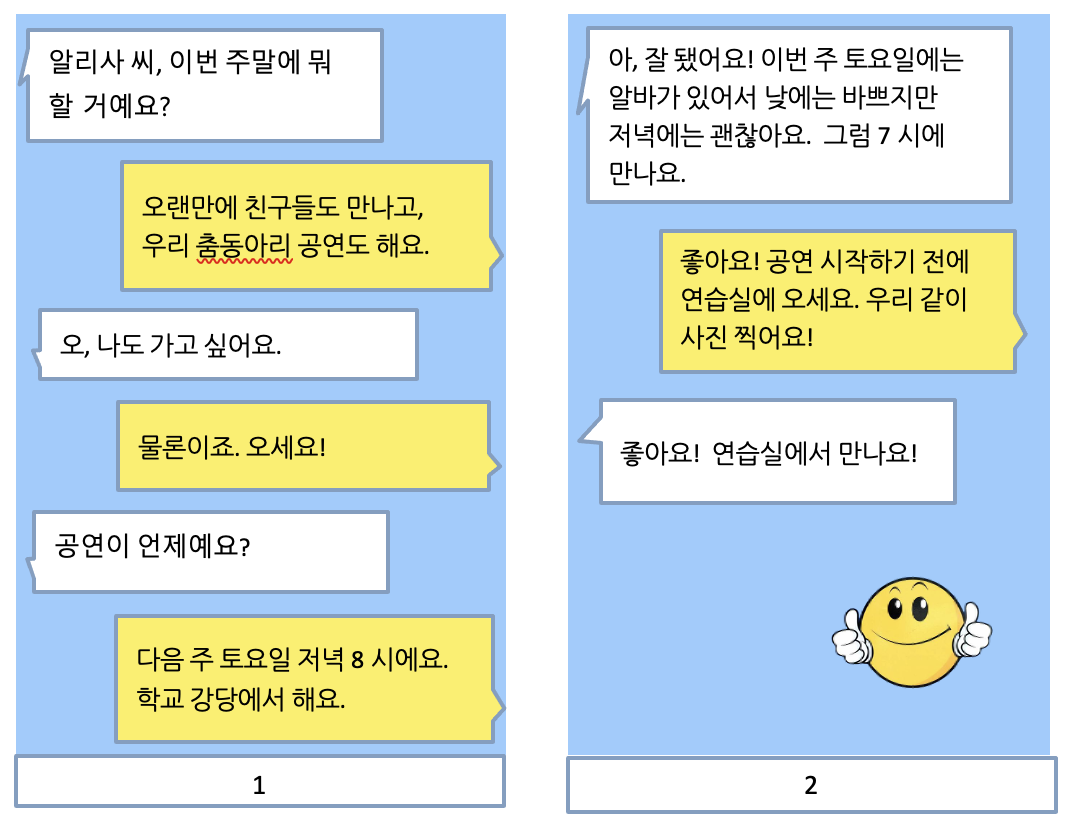
*갈게요 I will go (I promise)
1. Alyssa will work before going to the performance. T F
2. Alyssa’s friends want to meet Sarah. T F
3. Alyssa and Sarah will meet after the performance. T F
Helpful Vocabulary:
| 오랜만에 | after a long time | 공연 | performance |
| 강당 | auditorium | 연습실 | practice room |
Interpersonal & Presentational Task 4. 말하고 발표하기 Speaking
Snow Day Plans
Due to the severe weather conditions, your work/school will be closed for three days starting tomorrow. Now you don’t have any internet connection or electricity. What would you like to do during those three days and why? Talk with your classmates first and then present your step-by-step plans to the class.
| Day 1 | Day 2 | Day 3 |
Language Point
되다 Idioms
You will see idiomatic uses of 되다 far more frequently than literal ones during your Korean learning career:
| 안돼요! | No way! No can do! You shouldn’t! |
| 이거 안 돼요! | This isn’t working. I can’t get it to work. |
| 다 됐어요. | It’s all done/finished. |
| 거의 다 돼 가요. | It’s getting there. Almost finished. |
| 한국 사람 다 됐네요. | You are so Koreanized! (very Korean!) |
| 마침 잘 됐어요. | It hits the spot. Just in time. |
| 아직 때가 안 됐어요. | It’s not time yet. |
Culture
New Year’s Resolutions in Korea

http://news.khan.co.kr/kh_news/khan_art_view.html?art_id=201901041013001
In a recent survey from Korea, 95 percent of all respondents said they made New Year’s resolutions with 34 percent of the respondents choosing “exercising for health” as their top priority. Additionally, 23 percent of the people plan to engage in personal-development activities, such as learning foreign languages or new sports, while 22 percent of respondents said they plan to go on a diet. In the U.S., 44% of respondents claimed that their resolution for the year was to exercise more, and 42% responded that they plan to eat healthier.
When asked how long they are expected to keep their New Year’s resolutions, the majority (63%) said they will keep them for more than six months until they achieve their goals. Over three months and more than one month accounted for 14 percent and 13 percent, respectively.
According to one U.S. study, the hardest resolution to keep was changing your diet, and the easiest was personal development or learning a new skill.
할 수 있어요! I got this!
1rCheck to see if you can do the following.
- Ask and answer about wishes and plans for a new year.
- Ask and answer “why” questions.
- Talk about sequences of events and activities.
| Listening Script
알리사: 웨이 씨, 새해 복 많이 받으세요! 웨이: 알리사 씨도 새해 복 많이 받으세요. 알리사: 웨이 씨, 올해는 뭐를 꼭 하고 싶어요? 웨이: 저는 한국에 유학 가고 싶어요. 그리고 K-pop 콘서트에도 가고 싶어요! 알리사: 아, 그래요? 저 다음 주말에 친구들하고 K-pop 콘서트에 가요! 웨이: K-pop 콘서트요? 정말요? 우아, 나도 가고 싶다! 다음 주 언제요? 알리사: 금요일 밤 7시요. 나하고 같이 가요. 웨이: 네, 정말 가고 싶어요. 지금도 표 있어요? 알리사: 잠깐만요. 지금 같이 봐요. (pause) 아, 표가 없네요. 웨이: 아, 그래요? 표가 없어요? 알리사: (카톡!) 어, 잠깐만요. 제 친구한테서 문자 왔어요. 알리사: 친구가 표가 있지만 콘서트에 못 가요. 웨이 씨, 제 친구 콘서트 표 사고 싶어요? 웨이: 물론이죠! 와, 신난다! 알리사: 잘 됐어요! 그럼, 우리 콘서트에 가기 전에 같이 저녁도 먹어요. 알리사: 순두부찌개 먹고 싶어요! 웨이: 좋아요! 그리고 콘서트 끝나고 나서 같이 디저트 먹으러 가요. 알리사: 네! |