Main Body
8 Lesson 8 Communicative Tasks
Lesson 8
By the end of this lesson, you’ll be able to:
- Interpretive communication: Understand how to make a specific dish step-by-step.
- Interpersonal communication: Discuss cooking process to prepare for a potluck party with limited ingredients.
- Presentational communication: Explain the recipe of your favorite dish.
- Intercultural communication: Talk about customs related to foods eaten on specific days in Korea.
Task 1. 떡볶이 만들기
Watch this video on how to make tteokbokki (0:35–9:53) and answer the following questions in full Korean sentences.
- 어남선생의 떡볶이 양념장1에 어떤 재료가 들어가요? (List seven)
- 프라이팬에 뭐를 넣었어요? (List the eight ingredients in order)
- 싱거운 떡볶이가 좋으면 어떻게 하면 돼요?
- 시장 떡볶이가 맛있는 이유2는 뭐예요?
- 마지막3에 불을 낮춘 다음에 몇 분을 끓였어요?
1양념장 sauce
2이유 reason
3마지막 last
Task 2. Potluck Party 준비하기
Meet with your partner(s) and video-record your best performance. You are preparing for a potluck party. Ask your roommate, who is good at cooking, for suggestions on what you can make with the ingredients you currently have: flour, green onions, shrimp, salt, kimchi, squid, oil, water, and soy sauce.
1. Guided Conversation Practice
Your roommate suggests making 파전.
가: 이 재료로 무슨 음식을 만들면 좋을까?
나: 밀가루1, 파, 새우가 있으니까 파전을 만들어 보자.
가: 그럼 뭐부터 해야 돼?
나: 우선, ____________________________________________________
가: 여기 다 썰었어!
나: 그 다음으로, 밀가루에다가 _________________________________
가: 간장도 넣어야 해?
나: 아니, 간장은 파전을 다 부치고 나서 파전을 찍어 먹을2 때 필요해.
가: 아, 그렇구나! 다 됐다! 잘 섞었지3?
나: 좋아. 이제 프라이팬을 준비할까4?
나: 프라이팬에다가____________________________________________
가: 얼마 동안 부쳐야 해?
나: 파전이 바삭바삭해지면 _____________________________________
가: 거의5 다 된 것 같아.
나: 그래, 불을 끄고 이제 먹어 보자!
2. Create Your Own Dialogue with a Classmate
Your roommate suggests making 김치전.
(맛보기)
가: 이 남은 재료로 무슨 음식을 만들면 좋을까?
나: ________________________________ 김치전을 만들어 보자.
. . .
1밀가루 flower
2찍어 먹다 to dip and eat
3섞다 to mix
4준비하다 to prepare
5거의 almost
CULTURE NOTE |
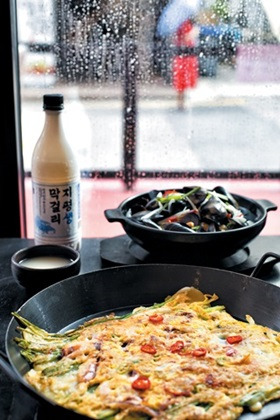
In Korea, people eat certain foods on specific days as part of their customs. Here are some fun facts about food-related traditions!
On rainy days, sales of 파전 increase by 169%. Koreans say that rainy days and jeon go well together because the sizzling sound of cooking jeon, 지글지글, resembles the sound of rain. It is said that the sound of rain and the 지글지글 sound share a similar frequency (Source).
Another tradition is eating 짜장면 on moving day, which is linked to the food delivery culture. Although we can have all kinds of food delivered these days, options were limited in the past. Therefore, on moving days, when people are often busy, 짜장면 became a popular choice as it could be easily delivered and quickly consumed (Source).
The custom of eating special foods on 복날 (the hottest days of summer) is related to coping with the summer heat. Specifically, restorative foods like 삼계탕 are said to help people recover from heat fatigue and boost energy (Source).
Task 3. 요리 유튜버
Audio or video-record your best performance. Imagine that you are a cooking YouTuber. Film a video explaining the recipe of your favorite dish. Introduce the ingredients and explain the recipe steps in detail. Adhere to the following guidelines:
- Include at least 7 meaningful sentences.
- Use the following grammar forms at least once: causative verbs, A/V–잖아요, and N에다가.
- Use both formal and informal polite speech styles.
(맛보기)
안녕하세요, 여러분! 저는 요리 유튜버 _____________(이)라고 합니다.
오늘 만들어 볼 음식은 _______________입니다!
우선, 재료부터 준비해 볼까요?
. . .
지금까지 ____________였습니다/이었습니다! 오늘 집에서 요리해 보시고 궁금한1 것 있으시면 댓글2 남겨 주세요!
1궁금하다 to be curious
2댓글 comment