Main Body
4 Lesson 15 Communicative Tasks
Lesson 15
By the end of this lesson, you’ll be able to:
- Interpretive communication: Understand recycling rules from a video and apply them to specific recycling practices.
- Interpersonal communication: Give advice and suggestions about living in a place based on what you have heard.
- Presentational communication: Compose and present a set of community rules.
- Intercultural communication: Learn about the recycling system in South Korea.
Task 1. 분리수거 퀴즈
Watch an informative video about recycling rules in South Korea. Choose True or False, and explain correct the false information in English.
| Statements | True or False | Correction |
| 1. 플라스틱 빨대1, 수저2는 일반쓰레기다. | ||
| 2. 플라스틱 음료3 병은 바로 버리면 된다. | ||
| 3. 아주 작은 종이는 재활용할 수 없다. | ||
| 4. 더러워진 피자 박스는 재활용할 수 있다. | ||
| 5. 영수증4은 재활용할 수 없다. | ||
| 6. 종이 박스를 재활용할 때는 테이프와 라벨을 제거해야5 한다. | ||
| 7. 코팅된 쇼핑백은 재활용할 수 있다. | ||
| 8. 종이컵을 모아서 주민센터6에 가져가면 휴지7를 받을 수 있다. |
1빨대 straw
2수저 spoons and chopsticks
3음료 beverage
4영수receipt
5제거하다 to remove
6주민센터 community center
7휴지 tissue
CULTURE NOTE |
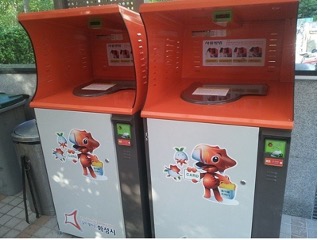
Food waste is a major contributor to greenhouse gas emissions, accounting for 8-10% of global emissions. While most countries struggle with managing food waste, South Korea excels with its innovative system, Jongyangje [종량제], which requires residents to separate food waste. They can dispose of it in electronic bins that weigh the waste and charge based on the amount, or use special compost bags (costing 10 cents to $2) for disposal in marked bins. Residents who mix food waste with regular trash face fines of up to $800. The collected waste is converted into biogas, fertilizer, or livestock feed, achieving a 98% recycling rate for Korea’s 5.5 million tons of annual food waste. This far surpasses the US’s 5% composting rate, highlighting the effectiveness of government-citizen cooperation. (Source).
Task 2. 거기 어떻대?
Meet with your partner(s) and video-record your best performance. Your friend is considering moving to a new place. Give them advice based on what you have heard about the place.
1. Guided Conversation Practice
지니is deciding whether to study abroad in Seoul. 카이 offers suggestions and advice, sharing what she has heard about life in Seoul.
지니: 카이, 한국에 유학 가고 싶은데 고민이 돼1. 혹시 한국 생활에 대해 좀 알아?
카이: 응, 내 친구도 한국에서 공부하고 있는데 _____________________________.
지니: 그래? 거기 집세는 어떻대?
카이: _________________________________________________________________
지니: 그렇구나. 아, 그리고 서울에서 꼭 운전을 해야 돼?
카이: _________________________________________________________________
지니: 오, 다행이다. 난 매운 음식을 잘 못 먹는데, 한국 음식 괜찮을까?
카이: _________________________________________________________________
지니: 그래? 그리고 유학하면서 여행도 많이 하고 싶어.
카이: _________________________________________________________________
지니: 와, 그렇구나. 여행하려면 돈을 많이 모아 둬야겠어. 고마워, 카이!
2. Create Your Own Dialogue with a Classmate
수지 is considering whether to live in a shared dorm room. 민offers suggestions and advice, sharing what she has heard about the dorm from another friend (e.g., roommates, trash, noise, food, rules).
Adhere to the following guidelines:
- Each person should speak at least four meaningful sentences.
- Use the following grammar forms at least once: short-form indirect quotation and V–아/어 놓다/두다.
- Use the familiar speech style.
1고민이 되다, 고민 중이다 to be debating (whether or not)
Task 3. 한국어 수업 규칙
At the beginning of the semester, your Korean language teacher asks students to gather ideas and establish a set of class rules. For your discussion, come up with seven class rules, and present them in class. Adhere to the following guidelines:
- Include at least seven meaningful sentences.
- Use V–아/어 놓다/두다 at least once.
- Use the Plain Speech Style for all the rules.
(Script)
안녕하십니까, 학우1 여러분! 오늘은 제가 생각한 한국어 수업 규칙에 대해 발표하겠습니다.
첫째, ______________________________________다.
둘째, ______________________________________다.
셋째, ______________________________________다.
넷째, ______________________________________다.
다섯째, ______________________________________다.
여섯째, ______________________________________다.
일곱째, ______________________________________다.
들어 주셔서 감사합니다.
1학우 fellow student